
6 Big Differences Between Kroger and Food Lion Every Virginian Should Know

Your Thanksgiving leftovers are probably running low by now, which means another grocery run is coming.
Whether you turn in at Kroger or Food Lion might come down to habit.
But the two stores treat your money differently once you’re inside.
Here are some of the biggest differences between Kroger and Food Lion that Virginians should know.
1. Richmond Store Counts
Kroger has fewer stores than Food Lion in the Richmond area, but by one 2026 estimate it sells more.
The 2026 Food World Mid-Atlantic study counted 18 Kroger stores and 50 Food Lion stores among traditional supermarkets, according to a Richmond TV station.
You’d expect more doors to mean more sales.
Kroger’s stores brought in an estimated $732.3 million over the 12 months ending March 31, 2026, against $685.3 million for Food Lion’s.
Count isn’t everything.
By that estimate, a typical Kroger rings up roughly three times what a typical Food Lion does, about $40.7 million to about $13.7 million.
So the Kroger you’re driving to is typically a higher-selling store than the Food Lion down the road.
The study’s market-share table has Kroger at about 15% and Food Lion at about 14%.
Kroger opened a 118,000-square-foot Marketplace in Mechanicsville in April 2026, after the study’s sales window closed.
2. Points Versus Shop & Earn
Kroger Points pay you 1 point for every $1 you spend on most groceries.
Every 100 points then takes $1 off your groceries, up to $10 a day.
That works out to $1 back on every $100 you spend on most groceries.
You can spend them at the pump too, where 100 points take 10 cents off a gallon.
That tops out at $1 off a gallon, or $35 off a fill-up.
Kroger announced the grocery option in June 2026, when it renamed Fuel Points as Points.
Food Lion’s Shop & Earn starts with personalized offers based on your shopping history, and they refresh at the start of each month.
You can activate them in the Food Lion app or on foodlion.com, or load them at the in-store Savings Center kiosk with your phone number.
Kroger points you earn in March expire April 30.
Food Lion rewards follow the same clock.
Then they’re gone.
So check your balance every month, whichever card you carry.
3. Store Guarantees
Food Lion promises double your money back on produce, meat, deli, bakery, dairy and its private brands.
Kroger’s Freshness Guarantee is a do-over, a replacement or a refund, on produce and on Kroger Brand, Simple Truth and Private Selection items.
That means Food Lion’s list of departments is longer, and its payout is double.
If something’s wrong, you can bring it back to your Kroger for a replacement.
At Food Lion, those store brands include Nature’s Promise, Smart Living and Taste of Inspirations.
Food Lion also reserves the right to limit refunds and double-money-back claims.
So you shouldn’t treat that double as a blank check.
Food Lion’s Scan Guarantee gives you a free item when the register charges more than the shelf tag.
Milk is the exception.
Food Lion lists milk as an exception to that free-item deal in Virginia and Pennsylvania, so milk that scans too high still rings up at the shelf price.
8 Ways Kroger Gets Virginia Shoppers to Spend More Than They Meant To
You walk in for a few things and walk out with a fuller bag than you planned.
Any store can nudge your cart past the list in your hand.
8 Ways Kroger Gets Virginia Shoppers to Spend More Than They Meant To
4. Giving Back
Kroger Community Rewards donates annually to organizations you link your card to, based on your share of spending.
It costs you nothing extra, but you need a digital account to take part.
In 2020, Food Lion added an option to donate your Shop & Earn rewards instead of redeeming them on your next trip.
With Kroger, the donation comes from the company, not from your savings.
With Food Lion’s option, the donation comes out of your rewards.
Who pays is the catch.
5. Coupon Limits
Most Kroger offers can only be loaded once per household.
That’s a cap on the offer.
Food Lion’s coupon policy allows only one coupon per item and doesn’t double or triple any of them.
It also stops at ten of the same coupon, one for each of ten items you buy.
Buy a dozen of one item, and only ten of them get the coupon.
A Food Lion register won’t take a coupon shown on your phone or tablet.
Load it in the Food Lion app or on foodlion.com before you shop instead.
Screenshots won’t work.
Food Lion also won’t let a manufacturer’s digital offer and a manufacturer’s paper coupon go on the same item.
6. Hometowns and Owners
Kroger’s story began in 1883, when its founder put his $372 life savings into one store at 66 Pearl Street in downtown Cincinnati.
Food Lion, by contrast, belongs to Ahold Delhaize USA, the U.S. division of Ahold Delhaize, a company based in Zaandam, in the Netherlands.
The first Food Lion opened in Salisbury, North Carolina, in 1957, back when it was called Food Town.
Neither started in Virginia.
Kroger says it runs nearly 2,800 stores in 35 states.
Food Lion says it has more than 1,100 stores in 10 states.
That puts your Kroger in a chain that spans more than three times as many states as the chain behind your Food Lion.
Psst! How well do you know the grocery aisle’s past and the chains behind it? Take our quiz and see if you can ace it.
Quiz
Grocery Aisle Trivia
Answer these questions on grocery history and the chains behind your cart. We bet you can’t get them all right. Prove us wrong?
The first Piggly Wiggly opened in Memphis in 1916. What made it so different?
What Doesn't Change at Checkout
Many things separate Kroger and Food Lion, but the tax lines on your total match at both.
Food for home use is taxed at a reduced rate of 1% throughout Virginia, according to the state Department of Taxation.
That's $1 in tax on every $100 of groceries you buy at either store.
Bags follow suit.
Virginia's 5-cent bag tax applies at the checkout of both chains in the eleven localities on the state's list, including Richmond, Roanoke and Charlottesville.
The tax skips durable plastic bags, which the state describes as having handles, built for repeated use and at least 4 mils thick.
8 Vanishing Diner Foods Virginians Still Talk About
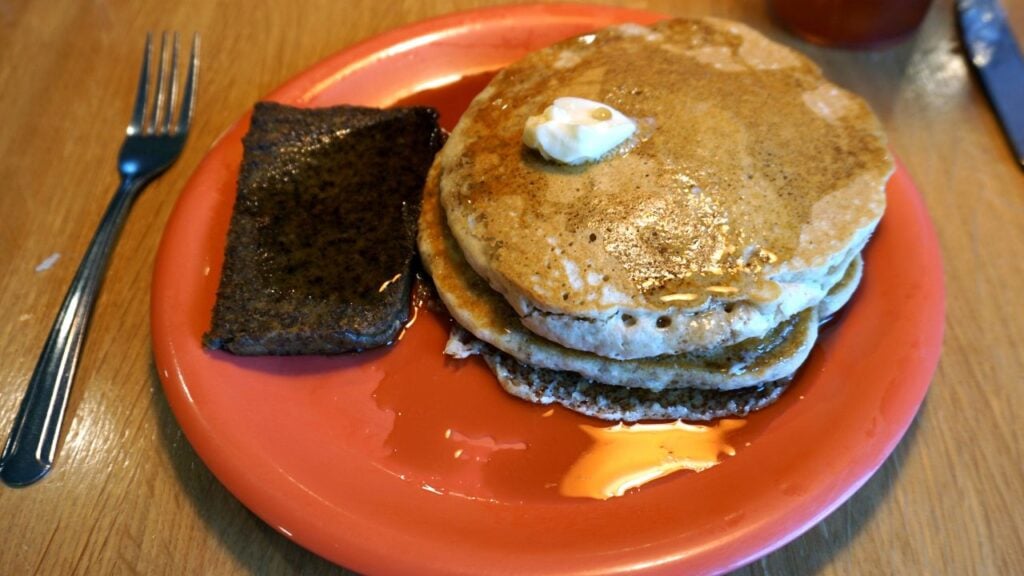
Many Virginians still talk about the diner plates they grew up on.
Some of them have faded from menus, and you might miss one you forgot about.
