

6 Charges South Carolinians Face After a Car Insurance Lapse of Even a Few Days

South Carolina gives a driver zero days of grace when a car insurance policy cancels.
The state’s database checks for an unbroken line of coverage the moment it does.
These are the charges South Carolinians face after a car insurance lapse of even a few days.
Note: This is general information, not legal or insurance advice. Licensing, registration, and insurance-verification rules are subject to change, so confirm the current requirements with the South Carolina Department of Motor Vehicles.
1. The $200 Fee to Get Your Registration Back
South Carolina’s insurance-verification system flags a lapse the moment an insurer reports one.
State law gives the vehicle owner no grace period to fix it.
That’s the Automobile Liability Insurance Reporting (ALIR) system.
Every licensed insurer has to feed ALIR every new policy and cancellation it writes in the state.
No exceptions.
Once the South Carolina Department of Motor Vehicles (SCDMV) suspends your registration over an unverified gap, getting it back costs $200 under state law.
Turn in the plate voluntarily before that suspension hits.
The SCDMV waives the fee entirely in that case.
That means walking the plate into a branch, not just canceling the policy and hoping nobody notices.
Few drivers do it in time.
2. Up to $400 to Restore Both Privileges
SCDMV’s guidance puts the total cost higher once a lapse touches both your driving privilege and your registration.
You get 20 business days after that cancellation notice to prove new coverage.
Miss that window, and the SCDMV suspends your license plate, your registration, and your driving privilege together.
Getting all three back can run as high as $400 combined, by SCDMV’s estimate.
That $400 ceiling isn’t just the $200 registration fee charged twice.
It kicks in once the 20-business-day window on that cancellation notice runs out, when the suspension grows to cover your driving privilege and not just the registration alone.
A steep bill.
The department also has to act within 15 days of that same cancellation notice to start pulling your plate and registration back.
It mails that notice by regular mail, not certified.
A forwarding address you forgot to update makes the tight deadline even tighter.
How SCDMV Catches a Lapse of Just a Few Days
SCDMV’s ALIR system doesn’t measure how long a lapse lasted.
It only checks whether your new policy’s start date lines up with your old policy’s end date, with zero days between them.
Switch insurers with even a one or two-day gap between policies.
The system logs that gap as a lapse, the exact same way it would log a six-month one.
That’s why a driver whose gap lasted only a day or two can still get the same suspension notice as someone who let coverage drop for months.
3. A 30-Day Suspension Plus $100
SCDMV treats a ticket for driving during a lapse differently than a routine paperwork mismatch.
One traffic stop is enough.
An officer pulls you over in a car you don’t own while your coverage is lapsed.
A court can find you guilty of operating an uninsured vehicle.
That conviction carries a 30-day license suspension.
SCDMV charges $100 to reinstate it.
A citation alone doesn’t trigger the suspension; a conviction does.
The car’s insurance doesn’t erase your personal lapse.
SCDMV still ties the suspension to the driver named on the ticket, not to the vehicle’s tag.
4. The $700 Uninsured Motorist Fee on Your Car
South Carolina reserves its steepest ticket-based charge for driving a car you own without coverage.
Not a technicality this time.
A conviction for operating your uninsured vehicle triggers a suspension of both your license and your registration until you pay a $700 uninsured motorist fee.
That $700 figure took effect in January 2026.
South Carolina law allows it to rise again in future years.
SCDMV won’t release the license or the registration until that full amount clears.
That $700 total is separate from any liability a driver owes if the uninsured car caused a crash.
5. A $25 SR-22 Filing Fee
SCDMV doesn’t stop at $700 once a lapse leads to a suspension.
The insurer then has to file an SR-22 (a certificate proving you carry the state’s minimum coverage).
State law requires that filing every seven months for three straight years.
Three years, not three months.
Filing it typically isn’t free, either.
Progressive’s guidance on SR-22 filings puts the typical charge at about $25, though the exact amount depends on the state and the insurer.
That fee lands on top of the policy premium, not instead of it.
Insurers often price an SR-22 driver as a higher risk, too, and raise the premium itself along with the filing charge.
That three-year clock starts on the date of the suspension, not on the day your insurer files the paperwork.
A single verified gap of only a few days can start that same three-year requirement, since the law counts the suspension itself, not how long the lapse behind it lasted.
6. A First-Offense Criminal Fine
Every fee above still leaves South Carolina’s criminal code in play.
Operating an uninsured vehicle is a separate criminal offense, layered on top of the reinstatement fees.
A first conviction under state law brings a fine of $100 to $200, or up to 30 days in jail.
A judge picks one.
None of that jail time or fine erases the separate reinstatement fees still due on the plate and the license.
A South Carolina Highway Patrol trooper or a county sheriff’s deputy can write the ticket that starts this chain.
None of these charges require an accident to happen first.
Psst! How much does South Carolina charge at each stage of an insurance lapse? Sort this table to see the fee, the suspension, and the SR-22 (proof-of-insurance) trigger side by side.
Why a Second Lapse Costs More
South Carolina doesn’t erase a first conviction from the record quickly.
State law counts any conviction from the previous five years as a prior offense.
A five-year memory.
Say a driver picks up a conviction in 2023 for a three-day lapse, then another for an unrelated lapse in 2026.
State law still treats the 2026 ticket as a second offense, with its $200 fine or 30 days in jail, or both.
A third conviction inside that same five-year window drops the fine option completely and requires 45 days to 6 months in jail instead.
Neither lapse in that example ran longer than a long weekend.
A payment plan through SCDMV can spread the reinstatement fees out over time, but it doesn’t pause the three-year SR-22 clock or erase a conviction already on the record.
That $700 reinstatement fee from the uninsured motorist charge above doesn’t shrink on a second or third conviction, either.
SCDMV still holds the license and registration until the full amount clears, on top of whatever fine or jail time that conviction brings.
7 South Carolina Beach Towns That Empty Out the Week After Labor Day
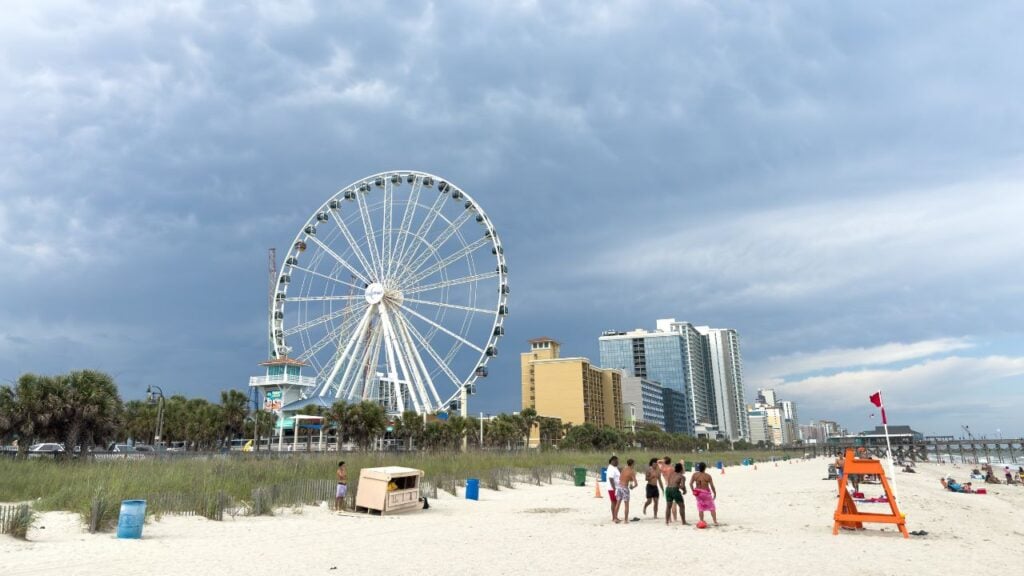
Census data up and down the Grand Strand and the Lowcountry show entire blocks of houses sitting empty for much of the year.
Those houses were built for one-week renters, not full-time neighbors, and the difference shows the moment the last cooler goes back in the trunk.
7 South Carolina Beach Towns That Empty Out the Week After Labor Day
10 Restaurant Chains South Carolinians Visit for One Menu Item and One Menu Item Only

The neon sign outside a Krispy Kreme off I-26 flips to a glowing red “Hot Now” at 7 a.m., and cars start pulling in before the light even finishes blinking on.
Nobody in that line wants coffee; they want the Original Glazed doughnut coming hot off the glazer, and that single-item pull repeats at chain after chain across the state.
10 Restaurant Chains South Carolinians Visit for One Menu Item and One Menu Item Only
