
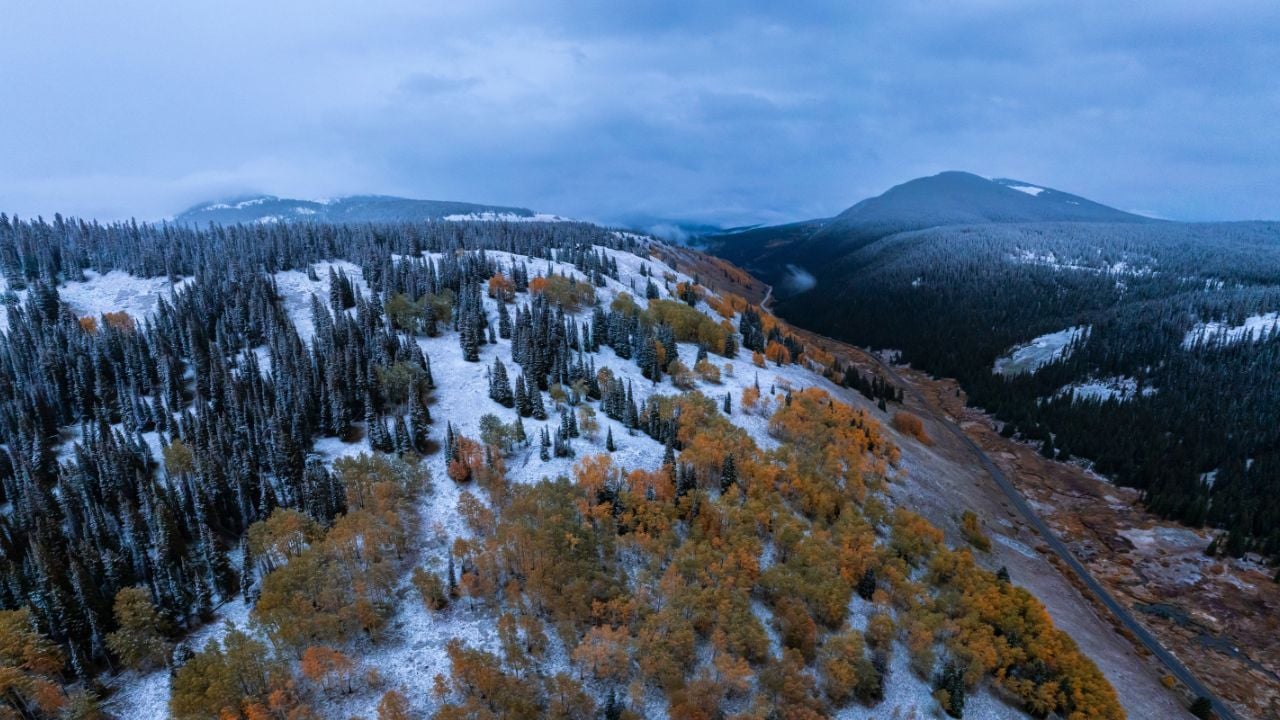
6 Early Snow Signs Colorado Mountain Towns Watch For in October

The Colorado Avalanche Information Center starts its backcountry forecasts every fall, before the peaks hold much snow at all.
These are the early snow signs Colorado mountain towns watch for in October.
1. Loveland’s Snowmaking Guns
Loveland Ski Area turns its snowmaking guns toward an October target every year, and the resort’s numbers back that up.
Loveland’s opening date has averaged Oct. 21 over the past 40 seasons, and the guns are why that date lands as early as it does.
Some years it slips.
Last season the resort opened Nov. 8, its 88th season, with guns running through the weeks before to build enough base for opening day.
Drivers crossing Loveland Pass on I-70 near Georgetown and Silver Plume see the plumes of manufactured snow before a single natural flake sticks anywhere else in Clear Creek County.
For those two towns, that’s days or weeks before the sky delivers anything on its own.
2. Race to Open First
Wolf Creek Ski Area, near Pagosa Springs and South Fork, calls itself the snowiest resort in Colorado, advertising an average of 430 inches of natural snow a year.
Some seasons that’s enough on its own to put Wolf Creek first in line.
It opened Oct. 22, 2024, days ahead of every other resort in the state that year.
Arapahoe Basin isn’t far behind.
The resort near Dillon and Keystone opened Oct. 26, 2025, and Nov. 2 the year before that.
Both dates came down to how much snow had piled up on its East Wall.
For towns tied to these two resorts, whichever one opens first each October settles an argument no forecast can: Winter is here, not just promised.
3. Fraser’s Early Deep Freeze
Fraser, a town tucked in a cold-air-pooling valley, produces some of the nation’s coldest overnight readings once winter sets in.
Fraser feels it first.
That pooling effect doesn’t wait for winter to officially start.
High-elevation valleys typically see their first hard freeze somewhere between September and November.
Fraser’s cold-air pooling means the town’s freeze often lands on the early side of that window.
The same valley posted a minus-44 night that beat every other spot in the country that day, a January record that shows how extreme the cold-air pooling can get.
Winter Park, just a few miles down the same valley, rarely gets that cold that early.
Psst! How much do you know about Colorado’s high country? Take our quiz and see how many you can get right.
Quiz
Colorado Mountain Trivia
Answer these questions on Colorado’s high country. We bet you can’t get them all right. Prove us wrong?
What is the coldest temperature ever officially recorded in Colorado?
4. Avalanche Center's Restart
The Colorado Avalanche Information Center (CAIC) restarts its daily backcountry forecasts every fall, whether the mountains have a base yet or not.
The date isn't fixed.
CAIC's daily forecasts started Oct. 31 for the 2024-25 season and Nov. 1 for the 2025-26 season, a full day later.
What never changes is the timing relative to the snow, not the calendar.
Forecasters come back before the mountains have piled up anything worth checking, and that head start is the signal that counts.
Backcountry-heavy towns like Silverton, Crested Butte, Ouray, and Telluride treat the restart as their cue regardless of the exact date.
Before it, conditions need no checking at all.
After it, a wrong guess can kill somebody.
CAIC keeps publishing daily updates for months afterward, long after many mountain towns already have their first snow on the ground.
5. Winter Outlook
The National Oceanic and Atmospheric Administration's (NOAA) Climate Prediction Center puts out a fresh winter outlook every fall. Mountain-town chambers and outfitters from Steamboat Springs to Breckenridge watch for its release every year.
Last year's dropped Oct. 16. This year forecasters are watching a strong El Niño pattern more closely than usual.
NOAA's seasonal outlook is a probability lean, not a locked-in forecast.
Nobody guarantees the totals.
Mountain towns still read it as the first signal for how the season might shape up each year, weeks before the actual snowpack can prove or disprove it.
Reading a Winter Outlook Percentage
NOAA's seasonal outlooks don't predict a fixed amount of snow.
They give a probability lean among three outcomes: Above normal, near normal, or below normal precipitation for the whole season.
A 40% chance of above-normal precipitation doesn't mean 40% more snow falls.
It means forecasters favor the wetter outcome over the other two, not that they're guaranteeing it.
Mountain towns that watch this number closely are reading the odds, not an actual snow report.
6. Leadville's October Marker
Leadville, at 10,152 feet, typically sees its precipitation flip from rain to snow by mid-October.
Winter comes early.
That's six months out from spring.
Leadville averages a little over 4 inches of snow in October alone, on top of whatever already fell before the month started.
Old-timers at that elevation treat the mid-October flip as a steadier guide than any single forecast.
It comes from decades of the same pattern repeating, not one meteorologist's best guess for this particular year.
The Pass's Closing Gates
Independence Pass, the highway linking Aspen to Twin Lakes, marks the other end of this list's early-snow timeline.
Not every winter marker shows up before Halloween.
The Colorado Department of Transportation says the pass usually closes for the winter in late October or early November.
Over the past decade the exact date has ranged from late October to Nov. 17.
No two years match.
Crews decide the exact day storm by storm, watching snowpack and visibility on the pass rather than circling a date on a calendar months in advance.
Aspen's fall driving season doesn't end until the pass closes, and some years that wait runs weeks past every marker on this list.
8 Aspen Viewing Mistakes That Ruin a September Drive in Colorado
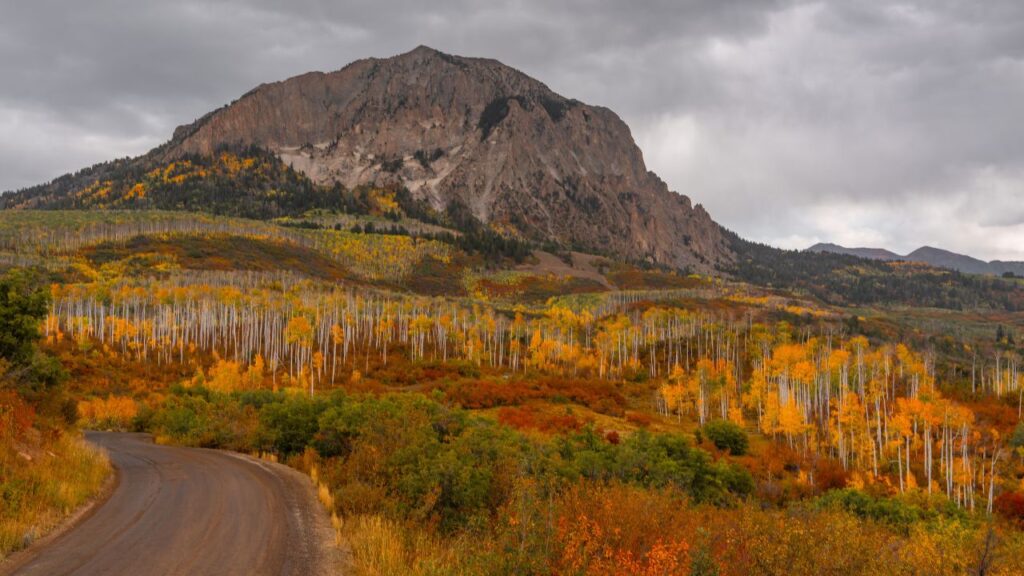
Maroon Creek Road shuts to unreserved private vehicles for almost five months every year. A driver who doesn't plan around that closure can lose the best part of an Aspen color drive before it even starts.
A handful of other clocks run out just as fast every September. Many visitors never see them coming until the drive is already ruined.
8 Aspen Viewing Mistakes That Ruin a September Drive in Colorado
