
6 Grocery Items Texans Have Started Treating Like Luxuries

Grocery prices haven’t risen evenly across your cart this year.
A few items have risen so much faster than the rest that shoppers are rethinking whether to buy them at all.
Here are the grocery items that have crossed the line from routine buy to luxury for many Texas shoppers.
1. Ground Beef
If you buy ground beef in Texas, you’re now paying an average of $6.49 a pound, the newest South region reading from the Bureau of Labor Statistics, which covers Texas.
That’s up from $5.57 a year earlier.
A 16.5% jump.
If you used to grab hamburger meat without checking the sticker, you’re probably doing math at the meat case now.
Some shoppers are swapping a pound of 80/20 for a leaner, cheaper blend, or stretching it further with rice and beans.
What a Higher Ground Beef Bill Costs a Texas Family
If you’re buying about three pounds of ground beef a week, you’re paying roughly $12 more a month than you did last year.
That works out to about $144 more a year on one item alone.
The Bureau of Labor Statistics’ South region covers Texas along with a dozen neighboring states, so one H-E-B or Walmart can run a little higher or lower than that average.
2. Steak
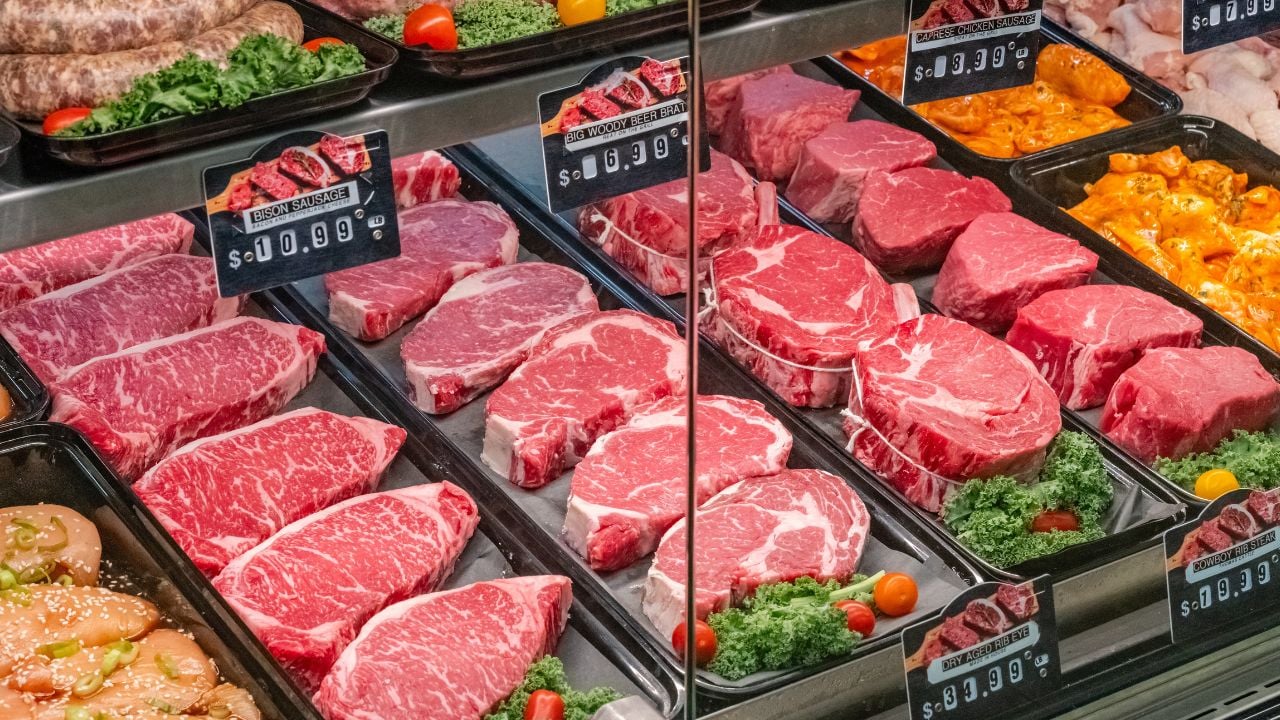
A Friday night ribeye or a weekend brisket used to be the default at a Texas cookout.
Now it’s the item Texas grillers treat like a luxury, not a Tuesday buy.
A pound of U.S. Department of Agriculture (USDA) Choice sirloin now runs $14.29 in the same South region data set, up 13.9% from $12.54 a year ago and a third higher than the $10.75 a pound sirloin from two years back.
That’s a big jump for two summers.
You might be stretching one steak across two dinners instead of buying two, the way some Texas grillers already are.
3. Coffee
Your coffee budget has taken one of the biggest hits in a Texas grocery cart this year.
A pound of ground roast coffee costs $9.46, the current national average from the Bureau of Labor Statistics, up 16.3% from $8.13 a year ago and 51% higher than the $6.25 a pound coffee cost two years back.
Rough stretch for coffee.
Brazil supplies about a third of the country’s unroasted coffee, and a rough harvest there has kept prices elevated even after Washington lifted its tariff on Brazilian coffee in November 2025.
You may already be reaching for a store brand instead of your usual bag, the way a lot of Texans are right now.
4. Orange Juice
Orange juice is turning into a splurge at your Texas breakfast table.
A 12-ounce can of frozen concentrate now runs $4.87, the current national average from the Bureau of Labor Statistics, up 8.5% from $4.49 a year ago and 14.5% higher than two years back.
Citrus greening disease and hurricane damage have cut deep into Florida’s crop.
Brazil, the other major supplier, has had rough harvests of its own.
No more free pours.
You might be swapping the carton for a cheaper juice blend instead, like a lot of Texas shoppers already have.
5. Chocolate and Candy
If you shop the candy aisle in Texas, you’re paying 9.58% more than you did a year ago, per the Bureau of Labor Statistics’ candy and chewing gum index through June 2026.
Cocoa is the reason. Futures hit $8,402 a metric ton in June, a 73% jump over five years, per Federal Reserve Bank of St. Louis data.
No relief yet.
Hershey raised prices by double digits this year to help cover the cost.
A candy bar that used to be your grab-and-go impulse buy at the register now gets a second look.
Worth it or not, you’re deciding right there at the checkout, like a lot of other Texans.
6. Imported Parmesan Cheese
If you buy imported Parmesan in Texas, tariff whiplash has driven the price as much as the cheese itself has.
The U.S. tariff on Parmigiano Reggiano from the European Union jumped from a historic 15% to 25% in April 2025, then dropped back to 15% that August.
Retail Parmigiano Reggiano ran $45 to $49 a kilogram in 2025.
Industry leaders now project it could rise past $55 a kilogram, about $25 a pound, in early 2026 as production costs and exchange rates work through the market.
It’s pricier than the steak.
Specialty grocery counters across Texas still stock it, just at a price that turns your weeknight pasta into an occasion.
Psst! How much do you know about Texas grocery history? Take our quiz and see how many you can get right.
Quiz
Texas Grocery IQ
Answer these questions on Texas grocery and food history. We bet you can’t get them all right. Prove us wrong?
What Texas company started as a one-room grocery store in Kerrville in 1905, opened by a woman named Florence Butt?
Why More Cattle Hasn't Meant Cheaper Beef in Texas
Texas raises more cattle than any other state, more than 4 million cows, well ahead of second-place Oklahoma's roughly 2 million.
That still isn't enough to keep prices down.
The national cattle herd fell to 86.2 million head as of January 2026, its smallest count since 1951, after years of drought, and Texas ranchers culled hard right along with everyone else.
Fewer cattle chasing the same demand pushes the price up on your grocery bill no matter how many ranches Texas has working the land.
Consumer demand for beef has also grown, adding even more pressure at checkout.
Beef and veal prices nationally ran 11.8% higher in June 2026 than a year earlier, per the U.S. Department of Agriculture's own food price tracking, so Texas isn't an outlier.
Big herd, bigger bill.
The Grocery Items Moving the Other Way
Not every item in your Texas cart is getting pricier.
Eggs are down 43% from a year ago, per the Bureau of Labor Statistics.
Butter fell too, from $4.87 a pound to $3.82.
Bacon dropped almost 8% over the same stretch.
Some relief, finally.
Bacon's drop tracks a bigger pork supply nationally, the opposite problem cattle ranchers are having with beef.
If you fill one cart with ground beef, coffee, and bacon this week, you'll pay more for two of those three and less for the third, all in the same trip.
9 H-E-B Mistakes That Cost Texas Shoppers Every Week
Not every H-E-B in Texas runs the same weekly ad, and the gap between stores can cost shoppers at checkout.
These are the mistakes that keep costing Texas shoppers week after week.
9 H-E-B Mistakes That Cost Texas Shoppers Every Week
8 Things Texans Refuse to Pay for That the Rest of America Accepts
Texas killed its yearly windshield inspection fee, and it isn't the only bill the state has stopped collecting.
These are the fees and charges Texans simply don't pay that many other states still do.
8 Things Texans Refuse to Pay For That the Rest of America Accepts
