
6 Ohio Fair Foods That Confuse Everyone Who Didn’t Grow Up in Ohio

Ohio’s Canfield Fair pulled in more than 280,000 people last year, and the 2026 run closes out on Labor Day this week.
A lot of them didn’t come for the rides.
Immigrant recipes and county pride built Ohio’s fairground menu, and nobody ever translated it for outsiders.
These are the fair foods that confuse everyone who didn’t grow up eating them in Ohio.
1. Cream Puffs
Cream puffs at the Ohio State Fair aren’t the dainty French pastry the name promises.
Schmidt’s of German Village has run a booth at the Ohio State Fairgrounds since 1914, making it the fair’s oldest concession stand, though the cream puff itself didn’t join the menu until the 1960s.
It’s a pastry the size of a fist, packed with whipped filling and dusted in powdered sugar.
Plan on sharing.
Out-of-state visitors expecting a two-bite bakery treat usually stop and stare at the line first, then at the size of what everyone around them is carrying.
Many fairgoers treat the cream puff as its own meal, and Schmidt’s rolls out a new limited flavor every summer. The 2026 version tastes like a root beer float.
2. Buckeye Candy
Buckeye candy confuses first-time visitors before they even take a bite.
It’s a ball of peanut butter dipped in chocolate, left with one bare circle on top so it looks exactly like the nut of Ohio’s state tree.
That’s the point.
Fair candy stands from the Ohio State Fairgrounds down to the smallest county booth sell them by the bag. Newcomers keep asking the same question: Does the actual buckeye taste like this?
It doesn’t. The actual buckeye isn’t safe to eat.
An Ohio woman named Gail Tabor dipped the first batch around 1964, working from her mother’s peanut butter recipe. Her husband said the finished candy looked just like the nuts scattered under the buckeye trees outside.
What Makes Ohio’s Buckeye Nut Dangerous
The buckeye nut behind Ohio’s favorite fair candy carries toxins called aesculin and aescin, and Extension horticulture experts confirm eating it raw brings on vomiting, diarrhea, and stupor in people.
Ohio State University’s Wayne County office also warns cattle farmers to keep the tree out of grazing fields, since livestock face the same reaction on a bigger scale.
Native communities once worked around the toxin by roasting the nuts and leaching them in running water for days, a process nobody bothers with for a candy that skips the actual nut entirely.
3. Sauerkraut Balls
Sauerkraut balls turn up at fair food stands across Ohio before many out-of-state visitors ever hear the name.
Fried sauerkraut, mixed with ground pork and cream cheese, rolled into a ball, breaded, and deep-fried until the outside cracks: That’s the whole idea, and it works.
Akron gets the credit.
A small Akron company started selling them commercially in the early 1960s, and county fair concession stands picked up the recipe fast, right alongside the church suppers and Oktoberfest tents that also carried it statewide.
The name confuses fairgoers who’ve never heard of the dish, but one bite at the fry stand usually settles it.
4. Cheese Coney
A cheese coney has nothing to do with the boardwalk hot dogs sold at New York’s Coney Island, and that catches many visitors from outside southwest Ohio off guard.
Order a cheese coney at an Ohio fair stand. It comes buried under Cincinnati chili, mustard, and chopped onion, with a snowdrift of shredded cheddar on top.
Eat it with a fork.
The name traces back to Cincinnati’s Empress Chili, which the Kiradjieff brothers opened near downtown’s Empress Theatre in 1922. The restaurant eventually called its chili-topped hot dogs “coneys,” and nobody’s ever fully settled whether the word borrows from New York’s Coney Island or just landed there on its own.
Psst! How much do you know about Ohio fair food? Take our quiz and see how many you can get right.
Quiz
Ohio Fair Food IQ
Answer these questions on Ohio fair food and trivia. We bet you can’t get them all right. Prove us wrong?
Which German-style Cincinnati breakfast meat, made from ground pork, beef, and steel-cut oats, gets its own festival every year?
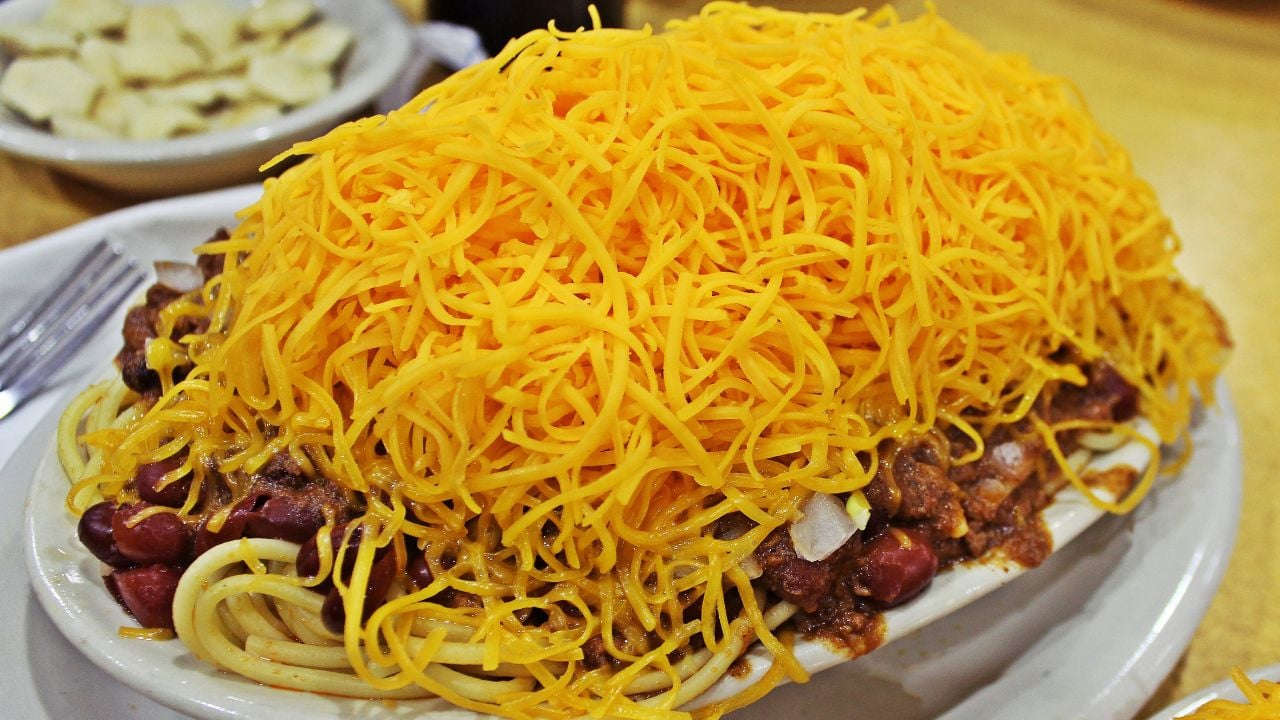
5. Cincinnati Three-Way
Order a Cincinnati three-way at an Ohio fair, and it isn't chili the way many parts of the country mean chili.
It's a mound of spaghetti, topped with a thin meat sauce spiced with cinnamon, allspice, and a hint of chocolate, then buried under shredded cheddar piled so high you can't see the noodles underneath.
The numbers matter.
A three-way is spaghetti, chili, and cheese. A four-way adds onions or beans. A five-way brings both.
Fairgoers new to it usually need the whole system explained twice, since nowhere else in the country orders chili by a number.
6. Apple Butter
Apple butter contains no butter, and that catches almost everyone off guard the first time they read the label at an Ohio fairground stand.
The Apple Festival sets up its stirring kettles right on the Van Wert County Fairgrounds every October, one of several Ohio fairground traditions that still make the spread from scratch.
It's just apples, sugar, and spice, cooked down for hours until the fruit turns into a thick, spreadable paste dark enough to pass for chocolate.
It has no dairy at all.
Geauga County's Century Village Museum in Burton runs its own version each fall, a batch it has cooked the old way for more than 65 years, in copper kettles set over open wood fires.
Volunteers peel, slice, and stir in shifts all day, then can and sell the finished batches as soon as they're cool enough to jar.
Pawpaw Gets Its Own Festival After Fair Season Ends
Pawpaw is the fruit many Ohioans have to explain from scratch, even to fellow Americans.
It's North America's largest native tree fruit, with flesh the texture of custard that tastes like a cross between banana and mango. It never makes it to a regular grocery store because it bruises within days of ripening.
It doesn't travel.
The Ohio Pawpaw Festival turns the fruit into ice cream, beer, salsa, and baked goods every September in Appalachian Ohio, and the crowd keeps growing every year.
Ask why a fruit this good never made it past Ohio and Appalachia, and even the vendors selling it shrug.
Ohio's Fair Season Runs Past Labor Day
Ohio's county fair season doesn't stop when the Ohio State Fair packs up its rides every August.
Dozens of county and independent fairs run across the state from late June through October, each with its own food vendors and its own local specialties.
The Canfield Fair in Mahoning County alone pulled in more than 280,000 people last year, and the 2026 run wraps up on Labor Day with the fairgrounds still smelling like fry oil.
That's dedication.
Ohio backs up its food obsession with an odd piece of paperwork, too.
The state named tomato juice its official beverage in 1965, the first state in the country to put a drink on its list of official symbols.
The Great Darke County Fair alone draws around 250,000 people to Greenville every August, one of the largest county fairs in the country, and its nine days of concessions run nothing like the lineup up in Canfield, on the other side of the state.
Most Ohioans Agree There's a Breaking Point for Houseguests. Here Are 10 of Them.

The average host's patience for a houseguest runs out after six days, according to a nationwide survey of 2,000 Americans.
Ohio hosts don't get a longer clock than anyone else, and these are the moments that make them start dropping hints.
Most Ohioans Agree There's a Breaking Point for Houseguests. Here Are 10 of Them.
9 Bad Checkout Habits Kroger Employees Wish Ohio Shoppers Would Stop
Barney Kroger opened his first store on Pearl Street in Cincinnati in 1883 with $372 and one motto: Never sell anything you wouldn't want yourself.
More than a century later, Ohio shoppers still trust the checkout line, even when their own habits slow it down.
9 Bad Checkout Habits Kroger Employees Wish Ohio Shoppers Would Stop
