
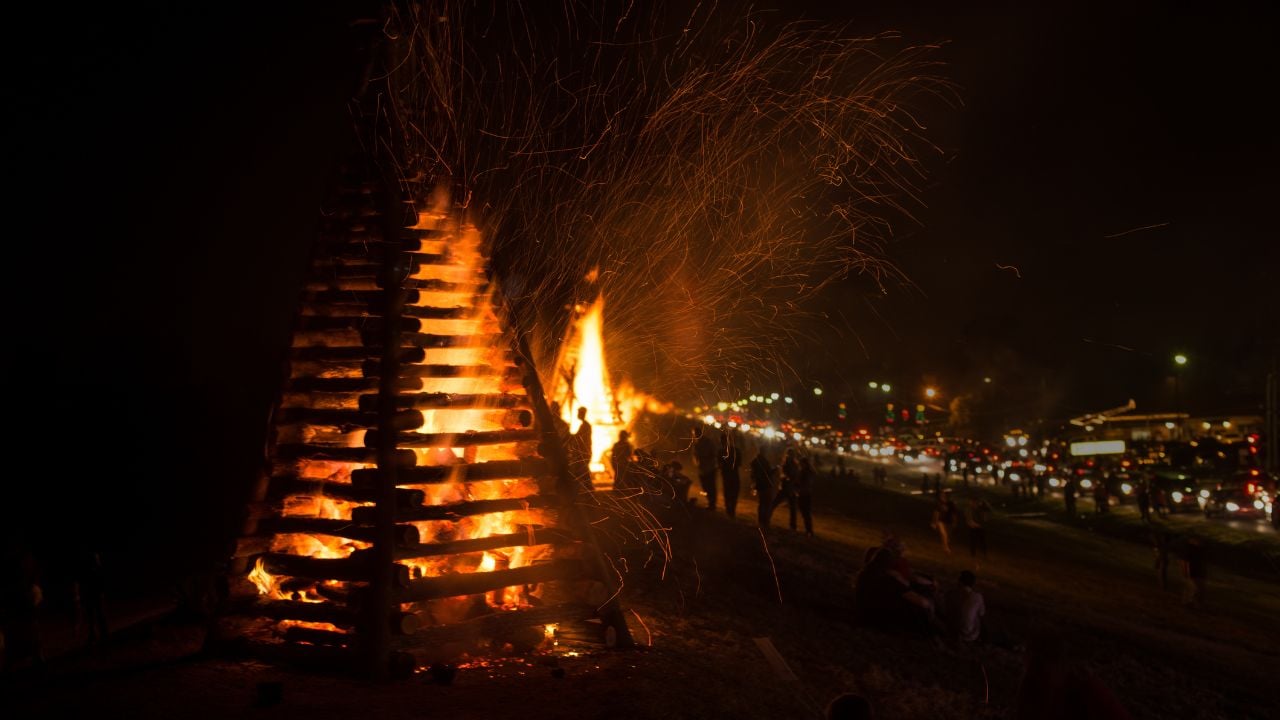
6 Rules Louisianans Follow to Build a Christmas Eve Bonfire on the Levee

Will you be building a Christmas Eve bonfire on the levee in St. James Parish?
You have to stop work at sunset.
Permits stop going out Dec. 15, so Louisianans who build one every year know to start planning now.
Here are the rules Louisianans follow to build a Christmas Eve bonfire on the levee.
Note: This is general information, not legal advice. Permit rules and deadlines are subject to change, so confirm the current requirements with St. James Parish.
1. 15-Foot Height Cap
A Christmas Eve bonfire on the levee can’t rise past 15 feet under St. James Parish’s ordinance.
A parish council member who has overseen bonfire permits for nearly 30 years told PBS News in 2023 that bonfires have shrunk from 40 feet to 15.
The American Press reported in 2021 that the height runs from the base of the bonfire’s center pole to the top of it.
The ordinance sets the maximum base at 12 feet by 12 feet or whatever size your individual permit allows.
It limits a 12-by-24-foot base to one bonfire per local government.
Measure before you stack.
2. Dec. 15 Permit Cutoff
Every Christmas Eve bonfire on the levee in St. James Parish starts with a permit, and the ordinance stops issuing them after Dec. 15.
The ordinance lets the Festival of the Bonfires, Inc. set the day permits start going out.
In 2023, that council member issued 45 permits in the first three days of permitting.
The ordinance issues no permit to a minor, so the permit holder has to be an adult who assumes full responsibility.
You can’t hand your permit to someone else because the ordinance strictly prohibits transferring a permit from its original holder.
Next comes the building. If no visible construction has begun by Dec. 20, the ordinance says the permit will be rescinded.
Paperwork first, wood second.
What a Bonfire Permit Includes
Paying the fee for a St. James Parish bonfire permit makes the permit holder and all listed participants members of the Festival of the Bonfires, Inc.
The ordinance says all members are insured for liability, subject to policy conditions.
3. Banned Materials
You can’t put tires, creosoted timbers, plastics, oil or hazardous materials in a levee bonfire under St. James Parish’s ordinance.
In the early days, the council member told PBS, builders could put anything they could find into a bonfire, including tires, plastics, bottle rockets and firecrackers.
Those days are over.
Now, he said, it has to be just wood, either trees or driftwood.
For lighting, St. James Parish’s rules favor diesel to help you start the fire and allow flares.
4. Self-Supporting Builds
The ordinance bars digging into the levee, so a bonfire has to be self-supporting.
Digging is out.
The one exception is a hole for the center pole, with a maximum depth of 18 inches and a maximum diameter of 10 inches.
PBS described many levee bonfires as simple cone-shaped pyres.
The ordinance requires you to tie the bonfire with number 16 wire or larger.
5. Permit-Designated Spot
PBS followed one builder up the grass-filled levee with his permit in hand, carrying fallen trees. Within minutes, a chainsaw drowned out the riverboat traffic.
The ordinance requires you to build on the spot your permit designates.
Nothing else goes on that spot except the bonfire itself, so the ordinance bars huts, buildings, sofas and chairs.
Leave the sofa at home.
Last year’s permit holders get the right of first refusal on the same bonfire location this year.
6. Sunset Work Cutoff
Under the ordinance, you have to stop work on a levee bonfire at sunset.
You and everyone else have to be off the levee by the time provided on the bonfire permit.
Some builders take vacation time to build, PBS reported, while others give up their weekends between Thanksgiving and Christmas.
Plan your work around sunset.
Who Makes the Call
Once your bonfire is stacked, the decisions leave your hands.
Under the ordinance, nobody lights a bonfire until the director of the Emergency Operations Center or a designee gives permission.
If wind forces a postponement on Christmas Eve, the ordinance has the Parish President reschedule the lighting by Executive Order.
The ordinance gives the levee district’s board of commissioners the power to delay, postpone or cancel all or part of the bonfire activities if high water or an emergency hits.
The board can require you to remove all bonfire materials within 48 hours of official notice.
Each year, local volunteer fire departments supervise the event on the festival grounds and the levee, a festival board member told PBS in 2023.
Those departments can decide up to the last minute whether conditions are safe to light the bonfires.
Under the ordinance, failing to follow these rules can cost the permit holder a fine and the permit.
Wait for the word.
Where These Rules Apply
These rules come from Section 46-21 of the St. James Parish Code of Ordinances, which covers Christmas bonfires built on the levee in the parish.
The parish adopted the current version in November 2022.
PBS reported in 2023 that the bonfires are set ablaze along the Great River Road in St. James and St. John parishes.
This ordinance covers St. James Parish, and it doesn’t tell you what applies in St. John or anywhere else.
This one is local.
If you plan to build, check with the parish before you cut your first log.
Psst! How much do you know about Louisiana and the Mississippi River? Take our quiz and see how many you can get right.
Quiz
River Country IQ
Answer these questions on the Mississippi River and Louisiana history. We bet you can’t get them all right. Prove us wrong?
At New Orleans, the river’s flow past Algiers Point each second equals how many semi-trailers of water?
Watching the Lighting
Ahead of Christmas Eve 2025, the St. James Parish sheriff said deputies, local police, state troopers and fire crews would be on standby.
The fires were expected to end promptly at 11 p.m., but the sheriff said law enforcement would stay out afterward to make sure everyone made it home.
A festival board member told PBS in 2023 about a favorite childhood memory.
The board member's grandfather, a member of the fire department, used the fire truck's loudspeaker to tell everybody it was time to light the bonfires.
If you're coming to watch, the ordinance bans parking on the levee, along with loud music or other noise.
Leave the speakers behind.
The Festival of the Bonfires' Christmas Eve page lists a 7 p.m. lighting. The page recommends arriving before 6 p.m. and spending the afternoon walking the levee, taking pictures and touring the museum.
The page puts parking in lots along Louisiana Highway 641, with a three- or four-block walk to the levee, and asks you not to park in roped-off lots.
5 Things Louisiana Families Do the Week Gumbo Weather Arrives

Louisiana has a name for the first stretch of cool fall weather.
When it arrives, families know just what to do.
5 Things Louisiana Families Do the Week Gumbo Weather Arrives
13 Signs Someone Was Raised in Louisiana No Matter Where They Live Now
If someone raised in Louisiana moves a thousand miles from home, listen to how many old customs travel with them.
Louisiana raised you with a habit that doesn't exist by name almost anywhere else.
13 Signs Someone Was Raised in Louisiana No Matter Where They Live Now
