
6 Things Alabama Pecan Growers Do Every November That Shoppers Never See

Freshly harvested pecans go into drying trailers hooked up to big fans long before they’re anywhere near your pie.
With Thanksgiving coming, Alabama growers are busy with work most Americans don’t realize.
Here’s what Alabama pecan growers do every November that shoppers never see.
1. Reading the Shucks
Alabama Extension ties pecan harvest to the shucks, the green husks that wrap each nut on the tree.
The nuts are mature once a shuck begins to open.
If you’ve got a pecan tree in your yard, you can watch the husks split open as the season moves along.
The season stretches October into December, which puts November right in the middle of it.
Extension also warns that predators often go after nuts left on the tree too long.
Waiting has a cost.
Weather can move the schedule.
In 2014, dry weather delayed the harvest about two weeks at one Bullock County farm.
If you only know pecans from the bag, you may not have seen one still in its husk.
2. Shaking the Trees
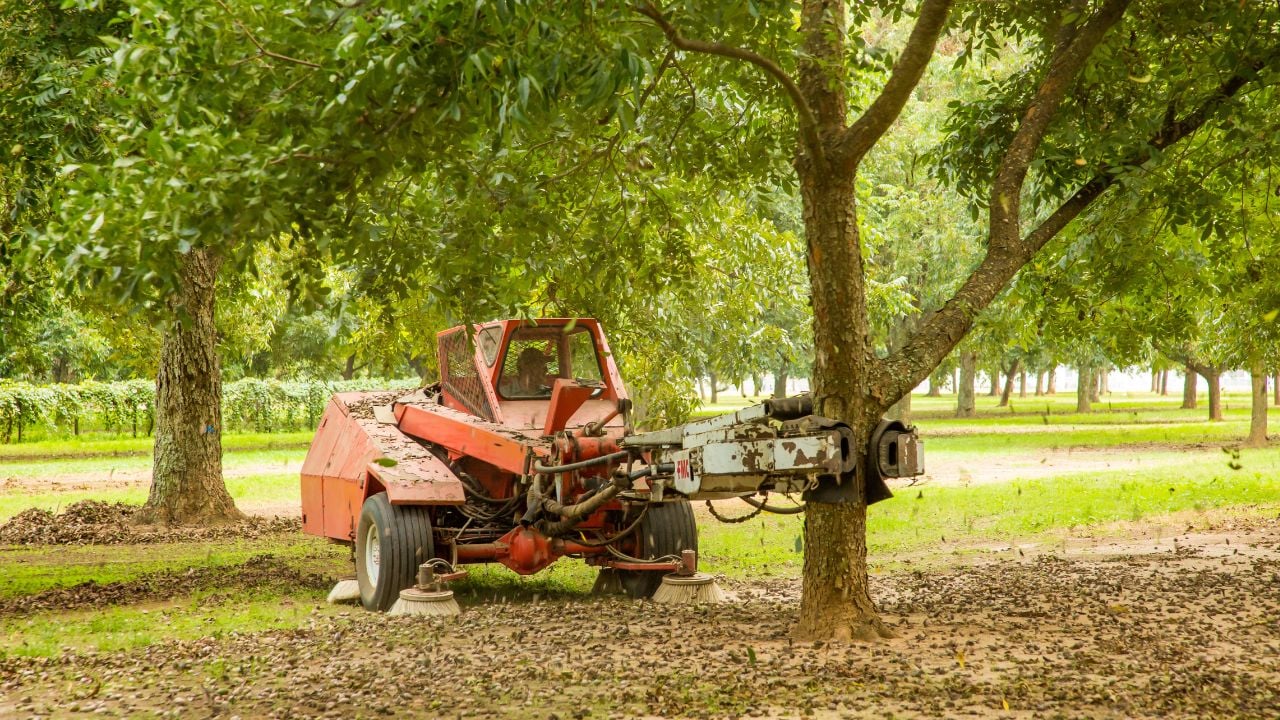
Commercial pecan orchards harvest mechanically, using a machine called a tree shaker to knock the nuts loose.
Machines do the work.
If you’ve waited for pecans to drop in your yard, you’ve seen the slow version.
Your backyard tree can get by on natural drop, but commercial growers use shakers instead.
A University of Georgia Extension specialist says many growers across the Southeast shake a good crop twice.
In the Southeast, the first shake normally starts once at least 80 percent of the shucks are open.
3. Gathering the Nuts
Pecan harvest also leans on a nut sweeper, a vacuum harvester and a trash separator.
The Georgia specialist says nuts shaken early may need to lie on the ground for a day or two before harvest.
If you’ve got pecans on the ground in dry weather, a couple of days usually gets the moisture down to around 6 percent in the Southeast.
Dry weather helps.
If you gather nuts in the morning before the dew dries, you only push the moisture back up.
Nuts can mold quickly in a wet windrow, so growers have to act fast.
Psst! How much do you know about Alabama pecans? Take our quiz and see if you can ace it.
Quiz
Pecan Orchard Quiz
Answer these questions on Alabama pecans and the orchards behind them. We bet you can’t get them all right. Prove us wrong?
After a pecan weevil larva chews its way out of a nut and drops to the ground, how long does the weevil stay in the soil?
4. Drying the Nuts
Pecan growers load freshly harvested nuts into large drying trailers hooked up to big fans.
The Georgia specialist says unheated forced air blown at 90 cubic feet per minute will dry pecans when the humidity is 70 percent.
In the Southeast, heating that air to 90 to 95 degrees Fahrenheit dries them faster, and 100 degrees Fahrenheit is the ceiling before the kernel can be damaged.
If you're drying a bucket of backyard pecans, Alabama Extension says to spread them in the shell in thin layers on elevated screens.
Home drying is slow.
How Dry Pecans Need to Get
Pecans can run as high as 20 to 30 percent moisture when the shucks first open, according to the Georgia specialist.
The ideal range to protect nut quality is 4 to 4.5 percent.
Alabama Extension gives home growers a simple test: After about two weeks of drying, shell a nut and bend the kernel, and a dry one snaps.
If you try it at home, shell one or two nuts first.
5. The Cleaning Plant
Pecan cleaning plants separate the debris from the harvest.
Nuts are taken to the cleaning plant for cleaning and further drying.
A Mobile Press-Register photo shows a worker dumping pecans into a cleaner at Sessions Farms in Grand Bay, in Mobile County.
Same job, different county.
Joe Adams, who farms in Bullock County, said he and his brothers built the first pecan cleaning plant in their area in 1977.
At one time, that plant ran nearly 50,000 pounds of pecans through each day.
If you buy pecans this month, your bag may have passed through a machine like that.
6. Cold Storage
Pecan growers send the majority of the crop to refrigerated warehouses, where it waits until it sells.
Cleaned and dried nuts held in super sacks in a dry warehouse are good for up to four months in cooler months.
That means the bag you grab this month probably spent time in one.
If you're storing pecans at home, remember that they're perishable because of their high oil content.
The Georgia specialist says nuts in the shell keep best in an odor-free space at 65 percent relative humidity and 32 to 36 degrees Fahrenheit.
Cold is the point.
Many shoppers don't see the inside of a pecan warehouse.
Where the Crop Goes
Some pecan growers sell in retail shops right next to their orchards, and larger growers sell to wholesalers.
If you find an orchard shop this month, you can buy straight from the grower.
An Auburn University researcher said in January 2025 that some growers sell directly to the public.
Some of them shell the pecans themselves instead of taking them to an accumulator.
That skips the accumulator.
In 2014, a Mobile County grower reported selling about 50 percent of his pecans through a retail store on his farm.
Buyers there could have the nuts cracked or shelled.
A Smaller Crop
The pecan crop used to be far larger, according to a 2022 Alabama Farmers Federation report.
Then the storms came.
They toppled thousands of trees near the coast.
Pecan crop estimates for Alabama ended in 2019.
In fall 2025, the Alabama Pecan Growers Association's president predicted about 3 million pounds, a sharp contrast to the 60 million growers harvested in the late 1960s and early 1970s.
7 Foods Born From Hard Times That Alabamians Still Eat Today
Many Alabama families couldn't spare money for store-bought sugar, so they leaned on cane syrup.
The list of foods that came out of those years might surprise you.
7 Foods Born From Hard Times That Alabamians Still Eat Today
