
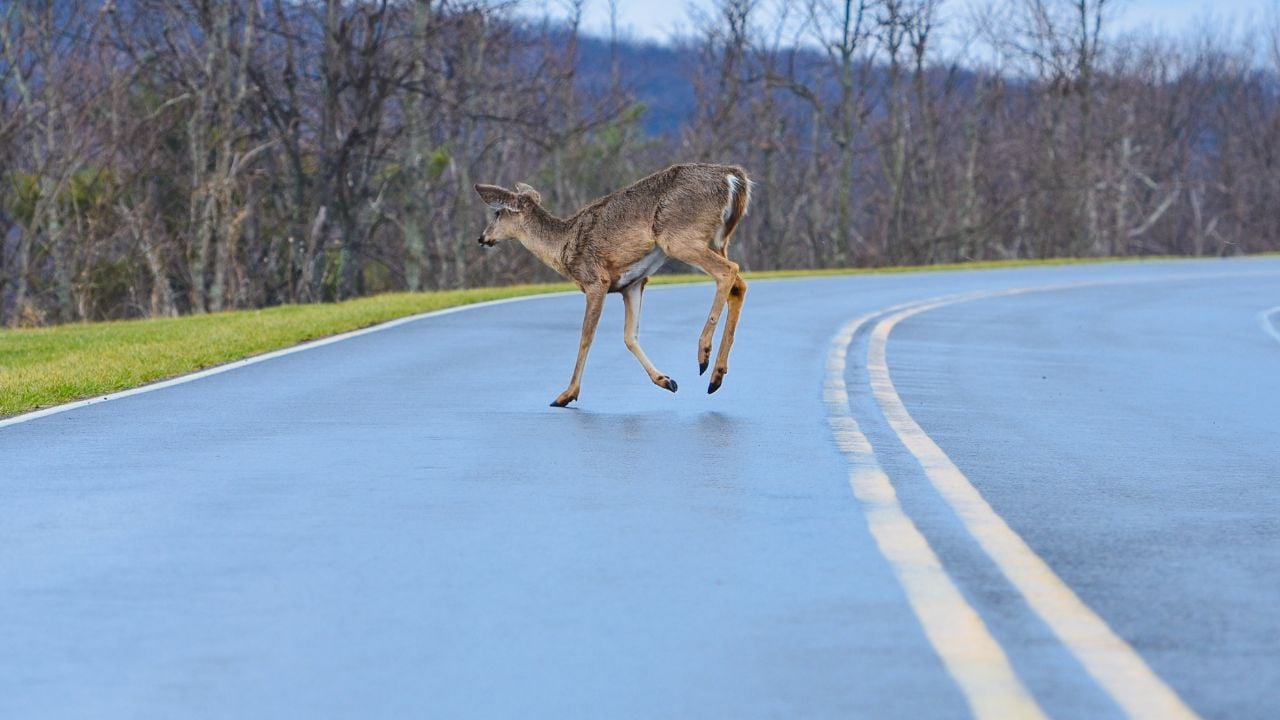
6 Things Iowa Law Says About a Deer You Hit on the Road

If you hit a deer on a road in Iowa, the dent in your bumper is only the start of what you need to grapple with.
Whether you need to report the crash at all isn’t as obvious as it seems.
These are the things Iowa law says about a deer you hit on the road.
Note: This is general information, not legal or insurance advice. Salvage rules, crash-reporting rules and coverage terms are subject to change, so confirm the current requirements with the Iowa Department of Natural Resources (DNR) and your insurer or agent.
1. Salvage Tag Before Possession
Iowa’s salvage rule says a roadside deer can’t go home with you until you’ve asked for a salvage tag and received it.
The rule covers any person wanting to possess game accidentally killed by a motor vehicle on a highway.
It says to contact the nearest conservation officer, Iowa state trooper, sheriff’s department or police department immediately.
A valid tag needs two signatures, yours and a peace officer’s or a designee of the DNR director’s.
The DNR said in 2025 that the tag is free.
The Natural Resource Commission replaced the whole salvage chapter, and the new version took effect June 17, 2026.
2. Claim Priority
Salvage requests don’t all rank the same when more than one person wants a crash-killed deer.
The rule puts individuals involved in the accident first, which includes you as the driver.
Public bodies come next, then nonprofit organizations, then everyone else, whenever a request is made.
The priorities apply only when the game is salvageable.
3. Whole Carcass Removal
The rule says you have to remove the whole carcass from the scene.
That rules out cutting the rack off a buck and leaving the rest at the roadside.
The DNR said in October 2025 that taking only the antlers is illegal.
4. Spotted Fawn Exclusion
Not every deer a car hits can get a salvage tag.
The rule lists spotted fawn deer as not salvageable when a motor vehicle kills them.
So you can’t get a salvage tag for a fawn still wearing its spots.
5. Tag Rules After Pickup
Once the deer is yours, the tag stays with it until the meat is consumed.
The rule makes a tag valid only for the time period assigned on it, so the dates printed on yours matter.
Salvage tags also aren’t transferable, which keeps you from handing yours to a friend.
6. Food and Feed Purpose
Salvage authorizes possessing game accidentally killed by a motor vehicle on a public highway.
The rule names the purpose as human consumption or the feeding of domestic animals.
It calls any other benefit, such as the legal sale of hides or antlers, a secondary benefit only.
Peace officers can’t salvage game solely for financial gain or commercial taxidermy.
Crash Reporting Thresholds
Iowa’s crash-reporting law, Code section 321.266, never mentions a deer or any other animal.
For any accident, the statute sets its line at an injury, a death or apparent damage of $1,500 or more.
A driver has 72 hours to report a crash that crosses that line.
If a law enforcement agency investigates, the driver doesn’t have to file a report.
If none does, the driver sends in an Iowa Accident Report form, and a form that isn’t returned within 72 hours may lead to a suspension of driving privileges.
Because the statute is silent on deer, how it reaches a deer strike isn’t spelled out.
When an Iowa Crash Injures Someone
Under the statute, a crash that injures or kills anyone is reportable at any damage amount.
It calls for immediate notice by the quickest means available.
That notice goes to the county sheriff, the nearest state patrol office or any peace officer near the crash.
The driver’s written report follows within 72 hours of the crash, unless law enforcement investigates.
Comprehensive Coverage
The salvage tag settles who keeps the deer, and insurance settles who pays for the car.
The Iowa Insurance Division cites 13.8% of reported motor vehicle crashes in Iowa as animal or deer collisions.
It says comprehensive coverage may help pay for repairs after an animal strike, minus your deductible.
It calls comprehensive coverage the most relevant coverage for animal collisions.
Under a liability-only policy, an animal strike wouldn’t be covered.
It also advises moving your vehicle to a secure location, calling authorities and taking photos of the damage.
Psst! How much do you know about white-tailed deer? Take our quiz and see if you can ace it.
Quiz
Whitetail IQ
Answer these questions on white-tailed deer, from fawns to antlers. We bet you can’t get them all right. Prove us wrong?
About how many female white-tailed deer can grow antlers?
November's Crash Calendar
Animal crashes pile up in early November, and Iowa DOT's table for 2014 through 2023 ranks Nov. 8 first, with 718 animal crashes.
Nov. 14 ranks seventh, at 654.
Those dates are when the steps above are likeliest to come up.
The DNR links the rush to breeding season, with deer movement peaking around the first week of November as crops come out and daylight shortens.
The DNR also says deer often travel in groups during the rut, so a second deer may follow the first.
Deer move more at all hours of the day during that period, not just at dawn and dusk.
7 Property Tax Rules That Change the Year an Iowa Farm Changes Hands
Buying an Iowa farm doesn't carry the family farm tax credit over with the deed.
You have to file for it again, and that's only one part of the tax bill that resets.
7 Property Tax Rules That Change the Year an Iowa Farm Changes Hands
Kum & Go Is Now Maverik. 6 Things Iowans Should Know About the Change
Your points didn't carry over when Kum & Go became Maverik.
The changes go well past the points.
Kum & Go Is Now Maverik. 6 Things Iowans Should Know About the Change
