
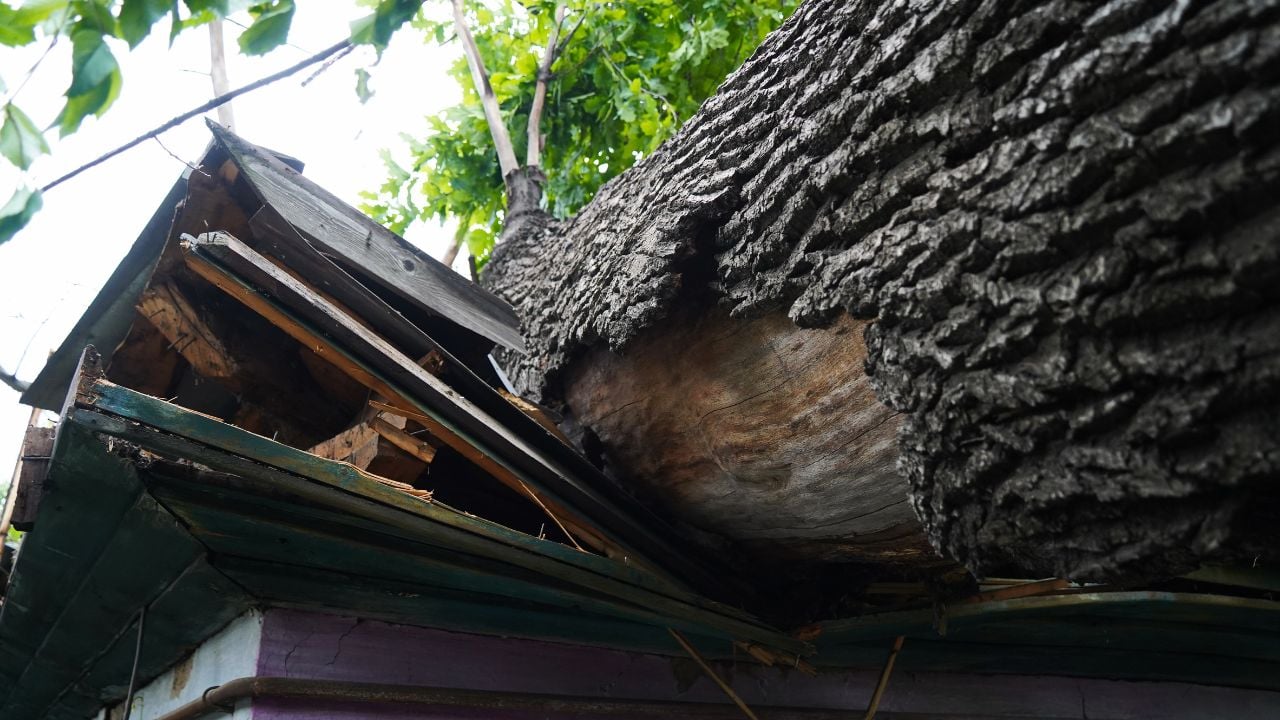
6 Rules That Decide Who Pays When a Neighbor’s Tree Falls on a North Carolina Home

Your homeowners policy might cover damage from a neighbor’s tree, but removing the tree is often capped at $500.
Many North Carolinians assume the neighbor pays.
The law doesn’t always agree.
Here are the rules that decide who pays when a neighbor’s tree lands on your roof in North Carolina.
Note: This is general information, not legal or insurance advice. Coverage terms are subject to change, so check the specifics with your insurer, your agent, or the North Carolina Department of Insurance. Liability rules are also subject to change.
1. Negligence, Not Ownership
A neighbor’s tree that lands on your house doesn’t automatically make your neighbor liable.
North Carolina doesn’t hold a tree owner automatically liable for a fallen tree, and the legislature hasn’t addressed the issue by statute.
Courts apply a negligence test instead, so you’d have to show your neighbor let a dangerous tree stay standing.
Proof comes first.
A hurricane or other act of God doesn’t assign liability on its own.
A landowner does have a duty to eliminate any reasonably foreseeable danger a tree may pose to adjoining property.
2. Foreseeability Test
A neighbor’s tree becomes the neighbor’s bill when the danger was foreseeable.
A court can weigh whether the tree was dead or visibly dying, or leaning prominently toward your property.
A court can also look at limbs reaching far across the line, or at a large anchoring root the owner cut.
A court can still view the effects of wind and heavy rain on an ailing tree as foreseeable, so an owner can’t always blame the storm.
Photos help.
If a dead pine next door leans toward your roof, pictures of it today give you something to show later.
The News & Observer recommends documenting a precarious neighbor’s tree early, in case you need the information later.
3. Your Homeowners Policy
When a neighbor’s tree falls on your house, your homeowners policy generally covers the damage, according to the North Carolina Department of Insurance.
You don’t have to prove anyone was negligent to file that claim.
Your deductible still applies.
A wind or hail deductible is typically a percentage of your dwelling coverage, so on a $300,000 home a 2% named-storm deductible works out to $6,000.
You cover that part.
Your declarations page lists the amounts that apply.
Filing Your Tree-Damage Claim
After a tree hits your house, call your agent or insurer right away.
Keep receipts for emergency repairs such as a roof tarp.
Photograph the damage before and after those repairs.
Hold off on permanent repairs until your insurer has inspected the damage.
Your insurer should acknowledge your claim within 30 days.
4. Insurer Indemnity Claims
When a neighbor’s tree wrecks your roof, your insurer’s payout doesn’t always close the file on your neighbor.
An insurer that pays your claim may pursue indemnity, meaning repayment, from your neighbor or your neighbor’s insurance company.
That claim rests on the same negligence test, so it only works if your neighbor let a dangerous tree stand.
North Carolina State Extension says how often insurers try isn’t readily known.
If you don’t carry homeowners coverage, the negligence question becomes your whole case.
Psst! How much do you know about North Carolina’s storms, forests, and insurance claims? Take our quiz and see if you can ace it.
Quiz
North Carolina Trivia
Answer these questions on North Carolina’s storms, forests, and insurance claims. We bet you can’t get them all right. Prove us wrong?
When Hurricane Hazel hit near the North Carolina-South Carolina line in 1954, its storm surge reached as high as how many feet at Calabash?
5. Contributory Negligence
Contributory negligence can leave you with nothing after a neighbor's tree falls.
North Carolina is one of a handful of jurisdictions that still follow the rule, which bars recovery if you share any fault for the damage.
A 1969 case, Rowe v. McGee, tested the rule on a hollow, partly rotten oak.
Homeowners Edward and Josephine Rowe and their insurer sued the oak's owners, the McGees. The Rowes had contacted the McGees about the tree 8 to 12 months before April 1967 and received permission to cut it down.
A jury ruled for the McGees, and the Court of Appeals affirmed, finding no error in letting the jury weigh contributory negligence.
The court also held that the McGees, who knew the tree was decayed, had a duty to eliminate the danger and couldn't place that burden on the Rowes.
If you received permission to remove a rotting tree and never acted, a jury could weigh that against you.
6. $500 Removal Limit
Removing a neighbor's fallen tree has a separate limit in a typical homeowners policy: $500 for any one loss, according to the North Carolina Department of Insurance.
The policy pays that amount only “provided that the tree has damaged a structure or blocked the driveway.”
A tree that falls in your yard and hits nothing may leave you paying for the cleanup yourself.
Past $500, the bill can land on you unless a negligent neighbor ends up paying it.
When a Neighbor Waits on a Damaged Tree
A neighbor who waits for a damaged tree to cause harm may end up liable for it.
A judge or jury could find the owner acted unreasonably in waiting for the tree to cause damage, a North Carolina State Extension lawyer wrote.
A tree damaged for some time can leave its owner liable for the damage and removal if the weather that brought it down was well documented in advance.
If your neighbor's tree hits your house, liability “may or may not be assigned,” depending on the extent of the damage and whether the event was foreseeable.
Trimming Limbs Over the Line
Trimming a neighbor's overhanging limbs yourself can put the liability on you.
The newspaper reports that a property line generally extends “all the way up to the sky.”
Even so, you may not have a legal right to alter a neighbor's tree in any way.
Limbs growing onto your side may give you more rights to cut than the rest of the tree.
But there's no cut-and-dried answer in North Carolina on how far those rights go.
Cutting a limb in a way that kills or damages the tree means assuming legal risk or liability for the tree.
4 Driveway and Easement Fights North Carolinians Lose in Court
Who wins when two North Carolina neighbors both claim rights to the same strip of land?
Driveways and easements are where many of those fights begin.
4 Driveway and Easement Fights North Carolinians Lose in Court
8 Reasons North Carolina Homeowners Get Dropped by Their Insurance Company
What does your insurer see when it looks at your house at renewal time?
The reasons may surprise you.
8 Reasons North Carolina Homeowners Get Dropped by Their Insurance Company
