
6 Things That Happen During North Dakota’s Sugar Beet Campaign

Some of the sugar beet piles you drive past in North Dakota this winter are frozen on purpose.
Freezing keeps the sugar inside from going to waste while the beets wait for the factory.
Here’s what happens during North Dakota’s sugar beet campaign, and what you’re seeing when you pass those piles.
1. August Pre-Pile Harvest
American Crystal Sugar calls its yearly beet-processing season the campaign.
The campaign gets going in August, when growers start the pre-pile harvest and factories begin processing within days.
In 2020, growers started on August 18, and every American Crystal factory, Hillsboro and Drayton in North Dakota among them, was set to start processing on August 20.
In 2024, growers across the company’s factory districts, North Dakota’s included, began a pre-pile harvest on August 13.
Farmers typically harvest about 15% of their sugarbeet acreage in that early round.
If you drive past a beet field in August, much of the crop is probably still in the ground.
Minn-Dak Farmers Cooperative in Wahpeton started its pre-pile harvest on August 29, 2022, and began processing the next day.
At Minn-Dak in 2022, the pre-pile harvest ran until the main harvest began in early October.
If you think of beets as a fall crop, that factory had been processing for weeks by then.
Where the Beet Factories Are
American Crystal Sugar slices beets at two North Dakota factories, in Hillsboro and Drayton.
Minn-Dak Farmers Cooperative processes its beets at a third, in Wahpeton.
American Crystal also has three factories across the state line, in Moorhead, Crookston and East Grand Forks, Minnesota.
2. Piling Beets at Receiving Stations
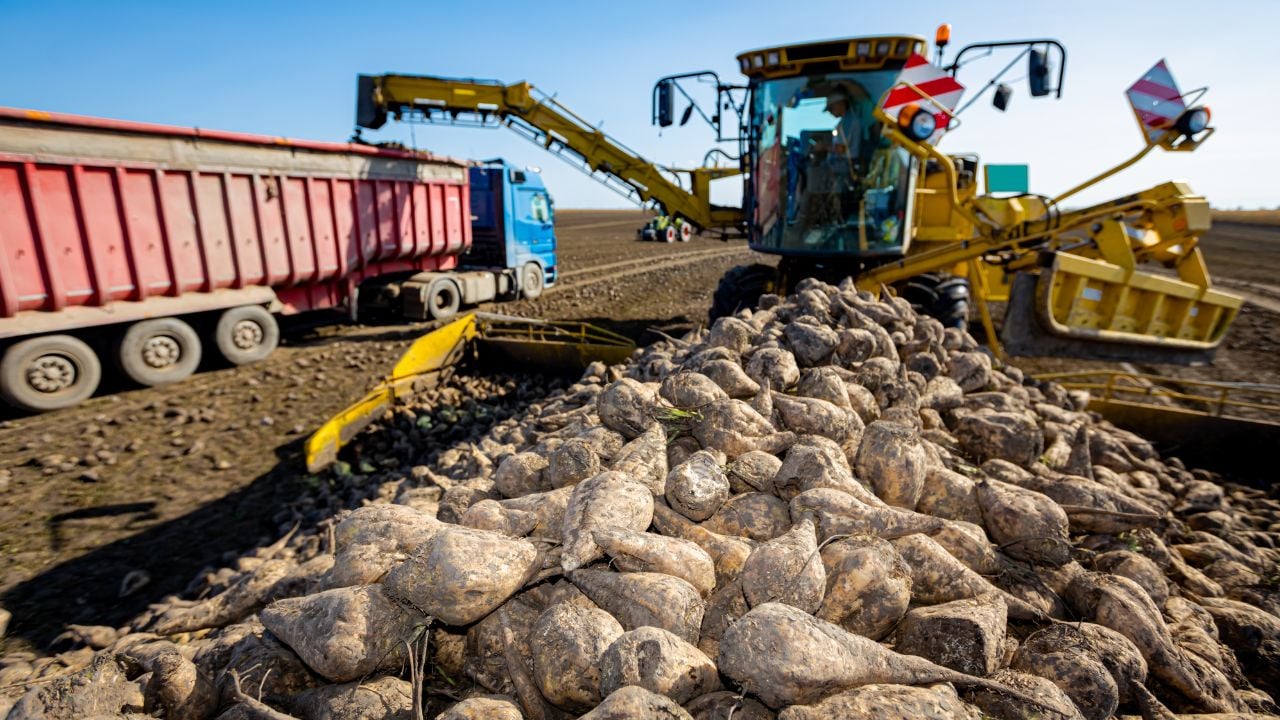
During the campaign, American Crystal says, beets at its receiving stations are weighed, sampled and tested for sugar quality, then unloaded and piled.
If you picture a beet pile, picture a long trapezoid.
Across its whole system, beets can stay at piling stations for up to five or six months.
If you pass a receiving station in North Dakota, you may be looking at beets that won’t be sliced for months.
Psst! How much do you know about North Dakota’s farm fields? Take our quiz and see how many you can get right.
Quiz
North Dakota Farm IQ
Answer these questions on North Dakota crops and harvests. We bet you can’t get them all right. Prove us wrong?
Which of these did North Dakota produce more of than any other state in 2024?
3. Freezing the Piles
Come winter, American Crystal freezes some of its beet piles on purpose to preserve the sugar inside.
Across its whole system, the pile fans come on whenever temperatures are below 20 degrees.
Below zero, those fans deep-freeze the entire pile solid.
In a normal year, the company would have to finish processing across its whole system by March 1 without the freeze.
With it, the company has run as late as June 1.
If you're counting months, the freeze adds three more of them.
4. Washing and Slicing
American Crystal says its factories, which include Hillsboro and Drayton, start by washing the beets.
A paddle wheel lifts the beets to the washers, where they roll in water to shake off dirt and debris.
The wash water goes to a holding pond or wastewater facility.
Then come the knives.
Corrugated knives cut the clean beets into long white strings called cossettes.
If you picture french fries, you've got the shape.
If you could look inside the diffuser, in one design you'd see cossettes riding up a slope while hot water pulls out the sugar.
The raw juice stays at the bottom, and the spent pulp moves out the top.
5. Pulp Pellets and Molasses
In American Crystal's factories, beet pulp and molasses are what's left once the sugar is out.
If you've wondered where the cossettes go after the hot water, the answer is a pulp press.
Factories squeeze some of the water out of that pulp, dry it and usually form it into pellets for livestock feed.
If you're wondering what else is left, it's molasses, the syrup a centrifuge separates from the sugar crystals.
Most molasses is refined further to recover leftover sugar, a step called desugarization.
American Crystal said in 1998 it would build a molasses desugarization plant at Hillsboro.
The molasses that remains becomes a liquid livestock feed additive.
6. Staggered Factory Closeouts
In 2021, Hillsboro was the first American Crystal factory to wrap up its campaign, on March 19, after slicing 2 million tons.
A March 30, 2021 report had Drayton expecting to finish on or about April 11.
If you lived near Hillsboro that spring, your factory finished about three weeks before Drayton was expected to.
If you're wondering how early that was, American Crystal expected to finish its whole campaign by mid-April, nearly a month earlier than usual.
The 2019 Early Finish
The 2019 crop shows you how short a campaign can get.
On November 9, 2019, American Crystal told its growers to stop harvesting after a freeze.
Across its whole system, about one-third of that crop, or 115,000 acres, was never harvested.
Those acres never reached a pile.
Hillsboro finished slicing that crop on February 3.
If you picture a campaign running into mid-May, the company expected most of its factories to wind up by early March, two and a half months ahead of that average.
Beets Lost in the Piles
Not every beet you see piled up during the campaign makes it to a factory's knives.
The outer layer of an outdoor pile is called rim beets.
American Crystal says that layer has virtually no sugar after the beets freeze, thaw and respire heavily.
In fall 2020, the company harvested just over 10 million tons of beets across all five of its factories.
It expected to slice about 9.3 million tons, after shrink, or losses, in the piles.
The 2023 crop shows you how much weather matters.
The winter of 2023-24 was unusually warm.
A Grand Forks Herald report on that winter said American Crystal had discarded about 50,000 tons of the 2023 crop.
Those beets came from the top 12 to 18 inches of the company's piles.
Minn-Dak Farmers Cooperative in Wahpeton tarped and blanketed its piles that winter.
Minn-Dak told the Herald it had not had to discard any of the 2023 crop as of February 21, 2024.
9 Things North Dakotans Keep in Their Car From October On

Starting October 15, North Dakota law lets drivers put metal studs on their tires for the winter.
Here's what else North Dakotans keep in their car from October on.
