
6 Things Tundra Swans Do Along the Mississippi Every November That Most Wisconsinites Never See

Step outside on a November night near the Mississippi, and you might hear tundra swans calling high overhead.
Most Wisconsinites never look up, and they miss what the swans are up to on the river.
Here’s what tundra swans do along the Mississippi every November that most Wisconsinites never see.
1. Digging for Tubers
Tundra swans use their long necks to reach the bottom of shallow water and dig up roots and tubers.
An adult swan eats an estimated 6.2 pounds of tubers a day on the Upper Mississippi River.
Along the river, they feed primarily on aquatic plants such as arrowhead, sago pondweed, and wild celery.
If you check a shallow backwater in November, you may see swans dipping their heads underwater to feed.
2. Calling Overhead at Night
Tundra swans often fly high overhead in vee formations, and you may hear their calls at night.
Each call is a clear, goose-like honk that can sound like a musical hoot from far away.
Their wings make noise too.
A whistling sound in the wings is why explorer Meriwether Lewis called them whistling swans, a name still in use.
Step outside near the river on a November night, and you may hear a flock before you ever spot one.
3. Roosting in Protected Water
Tundra swans packed the Upper Mississippi River National Wildlife and Fish Refuge on Nov. 20, 2006, when a survey counted 52,070 of them.
Of those, 31,000 were in the Wisconsin Islands Closed Area near Brownsville, Minnesota, a town on the Minnesota side of the river, across from Wisconsin.
That broke the old record of 34,730 from the year before.
Why that stretch?
If you wonder what drew them, a refuge biologist credited restored islands that shield birds from cold wind and waves, along with a hunting closure that reduced human disturbance.
Before the 1970s, only small numbers of tundra swans consistently stopped on the river.
That changed once it offered abundant food and relatively undisturbed resting sites where swans can roost.
Give the birds room if you visit, and your best odds of a big flock are on water that people leave undisturbed.
Psst! How much do you know about migratory birds? Take our quiz and see if you can ace it.
Quiz
Flyway Bird Smarts
Answer nine questions on migratory birds, flyways, and the Mississippi River. We bet you can’t get them all right. Prove us wrong?
The oldest known tundra swan, a female, was at least how old?
4. Reaching Deep Into the Mud
In November, tundra swans reach deep into river mud while they feed, deeper than other waterfowl can.
Down there, a swan can also find lead sinkers and hunting shot, a poisoning risk for the birds.
If you hunt or fish the river, spent lead could end up where a swan can reach it.
5. Traveling as Families
By November, tundra swans are on the Upper Mississippi River as families that average about two young apiece.
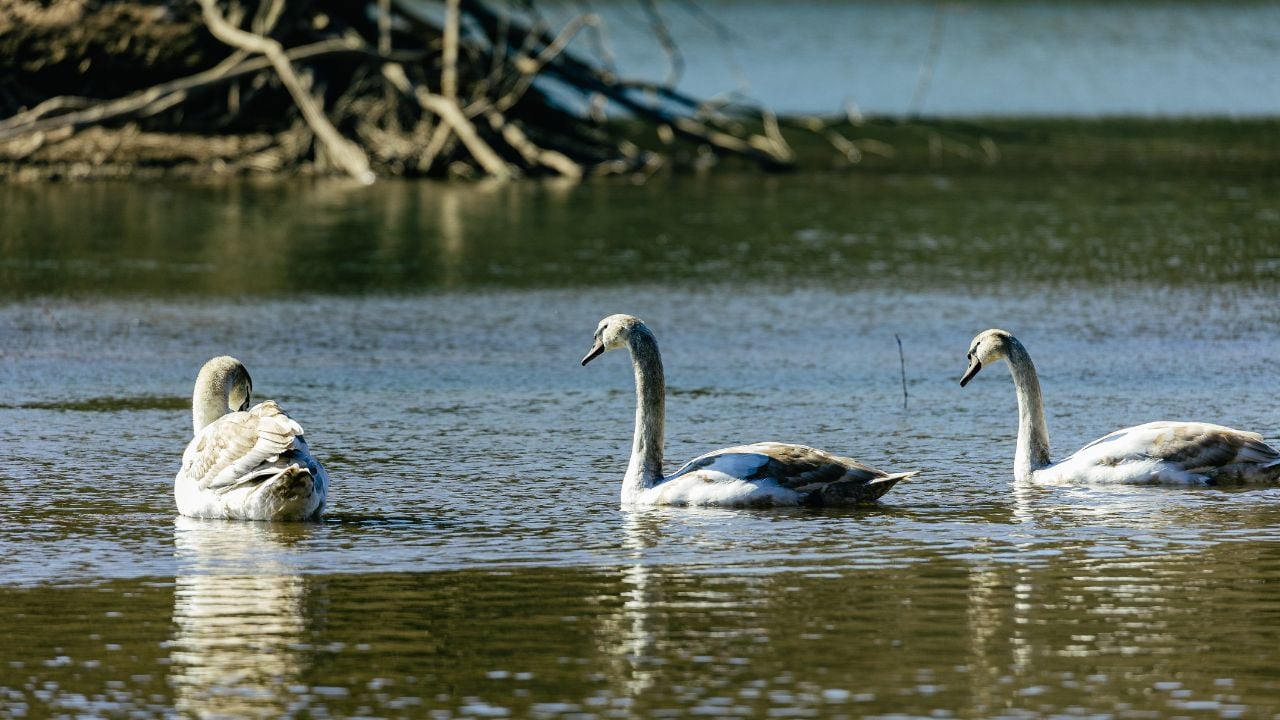
Those young are cygnets, and they stay brownish-gray for their first six to eight months.
If you spot a family on the river, those birds likely nested along the Arctic coast of Canada, from Hudson Bay west to northwestern Alaska.
Through your binoculars, you can often spot a family as two white adults with a gray cygnet or two.
Gray stands out against white.
Once a pair forms, the two feed and roost together year-round, and breeding pairs mate for life.
6. Waiting Out the Freeze
Come November, tundra swans wait for the ice.
They usually stay on the river until the backwaters freeze over, or until late November or early December if the water stays open.
That sets your deadline for seeing them.
Then they're gone.
From there, they continue southeast to winter along the Chesapeake Bay.
Counting Swans From the Air
Refuge biologists count tundra swans from planes, flying weekly aerial surveys through the fall.
In 2006, those surveys began Oct. 2 and continued through Dec. 6.
Researchers have also used digital aerial photography for daytime counts and thermal infrared imaging to document where swans spend the night.
What changed in 2006?
Total swan use of the refuge, counted in use-days, rose 150% from 2005 to 2006, while the peak count rose 50%.
Where to Watch
In Wisconsin, you can watch tundra swans from Shady Maple Overlook in Stoddard.
On the Minnesota side, Weaver Bottoms and Brownsville Overlook are two more spots.
Brownsville Overlook has mounted spotting scopes from mid-October to mid-November.
It's less crowded on weekdays.
Many Wisconsinites drive right past these spots.
Migration usually peaks the second or third weekend in November.
Warmer fall weather has delayed arrivals in recent years.
Telling a Tundra Swan From Other Swans
A tundra swan often shows a small yellow spot at the base of its black bill.
It also holds its neck straight up while it swims, unlike a mute swan, whose neck curves.
Trumpeter swans are slightly larger than tundra swans.
Refuge sightings reports from November 2025 list trumpeter swans mixed into tundra flocks.
Rieck's Lake and Lower Pool 8
A National Park Service page last updated in 2017 says a 2005 restoration at Rieck's Lake may take a few years to bring swan flocks back to historical numbers.
So check the refuge's recent bird sightings page first, then watch from the observation area at Rieck's Lake Park, north of Alma.
If you want bigger crowds, lower Pool 8, the stretch of river around Brownsville, Minnesota, is where refuge staff estimated 20,000 to 30,000 swans on Nov. 27, 2025.
Brownsville Overlook had 150 to 250 swans in front of it that day.
7 Arguments Wisconsin and Minnesota Have Never Settled

Football is arguably the loudest fight between Wisconsin and Minnesota.
But Wisconsinites and Minnesotans have been arguing about certain other things for just as long.
7 Arguments Wisconsin and Minnesota Have Never Settled
7 Cold-Weather Signs Veterinarians Want Wisconsin Dog Owners to Watch For

Cold weather can send a dog to the vet well before the first blizzard.
These are the cold-weather signs vets want Wisconsin dog owners to watch for.
7 Cold-Weather Signs Veterinarians Want Wisconsin Dog Owners to Watch For This Fall
