
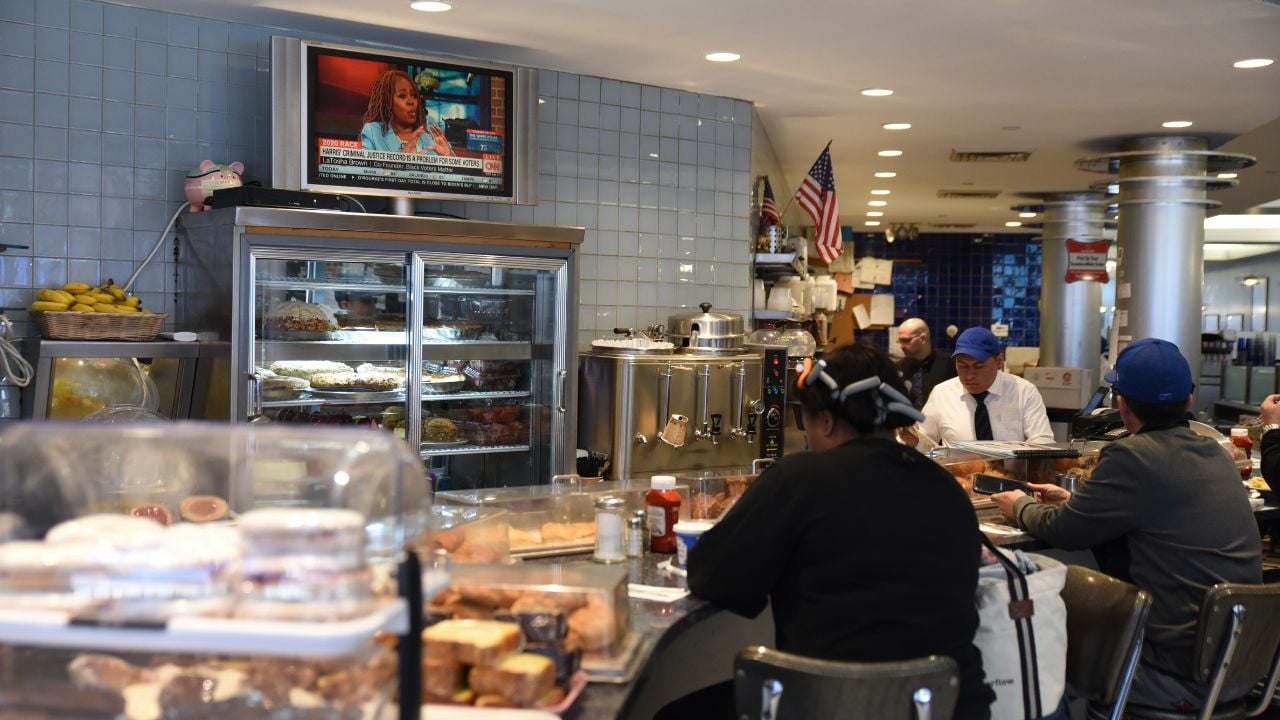
6 Things You’ll Only Find at a New York City Diner

A line cook slides a plate of home fries down the counter at four in the morning, past three off-duty nurses and a cab driver still counting their last fare.
Nothing about that counter is an accident.
Every plate, every cup, and every rule at the counter traces back to a piece of New York City history.
These are the things you’ll only find at a New York City diner.
1. Coffee Already Fixed for You
Say the word “regular” at a New York City diner, and nobody asks how you take your coffee.
The counterman already knows to stir in milk and two sugars before the cup reaches you.
Joseph DeRupo, a spokesperson for the National Coffee Association, has theorized the phrase traces back to immigrant-run coffee carts, where a language barrier around the word “regular” took hold.
No menu required.
Ask for a “regular” outside the five boroughs, and the answer is a shrug.
2. The Anthora Cup
A blue paper cup covered in a Greek key pattern still turns up when a New York City diner hands over coffee to go.
That’s the Anthora.
Leslie Buck designed it in the mid-1960s for the Sherri Cup company, built on purpose to appeal to Greek-owned coffee shops and diners.
It grew into a symbol of New York City.
A paper-cup company brought it back into production in 2015, after years of requests to see it in the city again.
“We Are Happy To Serve You” runs across the front in letters styled after ancient Athenian script.
Starbucks displaced the Anthora at many old counters years ago, but a few old-school diners never switched.
3. A Letter Grade by the Door
A New York City diner’s front window doesn’t always advertise the specials first.
It’s a letter grade.
New York City has required every food establishment, diners included, to post an A, B, or C sanitary inspection grade where passersby can see it.
The city’s Health Department has enforced the rule since 2010.
The Grade’s Point Scale
New York City’s grading system runs on points, not stars, and the math rarely makes it onto a diner’s wall.
An inspection turning up 0 to 13 points earns an A, 14 to 27 earns a B, and 28 or higher drops the grade to a C.
Every point marks a violation an inspector found that day, so the lower score always wins.
4. No Egg, No Cream
Order the fountain drink on an old-school New York City diner menu, and the egg cream shows up with neither egg nor cream in the glass.
Just seltzer, milk, and chocolate or vanilla syrup, built to foam up at the top.
Neither survives the glass.
Most accounts credit Louis Auster, who opened a Lower East Side candy shop around 1890, with mixing the first one.
The drink turned into a city staple within a few decades.
Bottled soda and the decline of soda-fountain counters thinned out how many diners still pour one.
The old counters that kept theirs are worth the detour.
5. Diner by Another Name
Ask a New York City local to meet at “the coffee shop,” and don’t be surprised when they lead you into a diner.
In New York City, “coffee shop” is often just another word for diner, counter stools and all.
New York City’s Administrative Code lists “coffee shop” right alongside “diner” when it spells out what legally counts as a restaurant.
A Midtown Manhattan diner ran for decades under the name Andrews Coffee Shop before the family that has owned it since 1964 finally added “diner” to the sign.
Outside New York City, the same two words mean something else.
Not a diner.
6. A Diner’s One-Way Trip
A New York City diner sometimes leaves town instead of closing for good.
Rising rent pushed the Moondance Diner out of SoHo in 2007, after 74 years on the same stretch of Sixth Avenue.
A couple bought the stainless-steel structure rather than see it demolished and trucked it nearly 2,400 miles to La Barge, Wyoming.
Manhattan’s Cheyenne Diner followed two years later, split into two sections and hauled roughly 860 miles to a new home near Birmingham, Alabama.
High rent, not a wrecking ball, usually decides which diners disappear.
It only moved.
Psst! How much do you know about diner history? Take our quiz and see how many you can get right.
Quiz
Diner History IQ
Answer these questions on diners, automats, and the food that made them famous. We bet you can’t get them all right. Prove us wrong?
Which chain drugstore does company history credit with inventing the malted milkshake, not any diner?
A Diner's Greek Roots
A New York City diner's four-page laminated menu often runs from a cheeseburger deluxe straight into a gyro platter, and that pairing has history behind it.
A wave of Greek immigration brought roughly 421,000 newcomers to the United States between 1890 and 1921.
Many started out washing dishes in diners and luncheonettes up and down the Northeast.
Those workers saved enough to buy the diners themselves.
A 1996 New York Times count found Greek families owned close to two-thirds of New York City's diners by then.
Some of the diners those families built still look like they wandered off a temple.
Fluted columns flank the entrance, and a Greek flag often hangs beside the American one out front.
Souvlaki, spanakopita, and moussaka rode onto the menu right alongside the burgers and fries.
One counter, two homelands.
The Fries Blamed on New York City
New York City diners get credit for a dish they didn't invent.
Disco fries, that pile of fries under melted cheese and gravy, is widely traced to the Tick Tock Diner in Clifton, New Jersey, which opened its doors in 1948.
The name comes from the disco era, when the dish became the late-night fix for club-goers stumbling in around 4 a.m.
Jersey's fries, all the same.
Many New York City diners carry disco fries on the menu now anyway.
The state line never made it onto the gravy.
7 Purchases That Make New Yorkers Look Wealthier Than They're Worth

A one-bedroom in a Manhattan building with a doorman can rent for up to 15% more than the same unit without one.
That extra money buys little more than a staffed lobby.
7 Purchases That Make New Yorkers Look Wealthier Than They're Worth
9 Wellness Routines That Turn Into Expensive Subscriptions for New Yorkers

New York City's consumer watchdog warned 187 gyms in February that their memberships were too hard to cancel, and a new rule arriving this fall finally forces a fix.
These are the wellness routines that turn into a monthly bill New Yorkers forget they're paying.
9 Wellness Routines That Turn Into Expensive Subscriptions for New Yorkers
