

7 Purchases That Make New Yorkers Look Wealthier Than They’re Worth

A one-bedroom in a Manhattan doorman building can rent for as much as 15% more than the same apartment without one.
That premium buys a lobby.
Some New Yorkers pay for the appearance of money ahead of having it.
These are the purchases that make New Yorkers look wealthier than they’re worth.
Note: This is general information, not financial advice. Costs, financing terms, and membership prices are subject to change.
1. Renting a Designer Handbag
A rented designer handbag lets a New Yorker carry an accessory that would cost thousands of dollars to buy, and nobody on the subway platform can tell the difference.
It’s borrowed, not bought.
Membership services like Vivrelle start at $45 a month, rising past $300 a month for full access to a rotating closet of Chanel and Louis Vuitton pieces.
The whole idea is manufacturing an appearance.
Members can swap in a different bag every 30 days.
A rented bag rarely stays in rotation long enough to feel familiar.
2. Financing a Canada Goose Coat
A Canada Goose parka carries a round arm patch that other New Yorkers recognize as money at a glance.
New Yorkers size each other up by their coats on a subway platform, in a school pickup line, anywhere the cold puts everyone in outerwear at once.
Many people don’t pay for a coat in a single swipe.
Canada Goose lets shoppers pay for a coat priced at $900 or more through Klarna, spreading the balance across four payments made every two weeks after the jacket ships.
So New Yorkers wear that patch in full while the payments are still coming due.
The last installment often lands weeks after the first cold snap.
3. Buying Into Bottle Service
A table with bottle service turns a New York City nightclub visit into a performance, and everyone in the room can see who bought the bottle.
The tradition started at a Manhattan club.
The Tunnel introduced American bottle service in 1993, pricing a bottle at $90, cheaper per person than ordering individual drinks once a group split the cost.
The economics haven’t changed much.
Splitting a table’s minimum across eight or ten people can land close to what a round of drinks at the bar costs anyway.
So the room sees one big splurge that no single person at the table made alone.
Many of the priciest Manhattan clubs still charge thousands for a single table, and every dollar of it is visible from across the room.
4. Living in a Doorman Building
A studio apartment in a New York doorman building rents for more than an identical apartment down the block, before anyone even opens the mailbox.
Visitors see marble, brass, and a person in uniform holding the door.
It’s impressive, but empty.
Manhattan appraiser Jonathan Miller puts that premium as high as 15 percent over a comparable building without a doorman, once the buildings are otherwise alike.
That gap buys a lobby, not extra square footage.
Many New Yorkers who want that address downsize the actual apartment to afford it, trading a bigger kitchen elsewhere for a studio behind a marble desk in Manhattan.
Neighbors size up the building by the person in uniform long before they see the apartment.
Psst! How much do you know about the ways New Yorkers have paid to look rich? Take our quiz and see how many you can get right.
Quiz
New York Status IQ
Answer these questions on New York money history and status trivia. We bet you can’t get them all right. Prove us wrong?
The original Waldorf-Astoria Hotel had a grand marble corridor nicknamed “Peacock Alley” in the 1890s. Why?
5. Joining Equinox
A New York Equinox membership buys a marble locker room, eucalyptus towels, and a lobby that looks more like a hotel than a gym.
None of that shows up on a paycheck.
Monthly dues at Equinox clubs in New York City commonly run $205 to $395, depending on how many club locations the membership unlocks.
For someone splitting rent with two roommates to afford Manhattan, that single membership can be the biggest line in the budget after housing.
Someone carrying the gym's tote bag onto the subway looks just as successful whether the membership is comfortable or a stretch.
6. Leasing a Luxury Car
New York neighbors read more into a leased German luxury car, a BMW or Mercedes, parked outside the building than an actual bank statement would show.
Leasing is often the cheaper move.
Experian's national data put the average lease payment at $659 a month in 2025, lower than the average loan payment of $682.
The bigger giveaway sits underground.
A monthly spot in a Manhattan parking garage commonly runs $600 to $1,000 or more depending on the neighborhood, which can rival or beat the monthly lease payment.
Whatever the driver pays for the car, the garage bill is where the bigger money goes.
The Math Behind a New Yorker's Lease
A New Yorker's lease payment covers the car's expected drop in value over the lease term, plus a finance charge, not the whole price of the car.
That's why a $70,000 luxury sedan can lease for less each month than a $35,000 sedan bought on a loan.
A loan payment has to cover the entire purchase price instead of just a few years of depreciation.
7. Choosing a Brand-Name Stroller
In New York's stroller-heavy pockets of Brooklyn and the Upper West Side, a brand-name stroller can cost a thousand dollars more than a basic model.
Other parents can spot the difference at a glance.
Slate has reported that UPPAbaby strollers function as lifestyle signifiers, letting parents communicate something about themselves as much as anything about the baby.
Bugaboo offers Affirm financing on its strollers, splitting a four-figure price into monthly payments the same way Canada Goose does for its coats.
A stroller bought outright looks the same on the sidewalk as a stroller still being financed.
A basic stroller costs less than $30.
An UPPAbaby Vista V3 runs $999.99 for the frame and seat alone.
A Bugaboo Fox 5 Renew lists at $1,499, pushing the same size baby down the same sidewalk.
Nobody on the sidewalk can tell which stroller is already paid for.
The Debt Behind the Look
New York shoppers are one slice of a much larger group.
Nearly 40 percent of Americans say they've spent more than they could afford trying to impress someone else, per a LendingTree survey, especially on clothes, shoes, or accessories.
Sixty-three percent of the people who did that went into debt over it.
More than a third say they're no longer in touch with at least one person they were trying to impress in the first place.
8 New York City Trash Rules That Sound Fake but Aren't
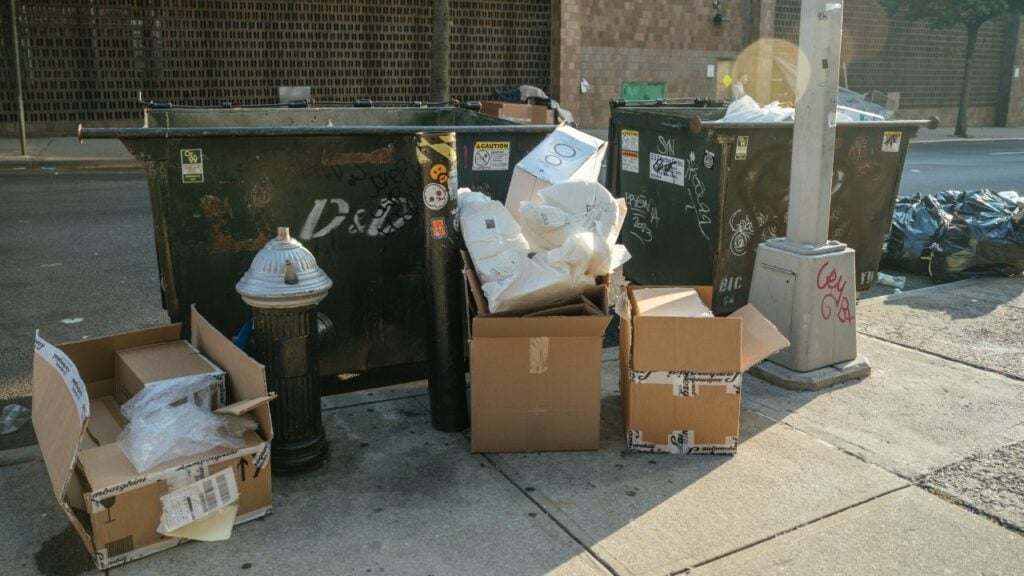
New York City sells an official trash can, and buying the wrong can risks fines for the building.
The can is rat-resistant by design, and city rules require certain buildings to use it or risk a violation.
8 New York City Trash Rules That Sound Fake but Aren't
9 Ways New Yorkers Can Find Money the State Is Holding for Them

New York is sitting on more than $20 billion in unclaimed funds, and some of it likely belongs to a person reading this.
A quick search of the state's database takes less time than many people expect.
9 Ways New Yorkers Can Find Money the State Is Holding for Them
