
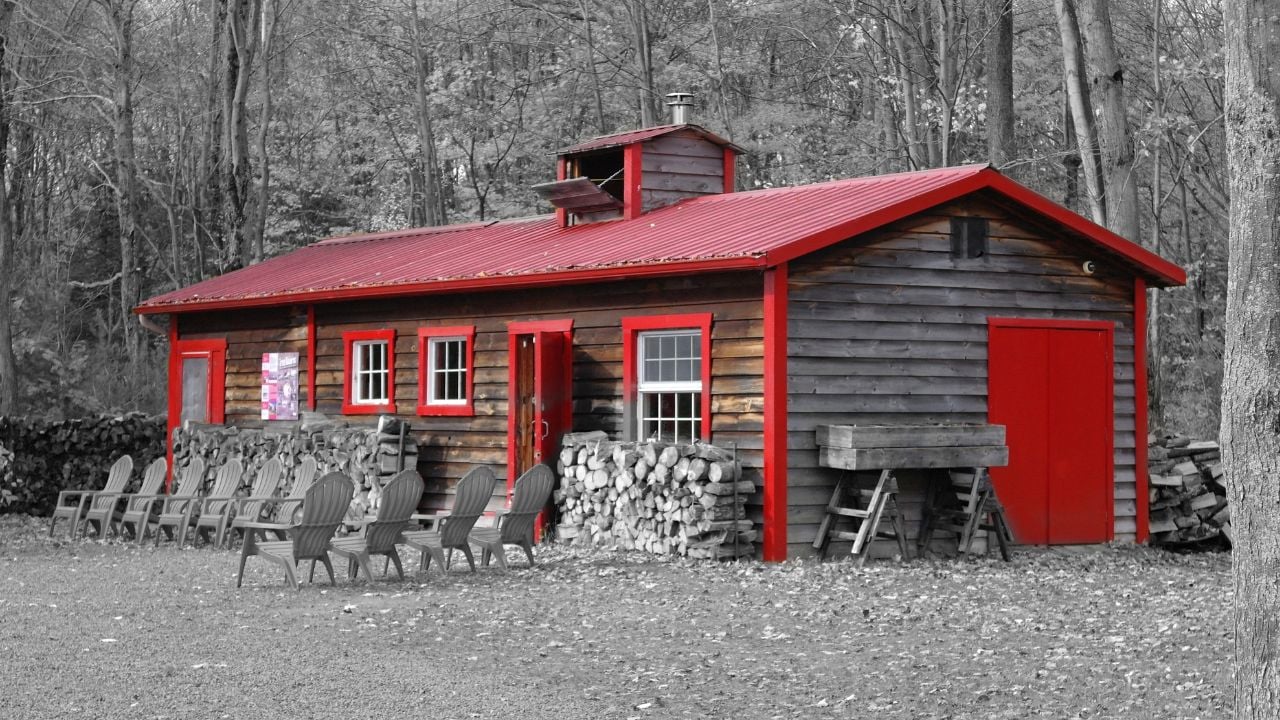
7 Fall Jobs New Hampshire Sugarhouses Can’t Skip

Maple syrup season may be months away, but the work starts long before the first tap.
Granite Staters who run a sugarhouse spend the fall getting ready while everyone else is out looking at the leaves.
Here are the fall jobs sugarmakers can’t afford to put off.
1. Clearing Fallen Timber
Clearing fallen timber from your sugarbush, the stand of maples you tap, is a fall job.
The Massachusetts Maple Producers Association says autumn is the time for a sugarmaker to clean up the sugarbush and repair damage from fallen or dead trees.
After the leaves drop, it’s easier to work in the woods because visibility is greater and the heat and insects of summer are gone.
With the leaves down, you can see more of your sugarbush at a glance.
That makes fall a good time to walk your trees and repair the damage you find.
2. Stocking Evaporator Wood
Cutting firewood for your evaporator, the large pan where you boil sap down to syrup, is a fall job.
The same association lists cutting firewood for the evaporator among its autumn tasks.
University of New Hampshire Extension says to plan on 1 cord of wood for every 80 to 100 taps.
A cord is the standard measure for stacked firewood.
So if you set 500 taps, you need about five to six cords before your first boil.
If you set 100 taps, you need about one to one and a quarter cords.
Apply that ratio to the 480,000 taps the U.S. Department of Agriculture’s June crop report lists for New Hampshire in 2026, and you get 4,800 to 6,000 cords statewide.
That assumes every tap feeds a wood-fired evaporator.
New Hampshire requires out-of-state firewood to carry heat-treatment certification.
That includes wood from Vermont and Maine.
New Hampshire’s Firewood Quarantine
New Hampshire’s firewood quarantine began in 2011 to keep damaging insects out of the state, according to the firewood page on nhbugs.org.
The quarantine prohibits out-of-state firewood unless it’s labeled as certified heat-treated.
Certified heat-treated means 140°F for 60 minutes.
The main advice is to buy firewood where you burn it.
3. Hunting Tubing Leaks
Ohio State University Extension calls for a fall assessment of your system once the leaves have mostly fallen.
It asks whether you’ve noticed a drop-off in performance compared with last year.
Bad tees, the fittings where tubing lines join, are one place to look.
They can cause micro leaks that are sometimes worse than squirrel chews because they’re harder to locate.
Vacuum, the suction that pulls sap through your lines, is measured in inches of mercury.
Dr. Timothy Perkins, director of the University of Vermont’s Proctor Maple Research Center, writes in The Maple News that producers can expect 5 to 7 percent more sap per inch.
Every leak you fix this fall means less vacuum loss when your first sap run arrives, the first day sap flows through your lines.
4. Sanitizing Your Tubing
Sanitizing your tubing is still possible late in the year, according to a Dec. 9, 2023, post from the University of Wisconsin Extension’s maple program.
You have time for last-minute sanitation as long as the weather is warm enough.
A drop is the length of tubing attached directly to each spout, the tap that goes into the tree.
Sanitizing can pay off, according to the Cornell Maple Program and the University of Vermont’s Proctor Maple Research Center.
An adequately sanitized spout and drop line could give you sap yield comparable to a new spout and drop.
3/16-inch tubing can also be prone to clogging from microbial masses, buildups of microbes, especially at fittings.
If your system uses 3/16-inch tubing, check the fittings first.
5. Sending RO Membranes Out
A reverse osmosis (RO) unit removes water from sap before you boil it, and its membranes sometimes have to go out for cleaning.
If your RO membranes need cleaning, send them out early.
The Wisconsin post says turnaround times for parts and cleaning are faster now than they will be in February.
According to the NH Maple Experience, based at North at The Rocks in Bethlehem, sugaring in New Hampshire runs from mid-February to mid-April.
That’s when you want your membranes cleaned and back in your unit.
6. Aging Tubing Parts
A mainline, the large tubing that collects sap from your smaller lines, doesn’t last forever.
Ohio State University Extension’s fall assessment says mainlines are good for 10 to 15 years, and eventually they must be replaced.
32 inches is a good starting point for drop length in established systems.
University of New Hampshire Extension’s setup guide says drops should be long enough, at 18 to 36 inches, so 32 inches falls inside that range.
It’s easy to blame a poor season on the weather.
The cause, the assessment says, could be the age of your system and some neglected repairs.
If your mainline is 10 years old or more, check it this fall.
Psst! How much do you know about maple syrup? Take our quiz and see if you can ace it.
Quiz
America’s Maple IQ
Answer these questions on where America’s maple syrup comes from. We bet you can’t get them all right. Prove us wrong?
Which state set the most taps in 2026?
7. Ordering Bottles and Labels
The same Wisconsin post says now is a good time to stock up on bottles so you have enough for the syrup you hope to produce.
The U.S. Department of Agriculture's June crop report puts New Hampshire's 2026 average at 0.307 gallons of syrup a tap.
At that average, 500 taps make about 150 gallons, and 100 taps make about 31 gallons.
Custom-printed labels tend to have a long lead time.
If you want custom labels on your syrup, order them well before your first sap run.
5 Current Use Rules That Cost New Hampshire Landowners When Land Use Changes

If you own woodland or open fields in New Hampshire, Current Use is the trade-off that shapes what you can do with that land.
Change how you use it, and the bill can change too.
5 Current Use Rules That Cost New Hampshire Landowners When Land Use Changes
9 Things That Change the Second Vermonters Cross Into New Hampshire
Cross the line from Vermont into New Hampshire, and many everyday things look different.
The checkout line is only the beginning.
9 Things That Change the Second Vermonters Cross Into New Hampshire
