
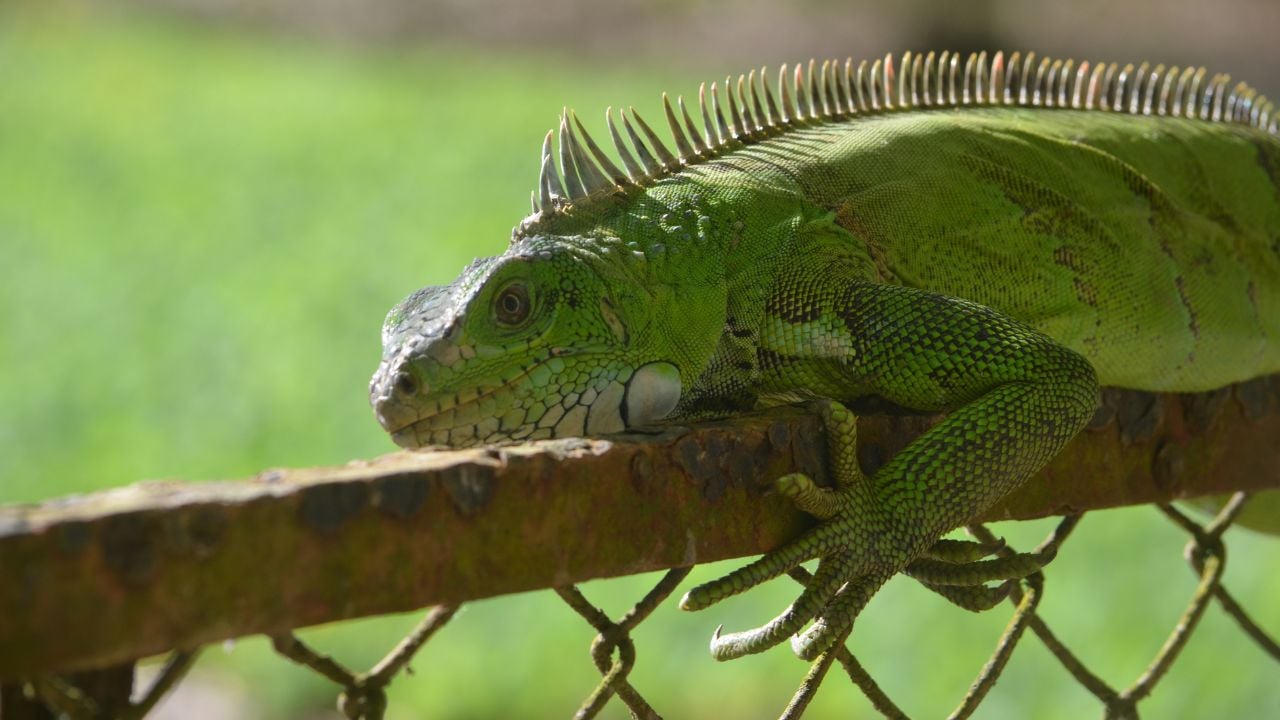
7 Iguana Rules Florida Homeowners Get Wrong

An iguana in the yard can chew up your plants and test your patience.
Florida homeowners often assume they can deal with it however they like, but the rules go beyond that.
Here are the iguana rules worth knowing before you take matters into your own hands.
Note: This is general information, not legal advice. Wildlife rules and local ordinances are subject to change, so confirm the current requirements with the Florida Fish and Wildlife Conservation Commission.
1. Removal Without a Permit
The Florida Fish and Wildlife Conservation Commission (FWC) says green iguanas aren’t protected in the state beyond its anti-cruelty law.
Humanely killing them is allowed year-round on private property with landowner permission.
You might expect a permit to come first.
You don’t need one.
The agency’s nonnative species page says the same about nonnative reptiles in general.
It even encourages landowners to remove green iguanas from their property.
2. Anti-Cruelty Law
Florida’s animal cruelty statute, Section 828.12, covers any animal.
That includes iguanas.
Unnecessarily killing or tormenting an animal is a first-degree misdemeanor.
You could face a fine of up to $5,000 on conviction.
Intentionally causing a cruel death, or excessive or repeated pain and suffering, is a third-degree felony with a fine of up to $10,000.
The FWC publishes a humane killing guide that says your method should make the animal lose consciousness immediately.
3. Firearm Discharge Limits
If you shoot an iguana, the FWC’s humane killing guide says to follow local firearm rules and any rules for the property you’re on.
Firearms and pre-charged pneumatic air guns are both on the guide’s list of methods for nonnative reptiles.
In a neighborhood, the state law you need to know is Section 790.15.
It makes it a first-degree misdemeanor to recklessly or negligently discharge a firearm outdoors.
That covers property used primarily as a home site or zoned only for residential use.
Your yard may count.
If you’re thinking of shooting an iguana there, check with your city first.
In 2014, an opinion approved by Coral Gables’ city attorney called it highly likely that firing a gun on private property in the city’s residential zones would violate that statute.
4. Ban on Relocating
Once you capture a green iguana, the FWC says you can’t relocate and release it at another location.
The agency added green iguanas to its Prohibited species list on April 29, 2021.
To some homeowners, driving a captured iguana to a park or canal seems like the kind thing to do.
It’s against the rules.
State law makes it unlawful to release nonnative animals in Florida without authorization from the FWC.
The Penalty for Releasing Iguanas
If you release an iguana, you face a first-degree misdemeanor on a first offense under Section 379.4015.
If you reoffend within 10 years, you face a minimum mandatory fine of $750.
5. Permits for Live Capture
You need a permit to possess live captured green iguanas for eradication and control purposes, the FWC says.
Permits are only required for trapping and removal efforts that involve live possession or transport of Prohibited species, or projects involving telemetry.
The public can still humanely kill nonnative reptiles at the site of capture.
Any lawful method works, with landowner permission on private property.
Holding is different.
You can get the permit free, and it lasts one year.
6. Other People’s Land
Before you kill an iguana on someone else’s private property, you need the landowner’s permission, the FWC says.
On some FWC-managed lands, you can remove and humanely kill green iguanas without a license or permit.
7. Pre-2021 Pet Iguanas
If you owned a pet green iguana before April 29, 2021, the FWC says you now need a permit to keep it.
The permit is no-cost but requires documentation proving you possessed the animal before its Prohibited listing.
It’s also illegal to import or breed green iguanas in captivity within the state.
Iguana Yard Damage
Green iguanas have a tendency to eat ornamental plants, and the FWC says that can make them a nuisance to homeowners.
Some green iguanas also cause damage to infrastructure by digging burrows that erode and collapse sidewalks, foundations and seawalls.
They may also leave droppings on docks, moored boats, porches, decks, pool platforms and inside swimming pools.
Removing plants that act as attractants and filling in holes can discourage burrowing.
If you can’t remove iguanas from your property safely, seek help from a professional nuisance wildlife trapper.
Cold-Stunned Drop-Off
For two days in February, FWC Executive Order 26-03 covered cold-stunned green iguanas.
If you didn’t have a permit, you could hold live green iguanas only to transport them to the FWC.
Five FWC sites took drop-offs on Feb. 1 and 2.
Under the order, the agency collected 5,195 green iguanas, including 3,882 at its Sunrise site.
Cold-stunned iguanas can recover more quickly than you may expect and act defensively once they do, the FWC warns.
Never bring a cold-stunned iguana into your home or building to warm up.
Psst! How much do you know about wildlife? Take our quiz and see if you can ace it.
Quiz
Wildlife Trivia
Answer these questions on invasive animals and wildlife laws. We bet you can’t get them all right. Prove us wrong?
How many other species share a gopher tortoise’s burrow, according to the FWC?
Exotic Pet Amnesty
If you can't keep your pet iguana, you have a way out without a penalty.
The Exotic Pet Amnesty Program from the FWC accepts surrendered pets without penalties, whether owners kept them legally or illegally.
You can do it with no questions asked.
The program aims to cut down on pet owners releasing animals into the wild, the agency says.
You can surrender a pet year-round by calling the Exotic Species Hotline at 888-483-4681.
7 Florida Rivers Floridians Refuse to Swim In

Florida's rivers can look inviting on a hot day.
Not every river is alike, though.
7 Florida Rivers Floridians Refuse to Swim In
15 Words Floridians Say That Stop Northerners Mid-Sentence

Florida has a distinct vocabulary.
Some of it may stop a newcomer mid-sentence.
