

7 Ohio Traditions That Have All but Disappeared in the Last 20 Years

Forty-two percent of the parishes in Ohio’s Cleveland Catholic Diocese were already running a deficit before a single closure went on paper.
That was true back in 2009, years before many Ohioans noticed the pews were emptier.
Several other Ohio traditions faded the same way.
These are the Ohio traditions that have all but disappeared in the last 20 years.
1. Hanging Out at Randall Park Mall
Randall Park Mall opened in North Randall, Ohio, in 1976 as one of the world’s largest enclosed shopping malls.
Teenagers spent entire Saturdays there, working the food court, killing time at the arcade, and doing laps past every storefront without buying a thing.
That mall closed in June 2009.
Demolition began in 2014.
A handful of other Ohio malls have since lost their anchor stores and then their shoppers the same way.
2. Working the Line at Lordstown
General Motors (GM) ran its Ohio assembly plant in Lordstown for more than 50 years, and Mahoning Valley families lined up for the chance to build cars there.
Generations of the same families worked those same shifts.
GM’s own statement on the closure said the loss would be felt by the workers, their families, local businesses, and the whole community.
Production stopped for good in March 2019.
More than 1,300 people lost jobs there, and only 417 of them transferred to another GM plant.
This wasn’t a layoff.
It was a closing.
The Chevrolet Cruze went with it, the last car the plant ever built.
3. Christmas Trips to Lazarus and Elder-Beerman
Lazarus and Elder-Beerman once anchored Ohio’s holiday season, from Columbus to Dayton.
Families rode downtown to see the animated window displays, wait in line for a photo with Santa, and finish the trip with a hot pretzel.
Federated retired the Lazarus name in 2005, folding the 1851 Columbus chain into Macy’s, a year before this list’s 20-year window even begins.
Elder-Beerman carried the tradition alone for another 13 years.
Elder-Beerman, a Dayton department store whose roots trace to 1883, closed every one of its stores in 2018.
Macy’s is the only downtown department store left standing where Lazarus and Elder-Beerman used to draw the holiday crowds.
4. Longaberger Basket Tours Near Newark
Longaberger built its headquarters near Newark, Ohio, in the shape of one of its own baskets, handles included.
Buses of visitors toured the building and the company’s basket-weaving plant nearby in Frazeysburg, year after year.
Employees moved out of the basket-shaped building in 2016.
The company shut down for good two years later, in 2018.
The tours ended.
So did the weaving.
Not one more basket rolled off the line.
The basket-shaped building sat empty after that.
5. Daily Paper on the Porch
Carriers used to drop a newspaper on porches every single morning, rain or shine.
Ohio has lost more than half of its newspapers since 2005, one of the steepest drops of any state in the country.
Cleveland’s Plain Dealer cut home delivery from daily to four days a week in 2013.
Smaller and mid-size Ohio papers cut delivery days too, for the same reasons.
Twenty-one Ohio counties now have no local newspaper covering them at all.
Nobody circles the yard sale ads with a pen anymore.
What a Missing Newspaper Costs Ohio
Ohio’s 21 news desert counties don’t just lose a local paper. They lose the outside check that used to help keep a county’s borrowing costs in line.
Those counties carry $1.3 billion in bond debt between them.
Going without a local newsroom adds an extra $12 million a year in interest on that debt, according to a 2026 report from Rebuild Local News.
6. Friday Nights at the VFW or Legion Hall
Veterans of Foreign Wars (VFW) posts and American Legion halls across Ohio used to fill up on a Friday night for fish fries, wedding receptions, and euchre tournaments.
Ohio’s American Legion membership has fallen from about 186,000 in the 1990s to about 75,000 in recent years, according to the group’s own state adjutant.
Posts lose another 3,000 to 5,000 members every year.
Smaller crowds mean shorter hours, and shorter hours mean fewer reasons to stop in on a Friday.
Some have closed.
Others have merged with a post two towns over.
Psst! How many of these faded Ohio traditions do you remember? Run through this checklist and see how many you can check off.
7. Sunday Mass at Your Neighborhood Parish
Cleveland’s Catholic Diocese once had 224 parishes spread across eight counties in northeast Ohio.
Bishop Richard Lennon announced a restructuring in 2009 that would leave the diocese with 52 fewer parishes within 15 months: 29 closing outright and 41 merging into 18 new parishes.
By mid-2010, the count had dropped to 172 parishes.
Bishop Lennon cited three reasons: Catholics moving to the suburbs, a shrinking number of priests, and parish finances that couldn’t keep up.
Fifty-two parishes, gone.
5 Ohio Towns That Were Booming 40 Years Ago and Sit Nearly Empty Now
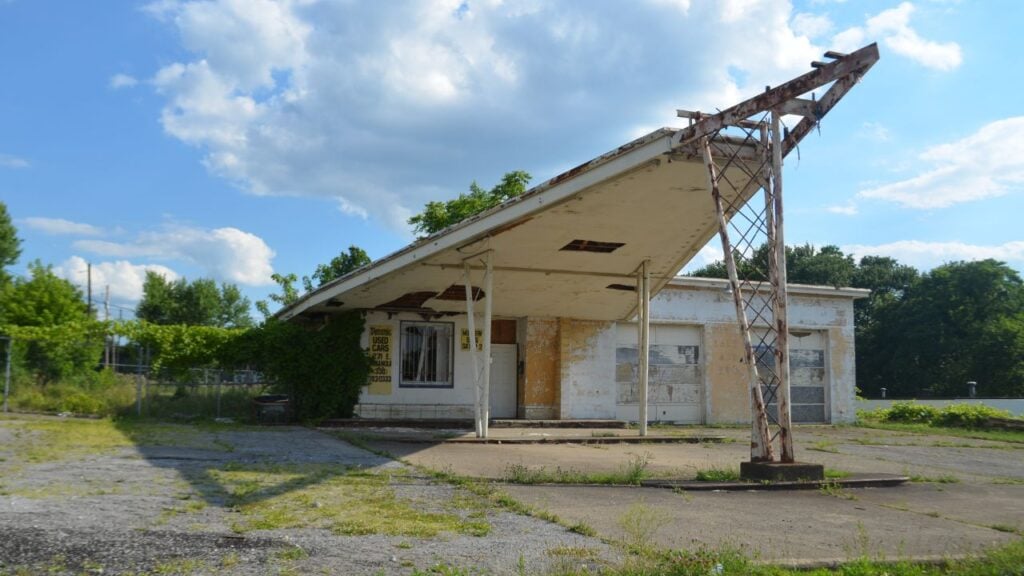
A “Now Hiring” sign hangs faded in a storefront window across from a “For Sale” sign that’s been up for three years.
Forty years ago, that same block had a line out the door on a Friday night.
5 Ohio Towns That Were Booming 40 Years Ago and Sit Nearly Empty Now
8 Grocery Store Habits Ohioans Refuse to Give Up, Even in the Age of AI

Just 15% of U.S. shoppers have used an artificial intelligence (AI) tool to help with grocery shopping in the past year.
Ohio’s grocery chains built the technology in anyway, and many shoppers still walk past it.
8 Grocery Store Habits Ohioans Refuse to Give Up, Even in the Age of AI
