
7 Roof and Gutter Checks Tennessee Homeowners Skip Before Winter but Shouldn’t

Nashville’s average first freeze is Nov. 11, just nine days away.
If you own a home in Tennessee, a cold snap is the wrong time to find a problem on your roof.
Here are the roof and gutter checks that are easy to skip, so you can get them done before winter hits.
1. Limbs Over Your Roof
A limb that hangs over your roof can end up on it.
Nashville’s January 2026 ice storm brought reports of fallen branches and trees.
Tennessee’s Division of Forestry says branches under ice more commonly break at weak points, such as old wounds and decay.
Branches that scrape against or overhang the roof should be trimmed back.
Prune dead and weakened limbs out of your trees every year.
Call a certified arborist if a tree can’t be removed safely or is near utility wires and structures.
2. Flashing at Chimneys and Pipes
Roof flashing is the seal where your roof meets a chimney, a pipe, or a wall.
A Department of Energy-funded Building America guide says pipes, plumbing stacks, flues and vents through the roof need boot or collar flashing.
Your chimney gets step flashing, too.
Flashing around roof edges, dormers and skylights needs a look, too.
Walk around your house and look for flashing that’s missing at every pipe and chimney.
Missing flashing can let water in and cause rot that may be hidden beneath the walls or roof.
3. Gutters at the Roof Edge
Where your roof edge meets the gutter, metal flashing does the work.
The Building America guide says the drip edge, a metal flashing along the roof edge, should extend into your gutters, not behind them.
Kickout flashing sits where the eave of a sloped roof meets a vertical wall, directing rainwater into the gutter.
Watch that spot from the ground during a rainstorm to see whether the water goes into the gutter or down the wall.
Where that flashing is missing, water can leak into the wall and cause serious water damage.
Rotting wood or peeling paint below the spot where a roof meets a wall is a sign of trouble.
4. Leaves in Your Gutters
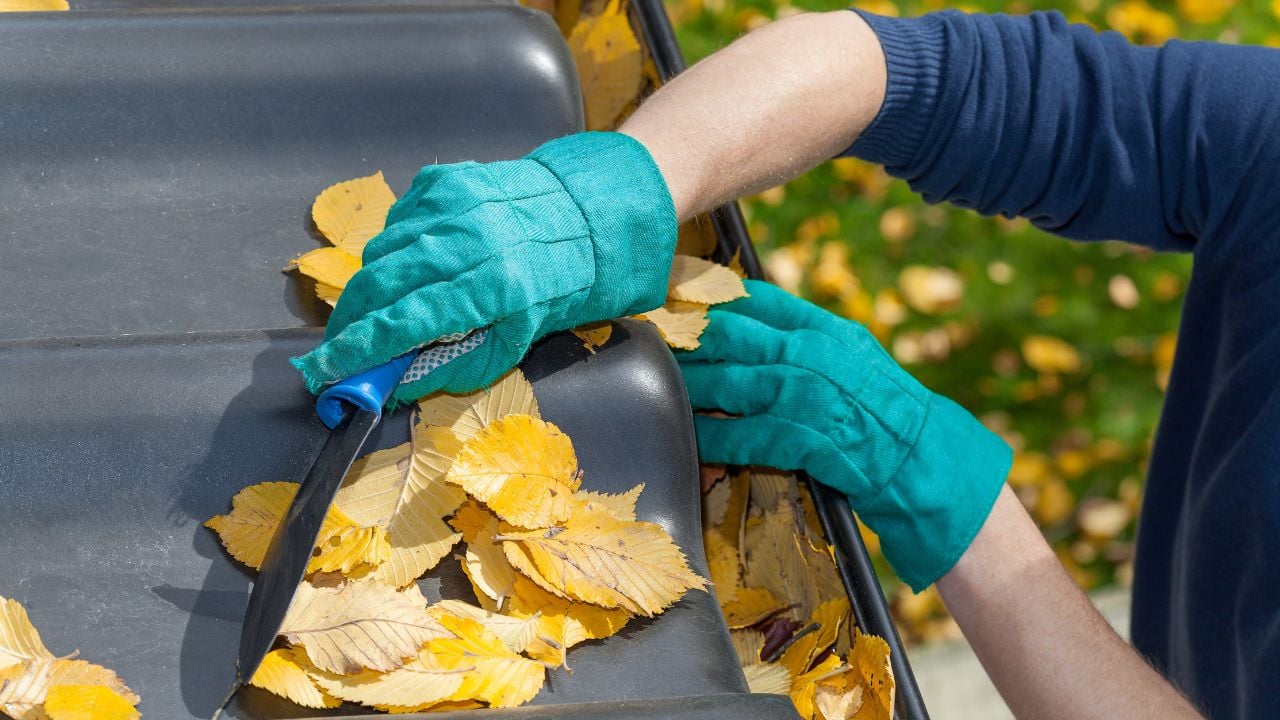
Your gutters can’t carry water away when leaves fill them.
The Environmental Protection Agency (EPA) says to clean and repair roof gutters regularly.
Clear them once the leaves have dropped, or hire someone if you can’t reach them safely.
Check the bottom of each downspout, too, for a clog.
Where the gutter edge overflows in a downpour, take a closer look.
Gutters, downspouts, hangers and strainers should be free of leaks and rust.
5. Downspout Drainage
Clean gutters are only half the job.
The Department of Energy’s Building Science Education page lists terminating downspouts at least 5 feet from the foundation among its stormwater options.
The ground should slope away from the building foundation.
Look for bare patches or washed-out soil where your downspouts empty.
When water heads toward your house, a downspout extension can carry it farther.
Measure the end of your downspout and the distance you want to cover, so you buy the right fittings and extension pipe.
A University of Tennessee Institute of Agriculture program, Tennessee Smart Yards, lists directing downspouts onto a lawn or garden, not hard surfaces, among its stormwater steps.
6. Curled and Missing Shingles
You can check your shingles from the ground by walking all the way around your house.
Look for shingles that are curled, damaged, loose or missing.
Binoculars help.
Take a photo of anything odd, so a roofer can see it.
After the January 2026 winter storm, Tennessee’s Department of Commerce and Insurance warned about contractors making door-to-door or telephone offers to repair roofs.
Hiring a Contractor After a Storm
The department gave contractor precautions after that storm.
Ask a licensed contractor whether the work will be done by employees or subcontracted out.
If the contractor needs payment to buy supplies, go with the contractor and pay the supplier directly.
7. Soffit Vents Under the Overhang
Soffit vents sit under your roof overhang and let outside air into the attic.
In winter, a natural flow of outdoor air through the attic helps keep it cold.
The federal Energy Star program calls blocking the flow of air at the eaves the most common mistake homeowners make when installing insulation.
When you check the attic, look for insulation or other material blocking the soffit vents.
Psst! How much do you know about roofs and gutters? Take our quiz and see how many you can get right.
Freeze Dates in Nashville and Memphis
Nashville’s November 11 average first freeze is only an average.
It has arrived as early as October 2, in 1984.
The latest first freeze on record came on November 29, in 2024.
In Memphis, the average first freeze is November 12, with the earliest on October 16, in 1952.
Its latest came on December 11, in 1994.
In an average year, you can expect 67 days with a low at or below 32 degrees in Nashville.
9 Everyday Words That Mean Something Else Once You Cross Into Tennessee

Some everyday words change meaning once you cross into Tennessee.
Test yourself on a few of them.
9 Everyday Words That Mean Something Else Once You Cross Into Tennessee
8 Food City Deals Tennesseans Only Get With Their Card Scanned First

That little card could do more for you.
Here is what you could be missing.
8 Food City Deals Tennesseans Only Get With Their Card Scanned First
