
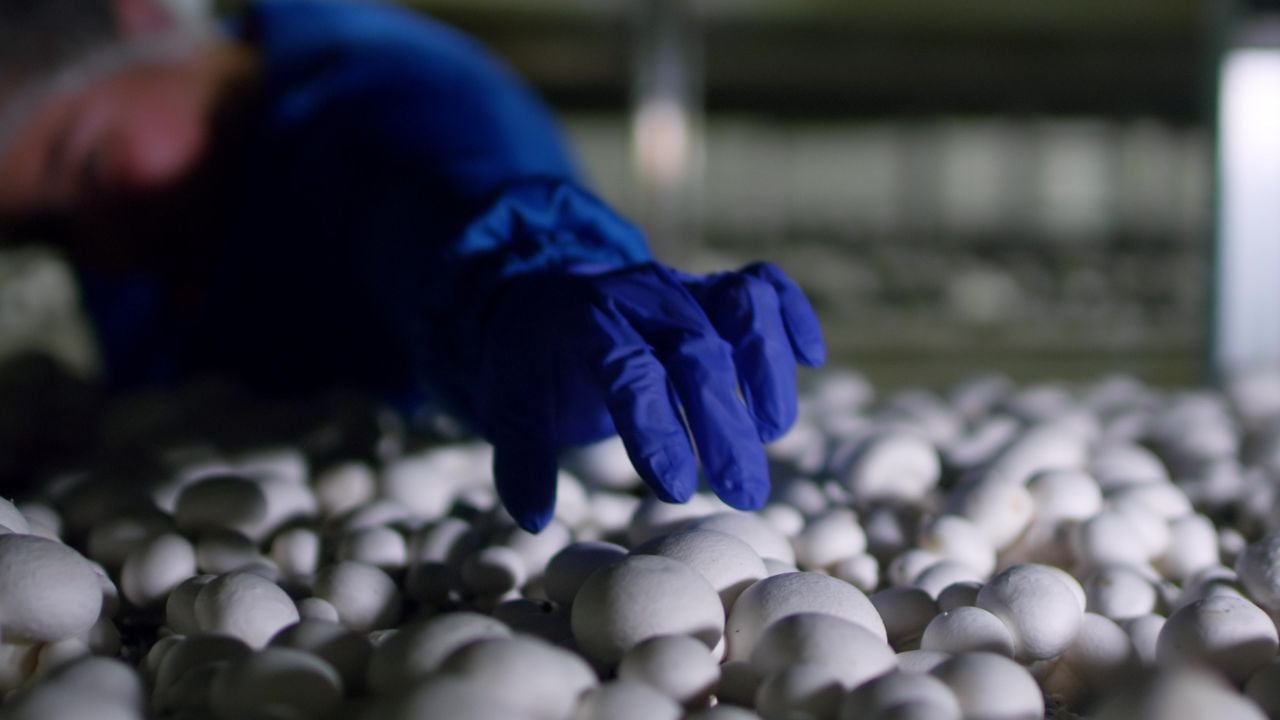
6 Things That Happen Inside a Pennsylvania Mushroom House

If mushrooms are going into your stuffing this week, they took a lot more work to grow than the celery did.
Most of that work happens in the dark.
This is what happens inside Pennsylvania’s mushroom houses.
1. Spawn Run
Penn State Extension outlines the general practices of commercial Agaricus mushroom growing, and individual farms may differ.
Once the compost is made, a mushroom house holds it warm, between 75 and 77 degrees, for what growers call the spawn run, when the fungus spreads through the compost.
A complete spawn run usually takes 14 to 21 days.
Penn State Extension says humidity should stay high so the surface of the compost doesn’t dry out.
2. Peat Casing
After the spawn run, a mushroom house covers the compost with a layer called casing.
Penn State Extension says most growers use sphagnum peat moss for it.
Casing supports the mushrooms and makes up for water the compost loses to evaporation.
Until the first mushrooms form, the house holds the compost at spawn-growing temperatures, so you shouldn’t picture the warmth ending when the peat goes on.
Harvest begins 15 to 21 days after the casing goes on.
3. Pinning Temperatures
During pinning, when tiny mushrooms called pins start to form, a mushroom house holds its air at 60 to 66 degrees.
Fresh air comes in during pinning too since the house has to manage carbon dioxide.
Psst! How much do you know about mushroom farms? Flip each card and see if you can ace it.
4. Flushes and Breaks
Mushroom houses harvest in waves that growers call flushes or breaks.
Each wave runs on a 7 to 10 day cycle.
Pickers cover the room over 2 to 4 days of it.
Growers take three to four breaks from one crop.
5. Picking by Hand
Mushrooms for the fresh market are only harvested by hand, Penn State Extension says, and they’re picked at a time before the cap becomes soft.
Doing it well takes months of training, a mushroom-farming guide says.
Mushrooms can double in size in a day.
Farmers and shoppers both favor medium to large mushrooms.
6. Steam-Off
When a house becomes unproductive, the grower usually ends the crop.
Then comes the steam-off, which holds the compost at 140 to 150 degrees.
That takes anywhere from 8 to 24 hours.
Penn State Extension says the spent compost should leave the farm.
Pennsylvania’s Lead in the Numbers
The USDA’s August 2026 report says Pennsylvania accounted for 74 percent of the volume of Agaricus mushrooms, the common white and brown kind, sold in the 2025-26 season.
That’s 459.5 million of the 619.8 million pounds American growers sold.
It’s also up from 69 percent the season before.
If you compare the two reports, that’s a gain of 5 percentage points.
What the 74 Percent Counts
The 74 percent is Pennsylvania’s share of Agaricus mushrooms by volume of sales, and it covers the whole state, not Kennett Square alone.
Of Pennsylvania’s 2025-26 total, about 403.7 million pounds went to the fresh market and 55.8 million to processing.
The 2025-26 report shows Pennsylvania’s yield at 5.33 pounds per square foot, up from 4.73, on a growing area that fell to 15.9 million square feet.
Chester County’s Share
A 2012 report on Chester County put its mushroom output at 400 million pounds from about 60 farms, roughly half the country’s mushrooms at the time.
USDA’s Pennsylvania mushroom survey credited Chester County with producing 199 million pounds in 2023-24, when growers nationwide sold 642.8 million.
Penn State Extension says southeastern Pennsylvania has the largest concentration of mushroom farms, and they employ nearly 9,300 people.
Kennett Square’s First Mushrooms
Kennett Square’s mushroom industry traces back to about 1885, when a florist named William Swayne began growing mushrooms.
He grew them beneath his greenhouse benches, the township says.
He imported spawn from England, and his early results were promising enough that he built a structure just for mushrooms.
The township says the Swayne family’s success, and high mushroom prices in city markets, inspired others in the region to make mushrooms their main job.
Before the Spawn Run
Mushroom compost’s first phase begins by mixing and wetting the ingredients as they’re stacked in piles.
Phase II follows.
It takes anywhere from 7 to 18 days.
During it, the air and compost are raised together to 140 degrees for at least 2 hours.
That pasteurizes the compost, and the phase eliminates remaining ammonia and simple soluble sugars.
Mushroom Farm Smell
A 2000 study interviewed 601 Chester County neighbors of mushroom farms by phone.
About 23 percent of those neighbors reported a concern of any kind.
Odors topped the list.
Neighbors who knew about a farm before they moved in were less likely to complain.
Neighbors were more likely to complain when a farm changed its operations after they moved in.
If you’re house-hunting near a mushroom farm, ask about it before you sign.
Psst! How much do you know about mushroom houses? Take our quiz and see how many you can get right.
Quiz
Mushroom House IQ
Answer these questions on Pennsylvania mushrooms and mushroom growing. We bet you can’t get them all right. Prove us wrong?
A Hershey, Pennsylvania plant has supplied Chester County compost makers with which leftover?
The Mushroom Drop
Kennett Square's New Year's Eve mushroom event, called Midnight in the Square, takes place in the town square at State and Union streets.
Its centerpiece, a stainless steel mushroom, stands 8 feet tall and 8 feet wide.
The tradition began in 2013, and the mushroom weighs 700 pounds.
3 Things Every Pennsylvania Kid Did in October That Their Kids Never Will
Some childhood traditions have changed over the years.
A few are gone entirely, and you may remember them.
3 Things Every Pennsylvania Kid Did in October That Their Kids Never Will
7 Pennsylvania Dog Laws Owners Break in Their Own Backyard

Colder nights can make you look at your backyard differently.
Here are some dog rules owners may forget at home.
