
8 Arizona Towns That Feel Like They Belong in Another State

One Arizona hillside has 155 stairs and not a single street.
Miners’ families built them by hand between 1910 and 1915 to reach the grocery store and bank.
It’s not the only Arizona town that doesn’t look like Arizona.
These are the Arizona towns that feel like they belong somewhere else entirely.
1. Bisbee
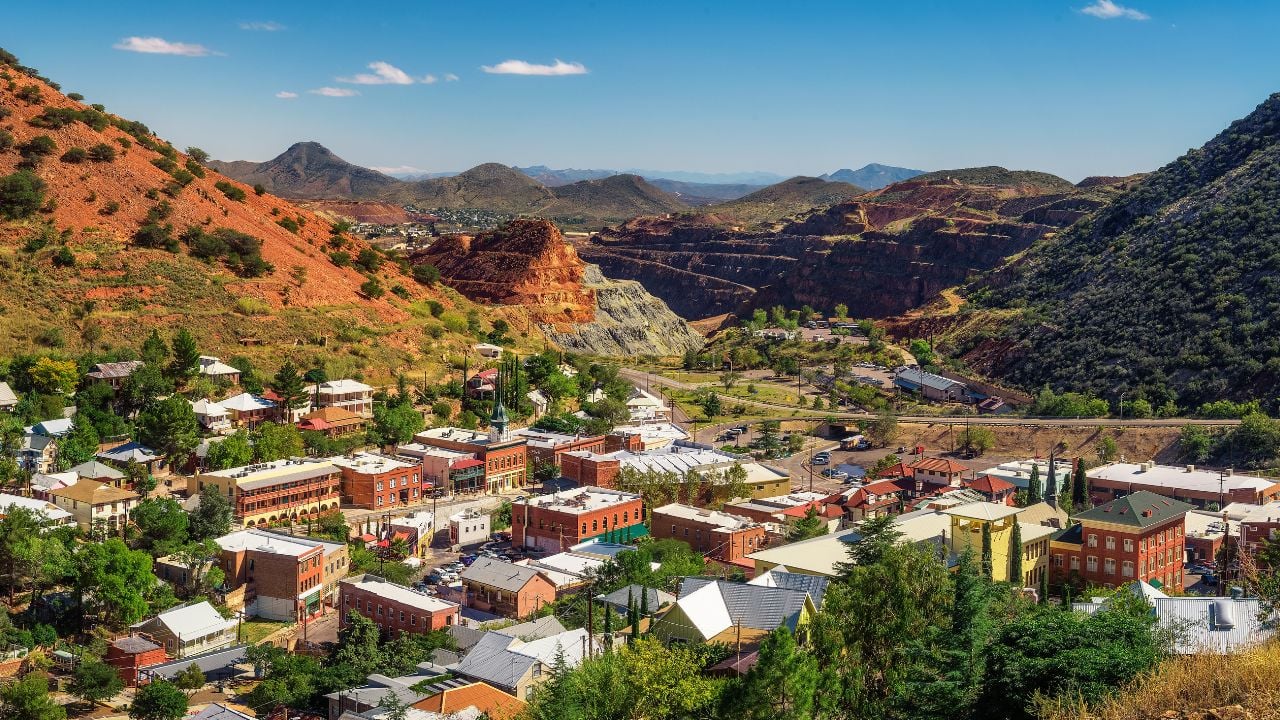
Bisbee climbs the walls of a canyon in the Mule Mountains, its streets laid out for foot traffic before anyone in town owned a car.
Copper, gold, and silver drew the first miners to that canyon in 1880.
The population swelled past 9,000 by 1910.
Victorian houses stack up the hillside in tiers, connected by staircases instead of driveways.
That’s the same terrain San Francisco’s steepest blocks work with.
Then the parallel gets sharper.
Once the mines wound down, Bisbee pulled in the same wave of artists and counterculture transplants that reshaped San Francisco in the 1960s and 1970s.
In 2013, it became Arizona’s first city to approve same-sex civil unions.
A mining camp turned into a hillside art colony with California’s politics attached.
2. Prescott
Prescott rebuilt its downtown in brick after fire tore through the original wooden buildings in the early 1900s.
That rebuild is why the square looks the way it does today.
Elm trees shade the Yavapai County courthouse plaza at the center of it, the same role a town green plays in a Massachusetts village center.
Locals still call the four blocks around it Whiskey Row.
That Massachusetts echo isn’t just architecture.
Prescott took its own name from William H. Prescott, a historian born in Salem, Massachusetts, honored by residents at a town meeting in 1864.
Prescott’s own welcome signs call it “Everybody’s Hometown.”
The city backs that up with something rare for Arizona: Four distinct seasons, including winters cold enough for a fireplace.
Not the desert cliché.
More than 800 buildings sit on the National Register of Historic Places downtown, brick storefronts instead of adobe.
3. Clarkdale
Clarkdale started in 1912 as a company town, built from scratch by the United Verde Copper Company to house its smelter workers.
Engineer T.C. Roberts platted the streets on a numbered grid the following year.
He didn’t invent that system.
Clarkdale’s own town history says the street-naming grid was adopted from Salt Lake City, right down to First North Street and Second South Street.
Utah’s capital, laid out around a temple block a state away, gave a copper camp in the Verde Valley its addresses.
Historians call Clarkdale the first master-planned community in Arizona.
Somewhere in Utah, a city planner would recognize the street signs immediately.
4. Tubac
In 1752, Tubac became home to the first Spanish colonial garrison built in what’s now Arizona.
Adobe walls and red-tile rooflines still line its streets.
That’s colonial Spain, still standing.
Add in the century of Spanish and Mexican rule that followed.
Tubac’s streets show less Sonoran Desert mining camp and more Santa Fe.
It’s the same adobe, just a different state line.
More than 100 art galleries, studios, and boutiques fill those adobe storefronts today.
That’s the same Spanish-colonial-plus-art-colony combination that built New Mexico’s reputation.
Just over 1,500 people call it home now, a fraction of Santa Fe’s crowd.
Psst! Eight Arizona towns above already channel another state. Sort this table by drive time, elevation, or the state each town channels to find two more that didn’t make the list.
5. Jerome
Jerome hangs off the side of Cleopatra Hill more than a mile up, its buildings stacked in tiers instead of spread across a grid.
Copper built the town fast.
By the 1920s, more than 10,000 people lived on that hillside.
Then the mines closed in 1953.
The population fell under 100.
One building, the old jail, slid 200 feet downhill on its own once the mine tunnels underneath it gave way.
It’s still there, just not where it started.
Jerome earned National Historic Landmark status in 1967.
It rebuilt itself around artists instead of ore, the same boom-bust-revival arc that turned Colorado’s old silver camps into hillside art towns.
Why Arizona Fits So Many Other States Inside One
A few thousand feet of elevation is all it takes to turn an Arizona hillside from saguaro country into spruce forest.
An Arizona State University (ASU) geography researcher told Phoenix’s public radio station (KJZZ) that few states carry anywhere near that much topographic swing inside their own borders.
The numbers back that up: Arizona’s elevation runs from 72 feet along the Colorado River near San Luis to 12,637 feet atop Humphreys Peak in Flagstaff, more than 12,000 feet of change inside one state’s borders.
That’s why one state can grow towns that resemble eight different states.
6. Snowflake
Snowflake carries the names of the two Mormon pioneers who founded it in 1878, Erastus Snow and William Jordan Flake.
The name has nothing to do with weather.
It’s a portmanteau of their surnames.
Snowflake grew as part of the same church-directed colonization effort that filled Utah’s valleys a generation earlier.
Not a coincidence.
Families were sent south along the Little Colorado River to plant farm towns built on the same plan.
A Latter-day Saint temple, dedicated in 2002, stands over the town today, the same kind of building that anchors dozens of towns across Utah.
More than 6,000 people call it home now, still inside the settlement pattern their great-great-grandparents platted.
7. Willcox
Willcox built its name on cattle first.
The town was a national leader in cattle production in the early 1900s, the shipping point for herds off the surrounding grassland.
Willcox calls itself home to Rex Allen, the singing cowboy known as “The Arizona Cowboy.”
He was born on a ranch 40 miles away.
Willcox built the rest of his legacy anyway, his ashes scattered at the town’s Railroad Park and a museum of his memorabilia standing across the street.
The town has thrown Rex Allen Days since 1951.
Then came the vineyards.
Willcox now grows roughly 74 percent of Arizona’s wine grapes across land that still looks like ranch country.
Cattle and wine share the same stretch of high plain in Cochise County.
That combination built entire towns in the Texas Hill Country, Fredericksburg among them.
8. Miami
Miami sits on the northeastern slope of the Pinal Mountains.
The copper industry that built the town never bothered flattening the ground first.
Mining families built their houses straight up the hillside instead.
Between 1910 and 1915, the mining company built 155 stairs and 12 ramps, known as the Keystone Stairs, just so those families could walk down to the grocery store and the bank.
No streets ran up there.
Just stairs.
That’s the same vertical geography that shaped Appalachian coal camps in West Virginia, where houses climb a hollow because flat ground was never part of the deal.
Miami’s hillside worked the same way, copper instead of coal.
9 Things That Confuse First-Time Visitors to Arizona
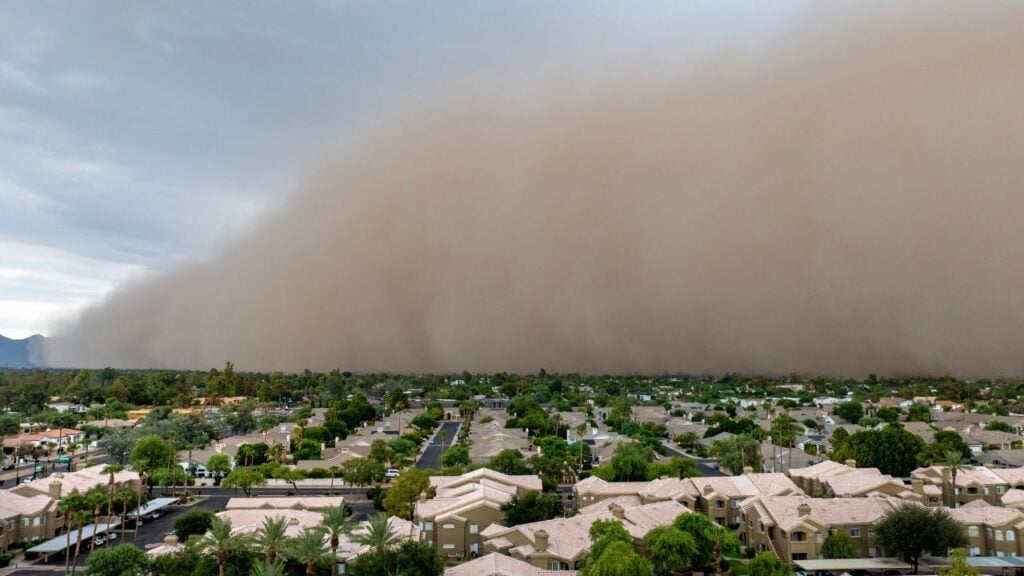
Cactus and sunshine are the easy part of Arizona.
The state also runs on daylight-saving quirks and rules that catch newcomers off guard fast.
9 Things That Confuse First-Time Visitors to Arizona
14 Things That Surprise Snowbirds Who Winter in Arizona
Florida gets all the snowbird headlines.
Arizona counters with backyard citrus ripening in January and a saguaro cactus protected by its own felony law.
