
8 California Parking Rules That Cost Tourists More Than a Ticket

A red and white “Tow-Away, No Stopping” sign hangs over nearly every block near Fisherman’s Wharf in San Francisco, even though the curb underneath it looks like open parking.
It isn’t.
California doesn’t run parking off one statewide rulebook.
Every city writes its own, and guessing wrong can cost far more than the ticket taped under your wiper.
These are the California parking rules that turn a five-minute mistake into a very expensive afternoon.
Note: This is general information, not legal advice. Parking rules, fines, and towing fees are set locally in California and are subject to change.
1. San Francisco Street Sweeping
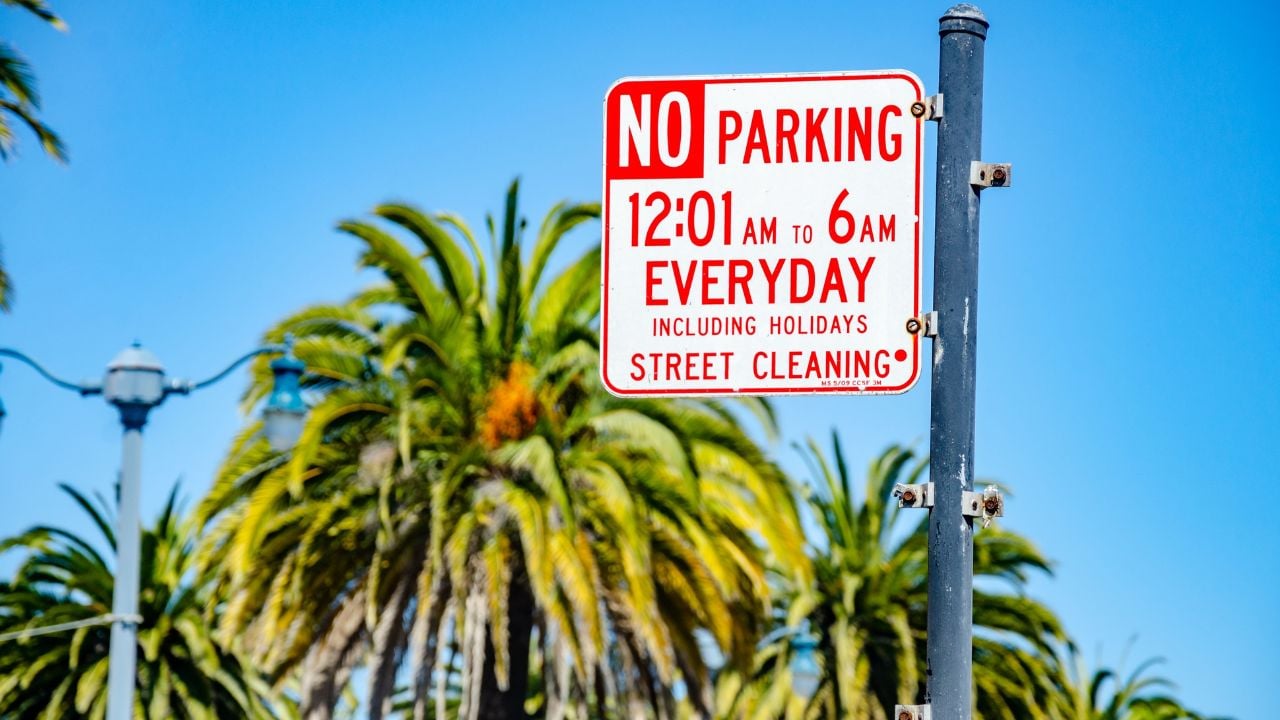
San Francisco enforces its street-sweeping parking rule every single day, and the posted signs rarely say what a visitor expects.
Each block sweeps on its own day and its own two-hour window, sometimes only once a week, with the schedule stapled to a pole between parked cars.
Miss it by five minutes, and the city’s contracted impound lot on 7th Street holds the car until someone shows up and pays in person.
That bill stacks fast.
A first-time tow adds a $335 administrative fee on top of a $317 tow fee, and storage runs $69 for the first day after four free hours, then $82 a day after that.
A second tow costs $385 in administrative fees instead of $335.
No ordinary ticket comes close.
What a San Francisco Tow Totals
San Francisco lists each parking-tow charge on its own line, so the full cost only shows up once someone adds them together.
A first-time tow totals $721: the $335 administrative fee, the $317 tow fee, and one day of storage at $69.
A second tow on the same car brings that total to $771.
Every extra day in the impound lot adds another $82 on top of that.
2. San Francisco Permit Parking
San Francisco layers a second parking trap on top of the first: Residential permit parking (RPP) zones cover neighborhoods near Fisherman’s Wharf, North Beach, and the Mission.
A car without the right color permit gets two hours, no more, before it has to move.
That citation alone runs $102 under the city’s own fee schedule, a steeper base fine than the $90 ticket for parking through a street sweep a few blocks over.
Moving means going at least a tenth of a mile away, not just around the corner and back.
Park in the same spot an hour later, and the rule treats the car as though it never left.
Leave the car there instead, and San Francisco can write a fresh $102 citation every time a parking control officer finds it still in violation.
A family that forgets to move a rental car for a five-day trip near the wharf can rack up several of those citations before they ever pack the suitcases.
Overstay long enough, especially past 72 hours, and the car also becomes eligible for a tow under the city’s separate parking-duration rule, stacking an impound bill on top of whatever RPP citations already piled up.
3. Los Angeles Rush-Hour Zones
Los Angeles turns entire boulevards into extra traffic lanes during rush hour, and a car parked in one of those posted “No Stopping, Tow Away” zones doesn’t get a warning.
Wilshire, Sunset, and dozens of other major streets carry the restriction, with the exact hours set sign by sign rather than one citywide schedule, commonly a stretch of the morning commute and another through the evening rush.
It overrides every other rule posted on that block, including a disabled placard.
That includes cars whose drivers never spotted the sign.
Tow trucks patrol those corridors right as the restriction starts, and 2026 rates from the city’s official police garages put a first hour of towing at $220, plus a separate $115 release fee and roughly $68 a day in storage.
A tourist who parks for a quick lunch at 2:55 p.m. can walk back to an empty curb by 3:05.
4. Los Angeles Preferential Parking Districts
Los Angeles writes about 137,232 preferential-parking citations a year, according to the city’s own transportation department, one of the most common parking tickets it issues.
Los Angeles carves these districts out of residential blocks where street parking runs short, then requires anyone without that district’s permit to move along once the posted hours kick in.
Parking there without one costs $68 under Section 80.58, not far off what an ordinary Los Angeles ticket runs.
The difference shows up when the car doesn’t move.
Officers can write a fresh $68 citation every time they find the same car still sitting there without a permit, so a car left outside a rented house for a five-day trip through one of these districts can rack up citation after citation before anyone realizes a permit was ever required.
One mistake becomes five.
Los Angeles only issues the permit that would have prevented it to residents of that district, so a tourist has no legal way to buy their way out once the car is parked.
Psst! How many of these California parking rules can you call correctly? Flip each card and see how many you get right.
5. San Diego Fire Hydrants
San Diego doesn’t need a painted curb to ticket a car parked too close to a fire hydrant.
City rules ban parking within 15 feet of a hydrant whether or not the curb is painted red, and turning on the hazard lights to “just run in” changes nothing.
There’s no exception and no grace period.
Blocking a hydrant is one of the few parking violations San Diego can tow for immediately, on the spot, rather than mailing a citation and waiting.
Compare that to the city’s newer daylighting citation, for parking too close to a crosswalk: It started at $77.50 when enforcement began in March 2025, then rose to $117 within a month, and even that current fine still doesn’t carry the hydrant rule’s instant tow.
6. Lake Tahoe’s Winter Parking Ban
El Dorado County bans parking on public roads throughout its Lake Tahoe basin communities, including the area around South Lake Tahoe, from November 1 through the following May 1.
The exceptions are streets where posted signs allow it.
Confusion is common because the county also enforces a separate “snow removal condition” ban that can run even when the ground looks clear, and local reporting notes officers ticket many cars every year whose drivers assumed dry pavement meant a legal spot.
That’s the wrong guess.
County code lets officers cite and remove a car parked in violation.
That violation comes with a price tag beyond the citation itself: California caps this kind of infraction at $250 before add-on court fees.
The region’s impound yards, South Lake Tahoe’s police-run lot among them, charge $165 just to release the car, with a storage bill that grows by the day on top of that.
El Dorado County is also direct about what happens if a plow clips a car left illegally in its path: The county’s own snow-removal guidance draws a hard line between a legally parked vehicle and one sitting in violation, and only the legally parked one has any claim to compensation.
A car parked somewhere it isn’t supposed to be gets towed at its owner’s expense.
El Dorado County owes that owner nothing if the equipment scrapes it on the way through.
7. Anaheim’s Disneyland Permit Streets
Anaheim built entire residential permit parking districts around Disneyland to stop park visitors from leaving a car on a neighborhood street and walking in for free.
Anaheim tickets a car without the right permit on one of those blocks $72, and the city can tow it on top of that fine.
Towing adds its own storage bill for every day the car sits at the lot.
The workaround some tourists try, renting a house nearby through a short-term rental listing and using that address for a permit, doesn’t work either.
Anaheim’s own rules bar short-term rental owners and their guests from holding a parking permit at all.
That workaround doesn’t exist.
8. Napa’s 72-Hour Rule
Napa doesn’t let a car settle into one parking space indefinitely, even during a busy wine country weekend.
City code caps a stay at 72 hours, and moving the car doesn’t reset that clock unless it goes at least a quarter mile, or 1,320 feet, from where it started.
Circle the block instead, and the 72 hours keeps counting as though the car never moved.
It’s still counting.
Napa police can cite or tow a car in violation once that window closes.
A rental car left outside a bed-and-breakfast for a five-day trip through the valley can run straight into this rule, and towing plus storage costs far more than any parking ticket the driver was trying to avoid.
Your Rental Car Adds Its Own Bill
California’s rental agencies don’t write a San Francisco street-sweeping ticket or a Los Angeles tow bill, but that citation still finds its way to the renter’s card.
Rental companies route those same city citations through the same processor that already handles their tolls, and the ticket itself is only step one.
Step two costs extra.
Many major agencies add their own administrative fee on top of whatever San Francisco, Los Angeles, or any other California city already charged, commonly $20 to $50 depending on the company.
That charge often lands on a card weeks after the trip ends, long after the tourist assumed a five-minute parking mistake had been forgotten.
9 Things You Can’t Legally Bring Into California From Another State

A family loads up a moving van in Nevada and points it toward Sacramento with everything they own packed in the back.
California’s agricultural border stations run on legal authority many drivers have never heard of, and a few common household items never make it across the line.
9 Things You Can’t Legally Bring Into California From Another State
9 Things Californians Do That Instantly Give Them Away in Another State

Regular gas in California costs about $1.60 more per gallon than the national average, among the widest gaps of any state in the country.
That kind of math rewires a person, and these are the habits that mark someone as a Californian the moment they cross into another state.
9 Things Californians Do That Instantly Give Them Away in Another State
