

8 Harvest Season Habits Ohio Drivers Ignore Until Something Goes Wrong

Ohio law caps farm equipment speed at 25 miles an hour or slower.
On top of that, the orange warning triangle bolted to the back of the equipment has to be visible from 500 feet.
That sounds like a lot of runway. But it’s not as much as many drivers expect.
These are the harvest season habits Ohio drivers lean on that the numbers don’t support.
Note: This is general information, not legal advice. Ohio traffic laws and their penalties are subject to change, so confirm current requirements with the Ohio Bureau of Motor Vehicles.
1. Treating a Farmer’s Wave as Permission to Pass
Ohio drivers wave off a lot of caution the moment a farmer in the cab of a combine waves them past, treating the gesture like a green light.
But it might be illegal.
A pass is only legal on a stretch with enough clear sight distance to finish it and return to the lane before meeting oncoming traffic, whatever the driver in the cab signals.
The wave changes nothing.
Telling a trooper that a farmer waved you by carries no legal weight if the crash report shows a double yellow line and no marked passing zone.
2. The Pull-Over Assumption
Behind a slow-moving tractor, many Ohio drivers lean on the horn and expect the operator to hop onto the shoulder and stop, as if the law owes them the lane.
Ohio’s right-hand lane rule only asks a slower vehicle to drive as far right as practical, and it says flat out that a driver never has to trade away their own safety to let somebody faster by.
No shoulder is required.
Ohio has no statute forcing a farmer to pull off and stop once a certain number of cars stack up behind, the way some other states require.
Drivers who run out of patience there sometimes decide to pass instead, crossing into a stretch of road that was never a safe place to do it.
Waiting out a slow stretch is what the law expects, not a courtesy the operator happens to extend.
3. Riding the Bumper Instead of Backing Off
Ohio drivers close the gap behind a combine or grain cart the same way they would behind a slow car in city traffic, and that’s exactly the wrong equipment to try it on.
The state’s space rule bars following any vehicle more closely than is reasonable and prudent.
It carves out no exception for equipment that looks harmless because it’s crawling along.
Combines don’t brake like cars.
A driver hugging the bumper loses the room to react when the machine drops from 20 miles an hour to a dead stop for a ditch, a driveway, or a sudden turn.
That gap is the only warning a tailgating driver gets.
4. Crossing the Line Without Sight Distance
Ohio drivers’ patience for a posted no-passing zone often runs out once the vehicle ahead is obviously slow.
It’s as if the double yellow line was meant for regular traffic, not a tractor.
Ohio’s passing exception only lifts that ban under two conditions.
The slow vehicle has to be running under half the posted limit, and there has to be enough room to finish the pass and return to the lane before meeting oncoming traffic.
Many hills and curves posted no-passing don’t offer that room at all.
The line stays the line.
Ohio also requires a passer to get back into the right-hand lane at least 200 feet before meeting an oncoming car, a buffer that shrinks fast on a road built for 55 miles an hour.
Slow doesn’t mean safe to pass.
5. Cutting Back In After Passing
Ohio drivers’ first move after passing equipment is often cutting back into the lane fast, before accounting for what’s still attached behind the cab.
A planter, a grain head, or a loaded wagon can trail many feet past the cab, well beyond where the equipment looks like it ends from the driver’s seat.
That’s not the whole vehicle.
Ohio’s overtaking law already requires a full return to the lane before closing in on oncoming traffic, and that standard doesn’t shrink just because the load behind the cab is easy to misjudge.
Clipping a trailing implement counts the same as clipping the tractor.
6. Writing off the Amber Flashers as Decoration
When amber lights start flashing on the back of a tractor, many Ohio drivers write them off as just for show.
They wait for the orange triangle instead, before slowing down at all.
Ohio law requires amber lamps and reflectors on farm machinery precisely so a driver notices the equipment well before getting close enough to read the triangle at all.
They’re not just background noise.
Skipping past that first signal and waiting for the triangle trims away exactly the extra seconds the lights were built to buy.
The fine for missing lights or a missing triangle is the same minor misdemeanor either way.
7. Misjudging How Fast the Triangle Is Closing
Ohio drivers spot the orange triangle on a piece of equipment and assume they have a lot of room to slow down, misjudging how fast that gap closes.
The triangle only has to be visible from 500 feet back, and the equipment behind it is legally built for 25 miles an hour or slower.
That gap closes fast.
A car doing 55 miles an hour is closing on equipment doing 25 at roughly 44 feet every second, which turns that 500-foot cushion into a handful of seconds, not a comfortable stretch of road.
By the time a driver reacts, a lot of that runway is already gone.
What Counts as a Slow-Moving Vehicle in Ohio
Ohio law defines a slow-moving vehicle as a boat trailer, farm machinery, or road construction machinery built to run at 25 miles an hour or less.
Bicycles and animal-drawn vehicles don’t count, even though drivers often lump them in with the same slow-vehicle assumptions.
The orange triangle bolted to the back isn’t optional trim.
State rule spells out its design as a point-up triangle with a fluorescent center and a reflective red border.
It also has to be visible from 500 feet back.
The color fades with sun exposure, so the emblem needs replacing well before it’s too dull to spot at highway speed.
8. Reading a Wide Turn as a Courtesy Pull-Over
A combine swinging wide toward the center line can look, to Ohio drivers, like the operator pulling over to let them by, when the machine is setting up to turn.
Ohio’s turn-signal law requires a driver to signal for at least the last 100 feet before turning, and that applies to farm equipment the same as any car or truck on the highway.
That’s not a lane change.
Large equipment often needs the width of the whole road, sometimes more, to make the turning radius work into a narrow field entrance or driveway.
Passing right as that swing starts turns a slow-speed turn into a highway crash.
Psst! How many of these harvest-season driving habits do you already follow? Run through the list and see where you land.
Rural Roads After Labor Day
Ohio’s harvest season doesn’t run on one single date, but Farm Science Review comes close to marking the start of the rush.
The show opens at the Molly Caren Agricultural Center outside London on September 22, and it pulled in more than 112,000 people last year, many of them farmers deciding what to drive home next.
Farmers drive it home.
That week lines up with when Ohio’s corn and soybean harvest typically shifts into high gear, a stretch that commonly runs from mid-September into November.
Farmers don’t wait for the road to clear before moving equipment between fields.
Ohio’s Farm Bureau posts the same reminder to members every fall: Expect slow-moving machinery on two-lane roads, not only near a visible field.
5 Ohio Towns That Were Booming 40 Years Ago and Sit Nearly Empty Now
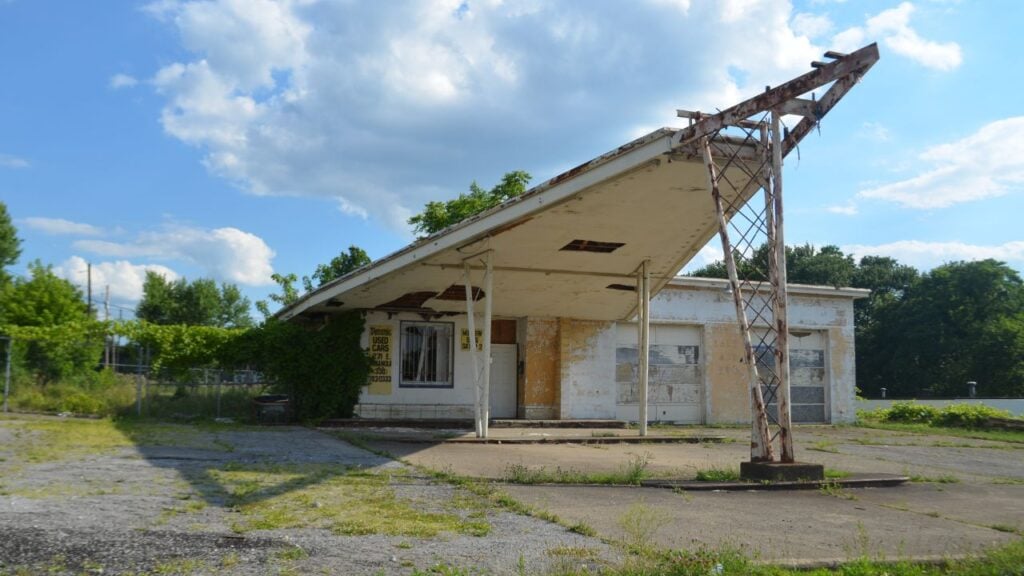
A “Now Hiring” sign hangs faded in a storefront window across from a “For Sale” sign that’s been up for three years.
Forty years ago, that same block had a line out the door on a Friday.
5 Ohio Towns That Were Booming 40 Years Ago and Sit Nearly Empty Now
8 Grocery Store Habits Ohioans Refuse to Give Up, Even in the Age of AI

Just 15% of U.S. shoppers have used an artificial intelligence (AI) tool to help with grocery shopping in the past year.
Ohio’s grocery chains aren’t waiting around for that number to grow.
8 Grocery Store Habits Ohioans Refuse to Give Up, Even in the Age of AI
