

8 Hurricane Season Mistakes Inland North Carolina Families Make

Historically, people who live hours from the nearest beach spent North Carolina’s hurricane season packing for anything but a storm.
But in 2024, more than 2,000 landslides tore through western North Carolina during Hurricane Helene.
That was a tragic wake-up call.
These are the hurricane season mistakes many inland North Carolina families made, and the mistakes new arrivals often get trapped in.
1. Assuming Hurricanes Stay at the Coast
North Carolina catches the fourth-most hurricane landfalls in the country, trailing only Florida, Texas, and Louisiana, and much of that damage never gets near a beach.
Distance from the coast decides less than you’d think.
A University of North Carolina at Chapel Hill study found that 43% of the state’s flooded properties between 1996 and 2020 sat outside the flood zones the Federal Emergency Management Agency (FEMA) marks as high risk.
A home twenty feet outside that boundary line floods exactly like a home twenty feet inside it.
Nobody outside is safe.
2. Skipping Flood Insurance While Inland
North Carolina homeowners away from the water buy flood coverage at a fraction of the rate coastal residents do.
Just 0.5% of homes in the western counties hit hardest by Hurricane Helene carried a policy through the National Flood Insurance Program, compared with more than 40% of homes in the Outer Banks’ Dare County.
Not close.
That gap shows up fast once the water recedes.
Homeowners without a flood policy can apply for up to $30,000 in federal disaster aid, a fraction of the $250,000 a flood policy covers.
What a Standard North Carolina Policy Skips
North Carolina homeowners insurance covers wind and fire damage, but it stops flatly at rising water.
Flood damage only pays out through a separate policy, either the federal program or a private flood carrier, regardless of what FEMA’s map says about the address.
A homeowner who never spots the word flood on that page still has no flood coverage, whatever the map shows.
3. Waiting on an Evacuation Order
North Carolina families in Yancey County spent the final hours before Hurricane Helene hit waiting for an evacuation order that never arrived.
None came.
County officials posted on social media asking residents to move to higher ground when they were able, wording a four-month investigation later found read as routine rather than urgent. Families caring for young children and frail elderly relatives stayed home, holding out for a directive their leaders never issued.
McDowell County, just southeast of Yancey, issued mandatory and voluntary evacuation orders in time for residents to leave, backed by bilingual flyers urging people out of flood-prone areas.
Many McDowell families left before the water rose. Yancey families never got that choice.
4. Trusting Their Phone for Warnings
North Carolina’s mountain communities lost cell service as Hurricane Helene moved through, and more than 74% of cell sites in the hardest-hit counties were still down two days after landfall.
The alert never landed.
Nobody reads a warning on a dead phone.
Local emergency managers leaned on text alerts and social posts as their main tools, and both go silent the moment a tower loses power.
A battery or hand-crank National Oceanic and Atmospheric Administration (NOAA) weather radio doesn’t need a cell signal to keep working.
Psst! Inland doesn’t mean immune. Check off what your household already has covered.
5. Running the Generator Too Close
North Carolina families reach for a portable generator the moment the power goes out, and many set it up in the wrong spot.
The U.S. Consumer Product Safety Commission (CPSC) says a generator needs to run at least 20 feet from a home, with its exhaust pointed away from windows, doors, and vents.
Not the garage.
Not the porch either.
Carbon monoxide has no color and no smell, and portable generators are one of the leading causes of the poisoning deaths that follow a storm.
6. Expecting the Power Back Fast
North Carolina’s mountain counties waited far longer for electricity than the rest of the state after Hurricane Helene knocked out the grid.
Duke Energy counted nearly 703,000 North Carolina customers without power as Hurricane Helene hit, and the company warned upfront that outages in the hardest-hit western counties could run multiple days.
That’s not a blip.
A week without power means no working refrigerator, no phone charger, and no medical equipment that needs an outlet.
ReadyNC, the state’s own preparedness program, recommends a 3-7 day supply of independent essentials for exactly this reason.
7. Ignoring the Well After Flooding
North Carolina’s private wells serve more than 300,000 people in or near the western flood-hit counties.
Testing a private well falls to its owner, not any water utility.
The North Carolina Department of Health and Human Services (NCDHHS) says a flooded well needs disinfecting and lab testing before anyone drinks from it again, not just a few days of running water and trust.
Looks clear. Isn’t clean.
8. Trusting the Interstate as Their Exit
North Carolina’s transportation department reopened more than 99% of the roads Hurricane Helene damaged, but a key route through the western mountains still isn’t whole.
Interstate 40 through the Pigeon River Gorge remains down to one lane in each direction, part of a $2 billion rebuild that isn’t expected to finish until late 2028.
Smaller routes fare worse.
U.S. 176 between Saluda and Tryon still forces drivers onto Interstate 26, and the road linking Chimney Rock, Lake Lure, and Bat Cave won’t be fully rebuilt until 2029.
Closing the Inland Warning Gap
North Carolina is one of several states that use zone-based evacuation planning called Know Your Zone, but the system rarely reaches far inland, even as warming ocean temperatures fuel stronger storms.
The U.S. Geological Survey counted more than 2,000 Helene-triggered landslides across western North Carolina, the kind of hazard those zone maps never flagged either.
Landslide Maps Still Catching Up
North Carolina restarted its landslide hazard mapping program in 2018. Lawmakers had cut its funding nearly a decade earlier under pressure from real estate developers and builders, per the same reporting on the state’s evacuation gaps.
Only nine of the nineteen mountain counties required by that 2005 law had hazard maps finished by the time Hurricane Helene hit in 2024.
Nine counties out of nineteen.
The Swannanoa River crested above 26 feet in Asheville that September, a level it hadn’t reached since 1791.
State geologists are now working through $3 million in new disaster recovery funding to map the 15 mountain counties Hurricane Helene left uncovered. They’re also taking a second pass at the nine counties that already have maps.
Each finished map draws an actual hazard line down a family’s own hillside.
9 Mistakes First-Time Visitors Make on North Carolina’s Blue Ridge Parkway
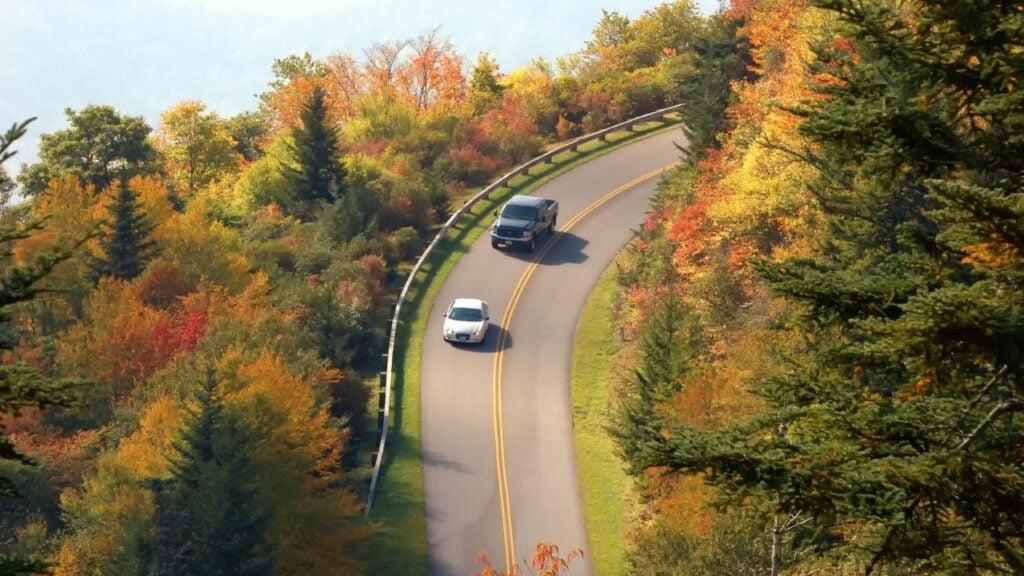
One seven-mile stretch of North Carolina’s Blue Ridge Parkway logged 144 crashes in six years, and many first-time drivers never see a number like that coming.
These are the mistakes that catch first-time visitors off guard on a scenic road that fools more drivers than you’d expect.
9 Mistakes First-Time Visitors Make on North Carolina’s Blue Ridge Parkway
8 North Carolina Barbecue Rules Outsiders Break at Every Cookout

More than 100,000 people crowd Lexington every October for one plate of North Carolina barbecue, and many out-of-staters order it wrong before they even sit down.
These are the barbecue rules that mark a visitor the moment they open their mouth.
8 North Carolina Barbecue Rules Outsiders Break at Every Cookout
