
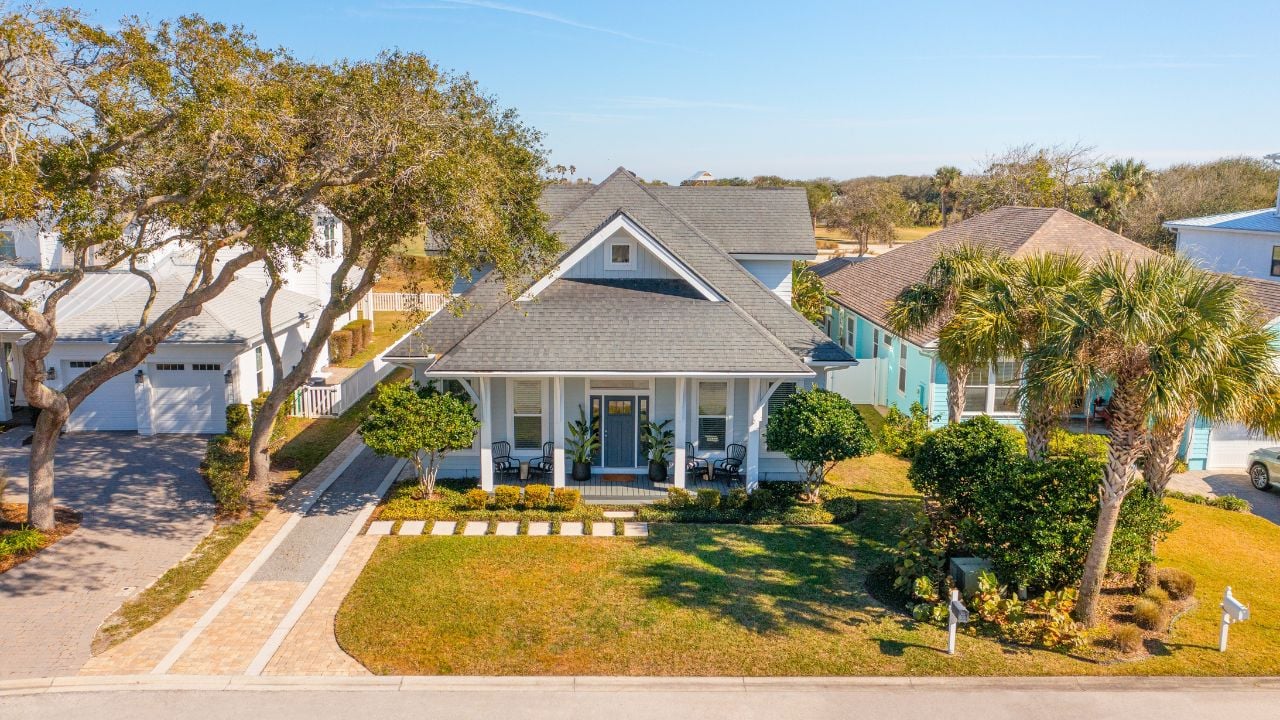
8 Landscaping Mistakes Lowering Florida Home Values in 2026

A pretty yard and a valuable yard aren’t the same thing.
Curb appeal photographs well.
But resale value has to survive an appraiser’s walk-through, a home inspection, and a homeowners association board meeting.
Note: This is general information, not legal advice. Florida statutes and HOA rules are subject to change, so confirm current requirements with a licensed professional.
1. Grading That Traps Water
Florida yards may look flat, but a difference of only a few inches decides where rainwater goes once a downpour hits.
Raised flower beds, mulch berms, and paver borders look tidy from the sidewalk.
Stacked against the house without a slope leading away from it, those same features can dam water right where the slab meets the soil.
Not a good trade.
The U.S. Department of Energy recommends a finished grade that drops about six inches over the first ten feet from a house.
Skip that slope, and Florida’s sandy soil holds rainwater against the foundation through the summer storm season, inviting the kind of moisture intrusion a home inspector writes up in bold.
Fixing your grade before the listing photos go up beats fixing it after an inspection report flags it.
2. Hurricane-Cutting Every Palm
Every summer, crews shave Florida’s palms down to a bare tuft of fronds, and many homeowners request the cut themselves.
The look is tidy.
But the palm is weaker for it.
University of Florida researchers observed that after the severe 2004 and 2005 hurricane seasons, palms pruned this hard were more likely to snap at the crown in high winds than palms with fuller canopies.
Arborists call the resulting thin spot on the trunk penciling, and it becomes the exact point where a storm breaks the tree in half.
A buyer’s inspector or a wind-mitigation surveyor spots a penciled trunk fast.
It reads as a replacement cost waiting to happen, not a mature landscape feature.
3. Planting Big Trees Too Close
A young oak or ficus by the front door looks harmless in a Florida yard the day it goes into the ground.
Give it a decade.
Its root system can spread wider than its canopy, and Florida’s oaks, ficus, and banyans are known for aggressive, shallow roots that lift concrete instead of diving deep.
The International Society of Arboriculture recommends keeping a large shade tree at least 20 feet from a house, with smaller ornamental trees planted no closer than 8 feet.
Ignore that spacing, and roots crack driveways, lift pool decks, and work into sewer lines.
Those are repairs that show up on a home inspection report, and in a buyer’s counteroffer.
A grand oak too close to the slab reads as a future bill to anyone who has priced a root-damaged driveway.
4. Piling Mulch Against the Trunk
Florida’s landscaping crews reach for mulch first, since it holds moisture through the dry months and keeps weeds down between waterings.
Piled straight up the trunk in a cone, that same mulch traps moisture against the bark instead of protecting the roots.
Landscapers call the mistake volcano mulching, and it buries the root flare, the flared base where the trunk meets the soil, under a mound of wet wood chips.
Rot.
Trapped moisture invites decay and pests that stay hidden until the tree declines, or until a home inspector pokes at a soft trunk during a buyer’s walk-through.
A healthy specimen tree in your front bed is worth something on a listing photo.
A tree rotting under a mulch cone is worth a repair estimate instead.
Psst! How much do you know about Florida yards and the history behind them? Take our quiz and see if you can ace it.
Quiz
Florida Yard IQ
Answer these questions on Florida yards, home values, and the plants everyone gets wrong. We bet you can’t get them all right. Prove us wrong?
A popular purple-flowered bedding plant in Florida yards is officially classified as what by the Florida Exotic Pest Plant Council?
5. Keeping a Banned Plant Alive
Brazilian pepper still grows along canal banks in Lee County and other older Southwest Florida yards, planted decades ago for its bright red winter berries.
The state banned it a long time ago.
Florida law prohibits the sale, transport, and cultivation of Brazilian pepper, and the Florida Department of Agriculture and Consumer Services lists it as a noxious weed that crowds out native plants and drops sap that irritates skin.
Several counties require homeowners to remove it on sight, and an unresolved code violation can turn into a lien that a title search catches right before closing.
A seller who never touched the hedge along the canal can inherit a code enforcement letter instead of a clean closing.
Pull it before a listing goes up, not after a buyer's attorney starts asking questions.
6. Choosing the Wrong Plants
Azaleas and hydrangeas fill Pinterest boards, and many new Florida homeowners plant them anyway, a few blocks from the Gulf in Naples or along a canal near Tampa Bay.
Those plants can't handle Florida's heat, humidity, and salt air.
Within a season or two, plants suited to a cooler, drier climate brown out, leaving bald patches in beds that looked full at closing.
Buyers notice bald patches fast.
Florida-Friendly Landscaping guidance points homeowners toward salt-tolerant natives instead, plants like muhly grass, dune sunflower, and live oak that hold up within reach of coastal air.
A yard full of struggling transplants reads as neglect to a buyer, even when you water it every day.
The plant is the problem, not the effort.
7. Racking up an HOA Fine
A homeowners association (HOA) in Florida can fine a resident up to $100 per landscaping violation, and up to $1,000 total for one that drags on, under state law.
Ignore the notices, and that unpaid fine can turn into a lien on the house.
Liens don't disappear at closing.
A title company catches an outstanding association lien before a sale can close, and the association can even move to foreclose over a balance that goes unpaid long enough.
A dead lawn or an unapproved fence line in a deed-restricted community like The Villages can add up to thousands owed by the time a homeowner is ready to sell.
Answer the first notice, and the fine usually stays small.
Ignore it through two listing seasons, and it becomes the seller's problem at the closing table.
8. No Room to Grow
A newly installed Florida bed looks sparse on day one, so many homeowners cram in extra plants to fill the gaps right away, from a St. Petersburg bungalow to a Jacksonville cul-de-sac.
Not by year two.
In Florida's long growing season, shrubs and groundcover reach their mature spread fast, and plants installed shoulder to shoulder turn into a tangled wall within a year, tall enough to cover the windows and the front steps.
Landscape designers plan for a plant's full mature size at installation, not its size in the nursery pot.
That's the spacing principle behind Florida's own Florida-Friendly Landscaping program.
An overcrowded bed also blocks airflow between plants, and Florida's humidity turns that trapped air into a fungus problem that spreads from leaf to leaf.
A landscaper thinning an overgrown bed before a listing photo shoot often pulls out a third of what's there, and the yard reads bigger in every picture, not smaller.
Florida HOA Paint Color Rules
A Florida HOA board can dictate the color a homeowner paints the front door, but only under one condition buried in the paperwork.
Many homeowners never check whether that clause even exists in their own covenants.
Can a Florida HOA Tell You What Color to Paint Your House? The 2026 Rules
Hidden Costs of Florida's No Income Tax
Zero state income tax looks like a raise the moment a new arrival signs the closing papers on a Florida home.
A second stack of bills waits behind that headline, regardless of what a homeowner used to pay up north.
8 Hidden Costs That Wipe Out Florida's No-Income-Tax Advantage
