
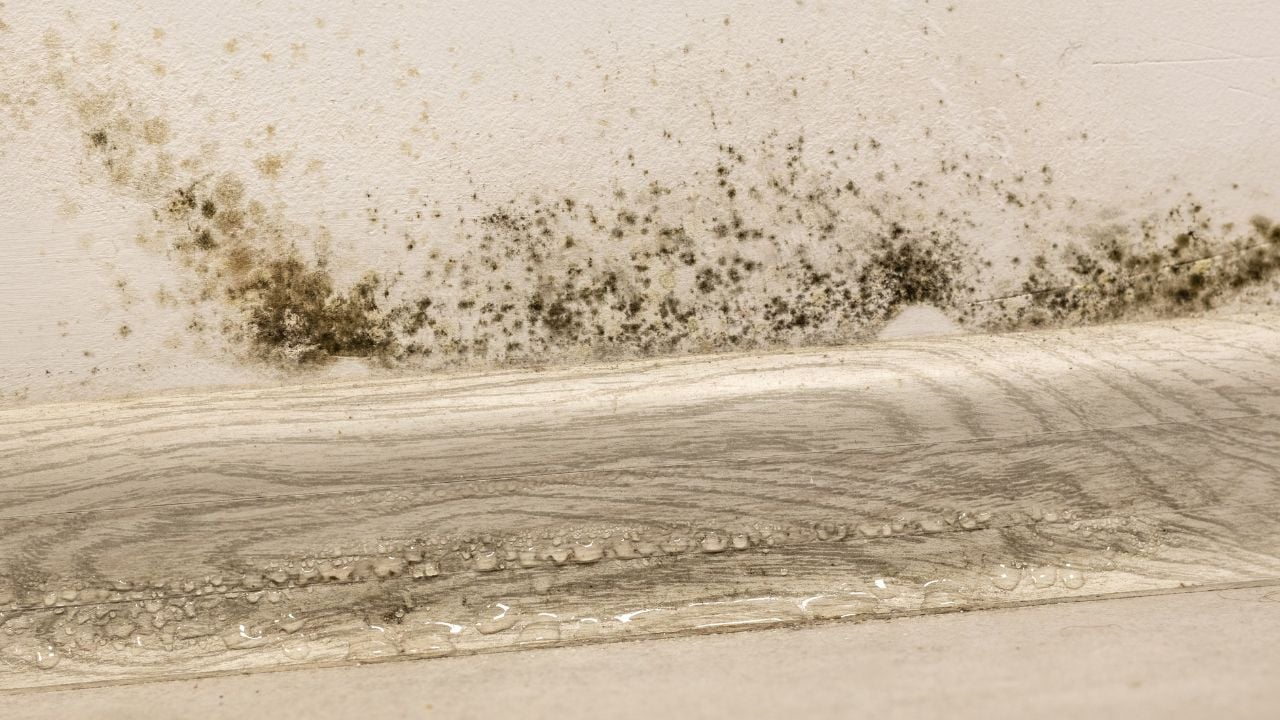
8 Moisture Problems Washington Homeowners Discover Too Late

Rain falls across Western Washington for months at a stretch, and a lot of what it does to a house happens where nobody’s looking.
These are the moisture problems Washington homeowners often discover too late.
Note: This is general information, not legal advice. Building and ventilation code requirements are subject to change, so confirm the current requirements with your local building department.
1. Moss-Covered Roofs
Washington’s shady, wet winters are close to perfect moss-growing conditions, and many homeowners treat the green carpet spreading across their roof as a look rather than a warning.
Moss holds water directly against the shingle mat, which keeps the surface wet long after the rain stops and gives decay fungi a steady place to work.
That’s where the damage starts.
Moss buildup is a known cause of lost shingle granules and roof leaks, and the University of Washington’s Miller Library guidance covers how to remove it safely.
Many homeowners never notice until then.
Cedar shake roofs are especially prone to moss, and by the time it blankets a slope, the deck underneath may already be soaking up water.
That happens on every rainy week of the year.
2. Blocked Attic Vents
Washington homes need a set amount of attic airflow to stay dry, and insulation projects are the most common way that airflow disappears without anyone planning it.
When warm, moist household air can’t escape through the ridge and eave vents, it condenses on the cold underside of the roof sheathing instead.
That soaks the wood and the insulation from above the ceiling.
Nobody notices right away.
A Seattle roofing company that inspects attics for a living has found that once that moisture settles in, it leads to mold and can void a shingle manufacturer’s warranty outright.
Homes built before the current ventilation rules took effect are the most likely to fall short today, even if nothing about the roof looks different from the street.
The Math Behind Washington’s Vent Rule
Washington’s residential code sets attic ventilation at a minimum of one square foot of net free vent area for every 150 square feet of attic floor.
For a 1,200-square-foot attic, that works out to about 8 square feet of vent area.
Contractors typically balance that vent area between low vents near the eaves and higher vents near the ridge, though the code’s base ratio doesn’t dictate the exact split.
Add a layer of insulation without adding vent area to match, and that ratio falls out of code even though nothing on the roof looks different.
3. Bathroom Fans in the Attic
Washington’s residential code says exactly where a bathroom fan’s exhaust has to go, and it isn’t the attic.
A contractor pulls a fan off the wall during a remodel and finds the duct dead-ending a few feet into the attic insulation, never reaching the outside air.
The plywood underneath is often black with mold by the time anyone looks.
Every shower and load of laundry pushes more humid air into that dead-end duct, and the moisture has nowhere to go but into the wood around it.
Many older homes ignore it.
4. Damp Crawlspaces
Damp, moldy crawlspaces are common under Washington homes with a high water table, leaky plumbing, or poor drainage.
Washington State University’s Energy Program has documented the pattern statewide.
Nobody checks first.
The space sits below the living area, out of daily view.
Mold allergens and structural rot can spread for years before a musty smell, a soft spot in the floor, or a home inspection finally sends someone underneath with a flashlight.
Mold spores from underneath the house can drift up into the living space, and people with allergies or asthma notice it before they ever see it.
Psst! How many of these Washington home moisture myths can you spot? Flip each card and see how you score.
5. Foggy, Rotting Windows
Western Washington mornings often sit humid outside, with outdoor relative humidity commonly running into the 80s and 90s.
That’s not the culprit.
Indoor relative humidity above about 55 percent is what condenses on the coldest surface in the room, the window glass.
Water condensing on the glass runs down and collects on the sill, and over months that moisture works into the wood frame and the drywall around it.
By the time paint bubbles on a windowsill or a musty smell shows up in a bedroom corner, the frame is often already soft.
Mold has usually moved in behind the trim by then.
6. Rotting Rim Joists
Washington homes rest their floor framing on a rim joist that sits directly on top of the concrete foundation, right where rain splash and condensation collect.
Once wood framing generally passes roughly 20% moisture content, decay fungi find conditions to grow, according to research from the U.S. Forest Service’s Forest Products Laboratory.
A rim joist reaches that level far more easily than framing higher up in the house.
That’s the danger zone.
Siding, insulation, or a deck ledger can hide the joist completely, so the wood softens for seasons before anyone finds it during a remodel or a deck repair.
7. Foundations Sitting in Water
Clogged gutters and disconnected downspouts are among the most common reasons water pools right at a Washington home’s foundation, per Washington State University’s crawlspace guidance.
When the ground next to a house slopes toward the foundation instead of away from it, every storm sends rainwater straight to the walls.
Bad grading makes it worse.
The water heads for the crawlspace below instead of draining out to the yard.
Homeowners rarely catch the pattern until a wet crawlspace, a cracked slab, or a musty basement forces a closer look.
That low spot has usually been collecting water for years before anyone traces it back.
8. Old Synthetic Stucco
Washington’s Puget Sound condo boom of the 1990s left many condo buildings wrapped in Exterior Insulation and Finish Systems (EIFS), a foam-backed synthetic stucco.
The material doesn’t breathe.
Early EIFS systems sealed water in instead of letting it drain, and once rain worked past a crack or a poorly flashed window, it had nowhere to go.
A 1998 investigation by the Seattle Times found insurers bracing for more than $100 million in Puget Sound leaky-building claims.
An engineering consultant quoted in that investigation, Randy Hart, put the fix at 20 to 45 percent of a building’s original construction price.
Homeowners in older EIFS-clad buildings often don’t discover the rot until a moisture probe or an opened wall shows soft wood underneath.
The outside can still look perfectly fine.
