
8 Questions California Homeowners Should Ask Before Hiring Any Repairperson

A California homeowner writes a check for half the cost of a new roof before a single shingle comes off the truck.
That check breaks state law.
The legal ceiling on a deposit sits far lower than people expect.
These are the questions California homeowners should ask before hiring any repairperson.
Note: General information only, not legal advice. Contractor licensing rules and contract requirements are subject to change, so confirm the current details with the Contractors State License Board.
1. Does This Job Need a License?
California lets a repairperson skip a contractor’s license on a small enough job.
Until January 1, 2025, that threshold sat at $500.
A change to state law raised it to $1,000 in combined labor and materials.
That’s not much room.
The exemption disappears the moment a job needs a permit, which covers most electrical, plumbing, or structural work in practice.
The exemption also disappears when the repairperson brings in another worker or advertises as a contractor.
A repairperson doing any of those still needs a Contractors State License Board (CSLB) license, no matter how small the price tag reads.
An unlicensed handyperson working legally under that cap still has to say so.
Any ad or sign offering the work has to state plainly that the person isn’t licensed.
A $900 patio repair can go forward with no license at all.
A $1,200 repair can’t, even from the same handyperson on the same afternoon.
2. Are You Licensed?
A homeowner can look up a California contractor’s license in one place, for free, before any money changes hands.
CSLB runs a license lookup tool that shows whether a number is active, expired, or was pulled for discipline.
The same search shows the bond and workers’ compensation status tied to that license, plus any judgments the contractor never paid.
It takes about a minute.
A repairperson who hesitates to give out a license number, or hands over one that comes back to a different name, has already answered the question.
Some pull a license number off a truck or a flyer that belongs to somebody else.
Ask for the number before the estimate, not after the deposit, and check it while the repairperson is still standing on the porch.
3. Does Your License Cover This Job?
A California contractor’s license is never a blanket pass to do every kind of work.
CSLB splits licensing into dozens of separate classifications, from C-39 roofing to C-36 plumbing to C-10 electrical.
A general building contractor holding a B license can’t take the prime contract on a roof-only or plumbing-only job.
Not without holding that classification, or bringing in a subcontractor who does.
License number isn’t enough.
A residential remodeling contractor faces the same wall around electrical, mechanical, and plumbing work.
The license lookup that confirms a number also lists every classification attached to it.
A homeowner comparing that list against the actual job catches the mismatch before a crew shows up unqualified for half of what they’re there to do.
4. Are You Bonded?
Behind every active contractor’s license in California sits a required bond.
CSLB has required a $25,000 license bond since January 1, 2023, up from $15,000 before that.
The bond isn’t insurance for the contractor.
The bond has a limit.
It’s a pool of money a homeowner can file a claim against over defective work or a licensing violation.
Employees can reach it too when they’re owed wages.
A bad job can use up the bond fast, and nothing refills it automatically.
Some contractors let the bond lapse while the license itself still shows active in an outdated printout or an old business card.
Ask to see current proof, not last year’s certificate pulled from a folder in the truck.
Psst! See how many of these you can already check off before you sign anything.
5. Do You Carry Workers’ Comp?
California requires an employer to carry workers’ compensation insurance the moment there’s even one employee on the payroll.
A repairperson hurt on a homeowner’s property without that coverage can leave the homeowner facing the medical bill.
Five CSLB classifications go further and must carry coverage without employees, covering concrete, heating and air conditioning (HVAC), asbestos abatement, roofing, and tree service contractors.
Coverage isn’t optional there.
Those trades carry enough injury risk that the state decided a solo operator still needs coverage.
A roofer working alone on a steep pitch is exactly the case the rule was built for.
Some repairpeople claim they’re covered under a general liability policy instead.
General liability and workers’ comp aren’t the same thing.
Neither stands in for the other.
Ask to see the certificate, not a verbal assurance.
6. How Much Do You Want Upfront?
California caps a home improvement down payment at 10% of the contract price or $1,000, whichever amount is smaller.
That’s the whole rule.
A repairperson who asks for half up front, or a flat few thousand dollars before ordering materials, is already past the legal line.
The cap applies no matter how the repairperson explains the number.
A repairperson who claims the extra covers materials hasn’t changed the math, and neither does a rush job or a busy season.
Payments after that first deposit are supposed to track finished work, not a countdown of days on the calendar.
A homeowner who pays $1,000 down on a $20,000 kitchen remodel has already paid every dollar the law allows before a crew pulls a single cabinet.
The Math Behind California’s Down Payment Cap
A $6,000 fence repair caps the legal down payment at $600, which is 10% of the total.
On a $20,000 remodel, the percentage stops doing the work.
Ten percent would run $2,000, well past the flat $1,000 ceiling, so $1,000 becomes the most any California contractor can collect before starting.
A contractor who collects more than that has already violated state contracting law, regardless of whether the crew finishes the job.
7. Will Changes Be Written Down?
A California repair job almost never goes exactly as bid.
Rot turns up behind a wall, or a part the contractor priced isn’t the part the job needs.
California’s contract law, the same rules that set the down payment cap, treats that added work as a change order.
A change order has to be in writing and signed by both sides before the extra work starts, and not after.
There are no exceptions.
A repairperson who promises to sort out the price later and keeps working anyway has skipped a legal step, not just a courtesy.
A verbal “it’ll run a bit more” holds no weight against an invoice that shows up bigger than the signed number.
Get the new price and the reason for it on paper before anyone picks the tools back up.
8. Can I Still Cancel?
California’s standard rule gives homeowners three business days to cancel a signed home improvement contract, no reason required.
The clock starts on the date printed on the signed contract, not the day work begins.
That date is what counts.
Homeowners 65 and older get five days instead of three, a protection the state extended to seniors starting in 2021.
The window narrows for one category of paperwork: A “service and repair” contract priced under $750 that a homeowner requests on short notice, usually for an emergency fix.
A homeowner who signs that kind of form for a $400 water heater patch waives the wait the moment the contractor starts working.
A $2,500 water heater replacement, written as a standard home improvement contract, keeps the three-day right no matter how urgent it feels in the moment.
Ask which kind of paper is on the table, service-and-repair or standard, before signing either kind.
The size of the job doesn’t waive that right.
Only the label on the paperwork does, so it pays to read that line before signing anything else on the page.
9 California Wildfire Insurance Rules Homeowners Learn Too Late
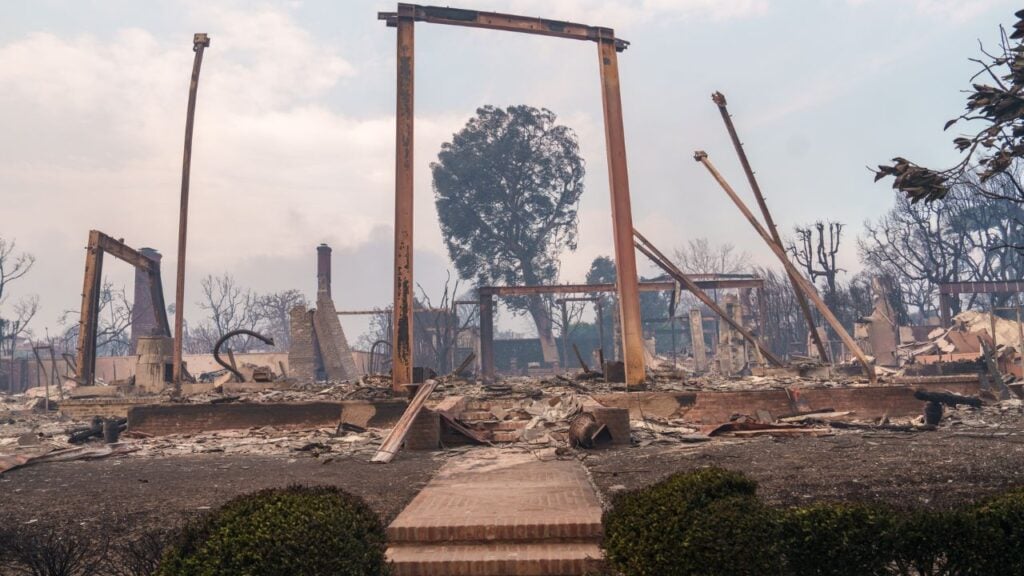
California’s Fair Access to Insurance Requirements (FAIR) Plan, the coverage backstop many high-risk homeowners end up on, won’t pay for a burst pipe or a break-in.
Homeowners who assume the plan works like a regular policy find out otherwise only after they file a claim.
9 California Wildfire Insurance Rules Homeowners Learn Too Late
8 California Lawn and Water Rules Homeowners Get Fined For

Desert Water Agency can fine a Palm Springs homeowner for running a sprinkler within 48 hours of a rainstorm.
Some homeowners never hear about the rule until a fine shows up in the mail.
