
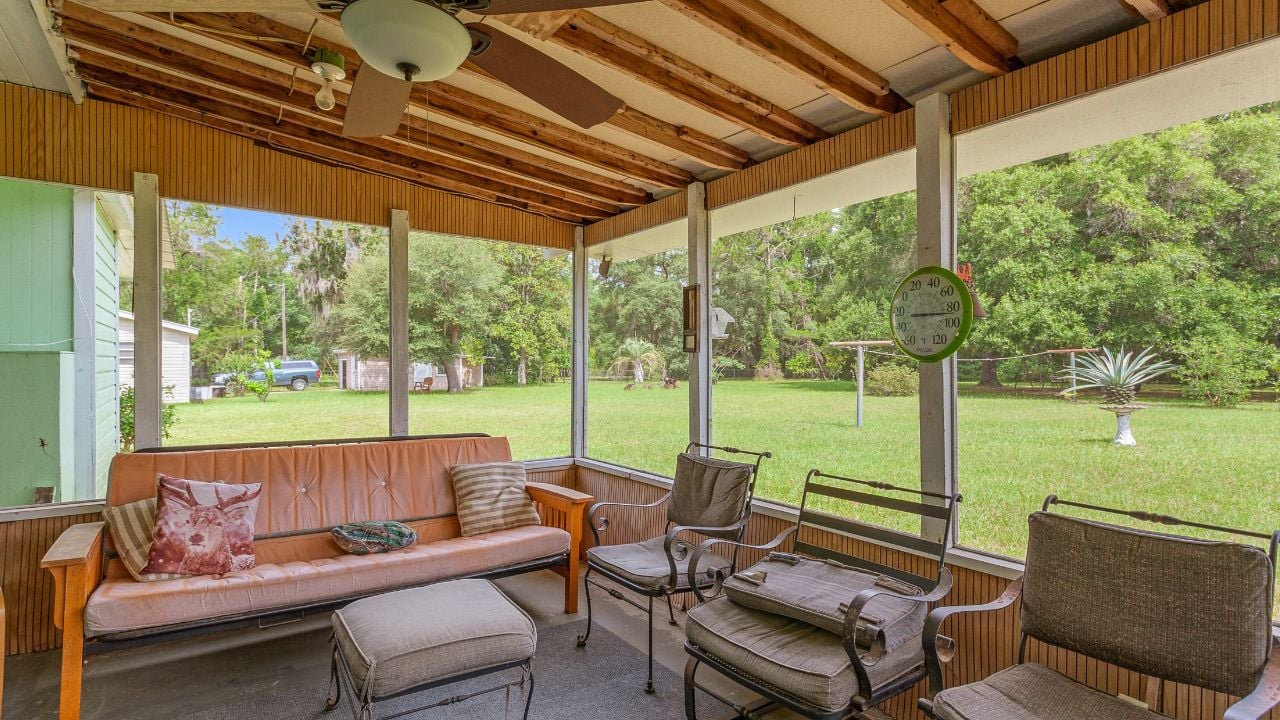
8 Reasons Your Georgia Porch Feels Hotter Than the Rest of Your House

A homeowner outside Macon steps onto her covered porch expecting shade and gets a wall of heat instead.
Her living room, ten feet away, sits at a comfortable 72 degrees.
Her porch might as well belong to a different summer.
These are the reasons your Georgia porch feels hotter than the rest of your house.
1. Your Roof Runs Hotter Than It Looks
Hot enough to fry bacon.
A Georgia porch roof spends the whole day facing the sun with only a layer of shingles between it and the sky.
Most subdivisions built across Georgia, from Gwinnett County to the suburbs outside Columbus, default to the same dark asphalt shingles.
Georgia’s building code sorts most of the state into International Energy Conservation Code (IECC) climate zones 2 and 3, and neither zone requires a reflective “cool roof” the way some hotter, drier states do.
In direct summer sun, those dark shingles have measured as high as 155 degrees.
A porch roof usually sits closer to the people underneath it than the roofline over the rest of the house, so that stored heat radiates almost straight down onto whoever is sitting below.
Few Georgia porches get a metal roof or a lighter shingle to slow any of that down.
2. Your Ceiling Skips the Insulation
Walk from an air-conditioned living room out onto the porch, and you’re leaving more than the cool air behind.
Georgia’s residential energy code, administered by the state Department of Community Affairs, sets a minimum insulation level for the ceiling over every conditioned room in a house.
A porch doesn’t count as a conditioned room.
So the same code that requires insulation over your living room has nothing to say about the boards over your porch swing.
Standard building practice leaves the cavity above a porch ceiling without insulation, unlike the attic ceiling that keeps summer heat from reaching the rooms below.
No insulation.
Many Georgia porches are finished with tongue-and-groove pine boards instead of drywall, a detail borrowed from old farmhouse and bungalow porches across the state.
That thin layer of wood is often the only thing between a rocking chair and a superheated roof deck.
3. Nobody Aimed It at the Shade
A porch runs cooler or hotter depending on one thing most homeowners never think about: Which direction it faces.
Georgia sits far south enough that the summer sun tracks high and hot for months.
A porch facing west catches the lowest, harshest light of the day for hours before sunset.
Older Southern porches, the kind you still find wrapping around farmhouses outside Macon or shading rowhouses in Savannah’s Historic District, were usually built deep, with roof overhangs stretching several feet past the wall.
Depth matters.
A shallow modern porch with a foot or two of overhang lets the sun crawl across the whole floor by early afternoon, while a deep, old-fashioned porch keeps most of that same floor shaded until much later in the day.
4. There’s No AC, Just a Fan
Step inside a Georgia house in July, and the air conditioner is doing real work, pulling both heat and moisture out of the air.
Step back out onto the porch, and none of that is happening.
Central air conditioning arrived in most American homes decades after Georgia’s porches were already standing.
Many houses in Savannah’s Historic District and Macon’s older neighborhoods went up before ducted air conditioning was standard, so the porch and its ceiling fan were once the entire cooling system, not a backup to one.
A ceiling fan can make a person standing under it feel roughly 4 degrees cooler, according to the U.S. Department of Energy, but that’s a trick of moving air across your skin, not an actual change in temperature.
The air itself never budges.
Turn off the fan and walk away, and the porch is exactly as hot as it was before anyone flipped the switch.
Psst! How much do you know about Southern porches and staying cool before air conditioning? Take our quiz and see how many you can get right.
Quiz
Georgia Porch Heat IQ
Answer these questions on porches, heat, and Southern history. We bet you can’t get them all right. Prove us wrong?
Southerners traditionally paint porch ceilings a pale color called “haint blue.” What were they originally trying to keep away?
5. Georgia's Humidity Changes the Math
Georgia's air rarely stays dry for long, and that humidity does more damage on a porch than a thermometer alone suggests.
The mountains of north Georgia run measurably less humid than the coastal marshes around Savannah and Brunswick, where the wetlands pump extra moisture into the air right along with the heat.
Sweat is the body's cooling system, and it only works by evaporating off your skin.
When the surrounding air is already thick with moisture, sweat has nowhere to go.
It just sits there.
The National Oceanic and Atmospheric Administration's heat index chart shows that 100 degrees at 40 percent humidity already feels like 109 degrees, and a muggy afternoon along the Georgia coast regularly runs more humid than that example.
An air-conditioned room strips much of that moisture out of the air as it cools, so a porch never gets the same relief, no matter how many fans line the ceiling.
6. Your Floor Is Storing Heat
Bare feet regret it.
Whatever you're standing on out there has been soaking up sun since sunrise.
Independent testing on decking materials found that with the surrounding air sitting at 86.5 degrees, dark composite and wood boards in direct sun reached as high as 170 degrees, a gap of more than 80 degrees above the actual air temperature.
Concrete slabs and pavers made from Georgia's own red clay brick work the same way, storing heat all afternoon and releasing it slowly for hours after sunset.
That's why a porch floor can still feel warm well into a Georgia evening, even once the air temperature has finally dropped back into the comfortable range.
7. Screens Block the Breeze Too
Screening in a porch solves Georgia's mosquito problem, but it creates a smaller problem of its own.
Fine mesh adds real resistance to moving air, so the same breeze that would sweep straight across an open porch has to push through a barrier first.
Less air gets through.
Older wraparound porches, still common on farmhouses across Georgia, catch a cross breeze from more than one direction at once, since air can move in one side and straight out the other side.
A screened-in porch tucked against one side of a house usually only has one or two directions a breeze can enter from, so on a still Georgia afternoon, the air inside barely moves at all.
8. Your Neighborhood Runs Hotter
Even a perfectly designed porch fights an uphill battle in a Georgia city.
Pavement, rooftops, and driveways all soak up sunlight and radiate it back out for hours, and a dense neighborhood traps that heat close to the ground instead of letting it rise and clear out overnight.
Researchers tracking city temperatures found that Atlanta runs about 6 degrees warmer than its surrounding suburbs on a typical summer afternoon, and some neighborhoods with less tree cover run 10 to 15 degrees hotter still.
Tree cover would help.
A porch next to a driveway or a busy Georgia street picks up extra radiant heat from all that pavement.
8 Kroger Traps That Cost Georgia Shoppers Money

A Decatur shopper scans her rewards card and watches the total drop, certain she caught every deal on the receipt.
She probably didn't catch all of them.
8 Kroger Traps That Cost Georgia Shoppers Money
How Much Does a Nursing Home Cost in Georgia in 2026?

A semi-private nursing home room in Georgia now runs into five figures a year, and a private room costs even more.
There's one piece of good news buried in those numbers.
