
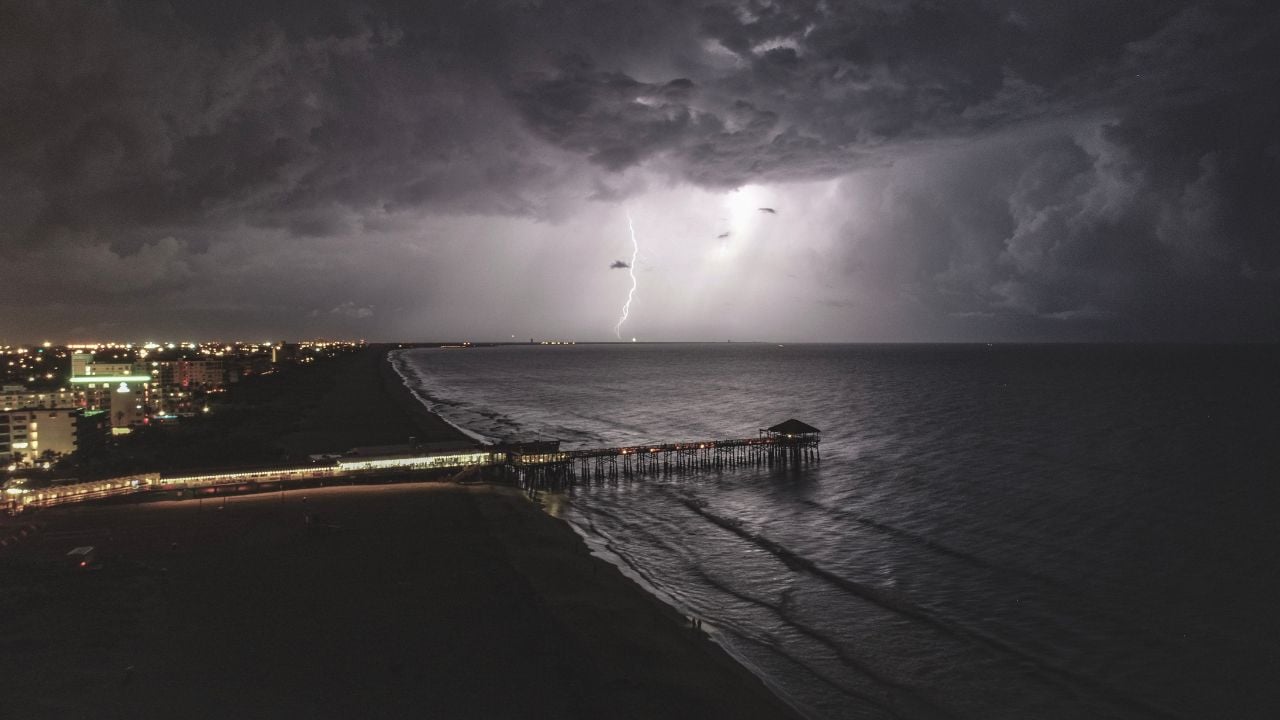
8 Signs a Florida Storm Is About to Wreck Your Afternoon Plans

Floridians can read the sky the way other Americans read a menu.
One glance over the pool fence, and they know whether their cookout will survive the afternoon.
These are the signs a Florida storm is about to wreck your afternoon plans.
1. Cloud Grows a Flat Top
Puffy Florida clouds are harmless right up until one goes vertical.
The whole tower can build in under an hour on a wet-season afternoon.
When a towering cloud stops climbing and spreads out flat on top, the storm inside it has reached full strength.
Meteorologists call that shape the anvil, and it points downwind, toward whoever gets the weather next.
The anvil can stretch for miles while the base underneath stays dark and busy.
Tourists photograph it.
Floridians time it.
Spot one over the tree line, and your window for a beach chair retreat is already shrinking.
2. Wind Flips and Turns Cool
You’re sweating in a dead-still backyard, and suddenly a cool breeze hits your face from a brand-new direction.
That’s not relief.
That’s a gust front, the leading edge of rain-cooled air a storm shoves out ahead of itself, per the National Severe Storms Laboratory (NSSL).
The wind shift and the temperature drop arrive before the first raindrop does.
Sometimes the boundary races miles ahead of the rain, which is how a storm you can’t even see yet steals your napkins off the picnic table.
Floridians feel that cool puff and start gathering the paper plates.
Psst! Before reading on, take our quiz on Florida’s wild weather. Many lifelong Floridians miss at least two.
Quiz
Florida Storm Trivia
Nine questions on lightning, storms, and Florida’s famous skies. We bet you can’t get them all right. Prove us wrong?
3. A Shelf Cloud Rolls In Low
Sometimes the gust front sculpts the sky into a long, dark wedge riding low over the horizon.
Storm chasers call it a shelf cloud, and it forms where cool outflow plows under warm, humid air.
Floridians on the Gulf side see them slide in over the water.
A shelf cloud isn't a tornado, though every visitor asks.
It looks worse than it is, and what follows close behind is the storm itself.
By the time a shelf cloud crosses your beach, the plans are already canceled.
Pack up before, not after.
4. Birds Go Silent
A noisy Florida backyard that suddenly goes still is telling on the weather.
Researchers have found birds respond to falling barometric pressure, changing their feeding and hunkering down before a storm arrives.
Mockingbirds stop performing.
Ibis and gulls drift away from the shoreline.
The feeding frenzy comes first: Researchers watched birds switch straight to eating when falling pressure signaled rough weather ahead.
When the loudest yard on the block goes silent in July, Floridians check the sky and start moving the cushions.
5. Your Thunder Count Shrinks
Old-timers count the gap between the flash and the boom, and the trick holds up.
Lightning doesn't need to be overhead to reach you, which is why the counting matters.
Sound needs about 5 seconds to travel a mile, per the National Weather Service (NWS).
Count 25 seconds, and the lightning sits 5 miles out.
If your count drops below 30 seconds, the strike is within about 6 miles, and that's the distance where the next bolt could involve you.
Shrinking counts mean the storm is headed your way.
That 30-second threshold is the reason coaches clear Florida ballfields while the sky over the outfield still looks fine.
6. A Sun Shower Starts
Rain falling through full sunshine confuses every visitor in Florida.
Those first sunlit drops often blow in from the edge of a storm cell you can't see from your lounge chair.
The drops feel warm and harmless, which is exactly the trap.
Tourists laugh and stay put.
But high wind can throw rain far ahead of the cell that made it.
Floridians know the sun shower is often a preview, and the feature presentation arrives with lightning.
7. Air Smells Sharp
That clean, almost electric smell before the rain isn't your imagination.
Storm downdrafts push ozone from high in the atmosphere down to nose level, sometimes well before the storm itself shows up.
Lightning splits oxygen and nitrogen high in the sky, and some of what recombines is ozone that rides the downdraft to the ground.
People describe the smell as sweet and pungent at once.
Catch that scent on a July afternoon in Florida, and you can beat the radar to the conclusion.
8. Every Local Phone Comes Out
Watch the Floridians around you at a pool, a ballpark, or a Publix parking lot.
Nobody says a word about the weather at first.
When three of them check their phones within the same minute, they're not reading texts.
They're watching a line of red blobs march across a radar app, and they're deciding how many innings or laps are left.
Radar apps have turned every Floridian into an amateur forecaster, and the group verdict is rarely wrong.
The apps replaced the old ritual of standing in the driveway squinting at the horizon.
The squint still works, though.
If locals start folding chairs while the sun's still out, don't argue with them, even if your radar app still shows green.
Fold yours, grab your cooler, and beat the first drops to the car. A Florida sky rarely gives a second warning.
12 Things Only Floridians Understand About Summer

The forecast says a 70% chance of rain every single day this week.
No Floridian panics, because they already know what it means, and a tourist checking the same forecast cancels their whole trip.
12 Things Only Floridians Understand About Summer
15 Florida Summer Traditions That Are Disappearing

Ask a Florida kid today what a fish camp is, and you might get a blank look.
Ask their grandparent, and you'll get a whole afternoon of stories.
