
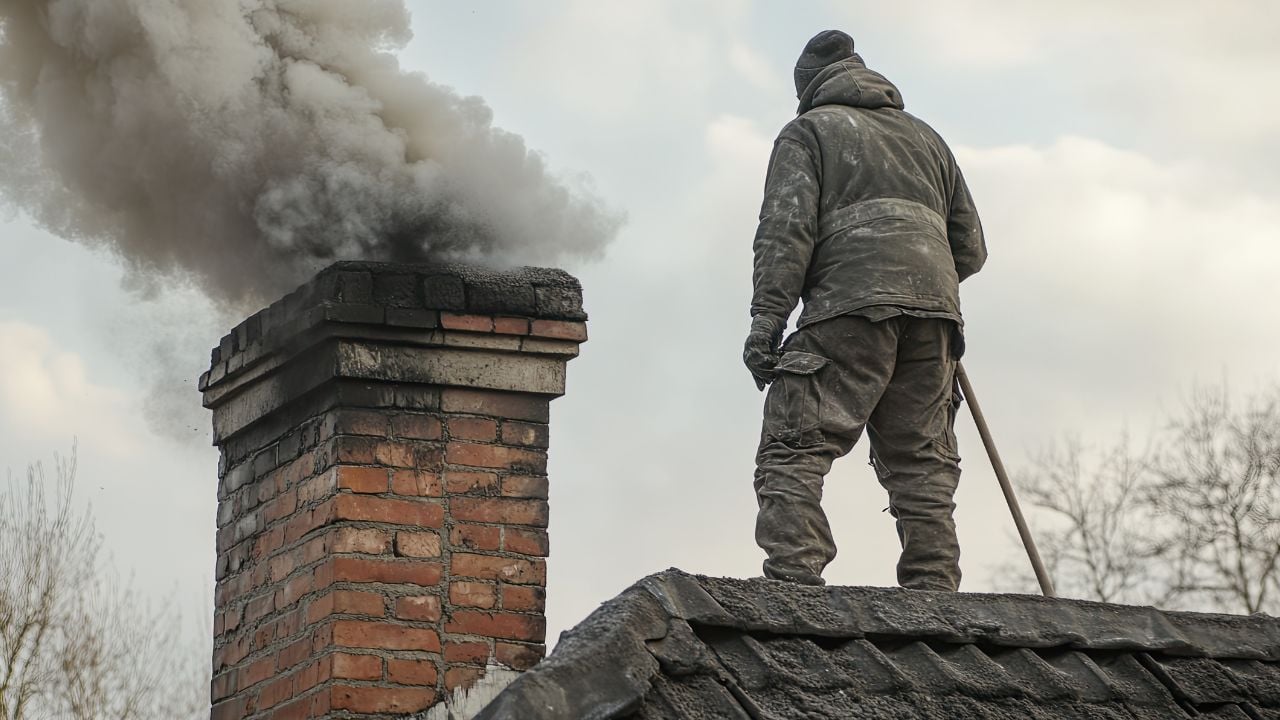
8 Things Chimney Sweeps Wish Mainers Knew Before Their Next Fire

Chimney buildup can start at your woodpile, before you light a single fire.
Burning wood that hasn’t dried enough is one way it happens, and it’s not the only issue you should know about.
Here’s what chimney sweeps wish Mainers knew before their next fire.
1. Creosote at 1/8 Inch
The Chimney Safety Institute of America (CSIA) recommends sweeping a masonry fireplace once sooty creosote buildup reaches 1/8 inch.
If any glaze is present in your flue, the sweeping comes sooner.
CSIA describes creosote as crusty and flaky, tar-like and sticky, or shiny and hardened.
Factory-built fireplaces have even less room, since they need sweeping as soon as any appreciable buildup occurs.
CSIA says the deposit is acidic and can shorten the life of a factory-built fireplace.
Chemicals can’t replace a sweep.
2. Cracked Flue Liners
CSIA says the majority of chimney fires go undetected.
You may never know.
When a fire does burn around 2000°F, the heat can melt mortar, crack tiles, cause liners to collapse, and damage the outer masonry.
An earlier fire in your flue may have left behind joint failure, metal fatigue, or structural cracking.
Oftentimes that damage can’t be seen from above or below.
A Level 1 inspection covers the readily accessible portions of your chimney.
A Level 2 inspection also includes a visual inspection by video scanning or other means to examine the internal surfaces and joints of the flue liners.
Before your first fire this season, you can ask a sweep to look at your flue liners.
3. Firewood Under 20 Percent
Chimney buildup can start at the woodpile because CSIA says burning unseasoned wood keeps the resulting smoke cooler.
The Environmental Protection Agency (EPA) says wood burns best at a moisture content of less than 20 percent.
It also says to test your wood with a moisture meter before you burn it.
What Seasoned Firewood Means in Maine
The Maine Forest Service publishes a firewood chart.
It sorts firewood into green, seasoned, and dry by moisture content.
Green wood runs from 50 to 36 percent moisture on the chart, and seasoned wood runs from 36 to 20 percent.
Dry wood is anything below 20 percent.
The chart defines seasoned wood as wood with a moisture content equal to that of the surrounding air.
So wood in the seasoned range can still read above 20 percent on your moisture meter.
4. Yearly Inspections
The Office of the Maine State Fire Marshal tells you to have your chimney and furnace cleaned and inspected annually by a certified chimney sweep or furnace professional.
Its 2024 annual report lists 52 of 977 structure fires with heating as the cause.
The report adds that among residential fires, heating-related fires are more often the result of poor installation, design, or misuse.
National Fire Protection Association (NFPA) Standard 211 calls for inspecting chimneys, fireplaces, and vents at least once a year.
Rarely used chimneys count too.
Animals may build nests in the flue, and other deterioration may make the chimney unsafe.
You can ask for a Level 1 inspection and a sweeping.
Many chimney sweeps wish more homeowners booked that check before the first fire of the season.
Psst! How much do you know about chimney safety and Maine heating? Take our quiz and see if you can ace it.
Quiz
Fire Season Trivia
Answer these questions on chimneys, firewood, and Maine heating. We bet you can’t get them all right. Prove us wrong?
In 2010, roughly what share of Maine homes used heating oil as their primary heat source?
5. Chimney Caps
The Internet Center for Wildlife Damage Management says a properly installed chimney cap helps keep wildlife from entering through your chimney.
Raccoons, pigeons, and starlings are among the animals it lists as entering chimneys.
A proper cap can also add years to a chimney by deflecting the rain that cracks the crown.
Skip the hardware cloth.
That mesh could block the escape of gases such as carbon monoxide.
Nests matter beyond the mess, since bird nests or other debris blocking the flue can leave your chimney non-functional.
6. Open Dampers and Air Inlets
CSIA says chimney creosote can build faster when a fire gets too little air.
Its list includes closed glass doors, a damper that isn't open wide enough, and closing a stove's damper or air inlets too soon or too much.
Overloading your firebox to get a longer burn time makes the list too.
You want the damper fully open before you light the fire, for safety reasons.
The EPA adds that for most appliances, a smoldering fire isn't safe or efficient.
7. Heating Oil Flues
A chimney isn't only for wood fires.
Heating oil was the primary heat source in just over half of Maine homes in 2023, the Governor's office reported.
CSIA says your oil furnace's chimney should get at least a Level 1 inspection every year from a CSIA Certified Chimney Sweep.
Your oil furnace is subject to long winter run cycles, and the soot that builds up may restrict the flow of flue gases.
Carbon monoxide may spill back into the house instead of going up the chimney if the chimney base isn't properly swept.
The sulfuric acid in oil soot can corrode a stainless steel liner, and failing to have an annual inspection lets that kind of deterioration go undetected.
The Maine Emergency Management Agency also lists having chimneys inspected by a professional every year before cold weather sets in among its carbon monoxide safety tips.
8. Certified Sweeps
The Office of the Maine State Fire Marshal publishes a list of Maine chimney sweep businesses, and it says the office doesn't certify chimney inspectors.
The list includes businesses discovered through a web search or ones that asked to be added, and it doesn't endorse any of them.
The check is yours.
The list tells you to ask each business about its level of chimney inspection certification and where that certification came from.
CSIA recommends that your yearly inspection come from a CSIA Certified Chimney Sweep.
9 Things You'll Only Understand About Maine After a Winter There
Summer visitors see Maine at its best.
Winter shows what living there takes, from the early dark to the chores that come with the cold.
9 Things You'll Only Understand About Maine After a Winter There
5 Maine Town Nicknames Nobody From Out of State Understands

You don't expect to need a translation when someone tells you where they're from in Maine.
Then they use a nickname, and you're left trying to match it to a town you've heard of.
