
9 Home Repairs New Yorkers Put Off That Get Twice as Expensive

New York has the oldest houses in the country, with a median home age of 64 years.
Every American homeowner eventually meets an unexpected repair bill. But decades-old housing gives New York’s homeowners less runway before it happens.
These are the home repairs New Yorkers put off that end up costing double or more.
Note: This is general information, not professional contracting, financial, or insurance advice. Repair costs vary by contractor, home, and region, and are subject to change.
1. Ignoring a Small Roof Leak
A small roof leak on an older two-story in Rochester rarely announces itself with a price tag.
It starts as a faint brown ring on the ceiling, easy enough to explain away as old paint.
New York gives its homeowners more of these moments than any other state: its median home recently turned 64 years old.
Reseal a vent boot or swap a few shingles now, and the fix runs $150 to $1,000.
One more New York winter is enough for that same leak to reach the decking and the roof trusses instead.
Repairs then run $6,000.
Mold remediation can add another $1,500 to $6,000 on top of that if it spreads through the attic, per HomeGuide’s cost data.
Not a small problem anymore.
2. Ignoring Ice Dam Damage
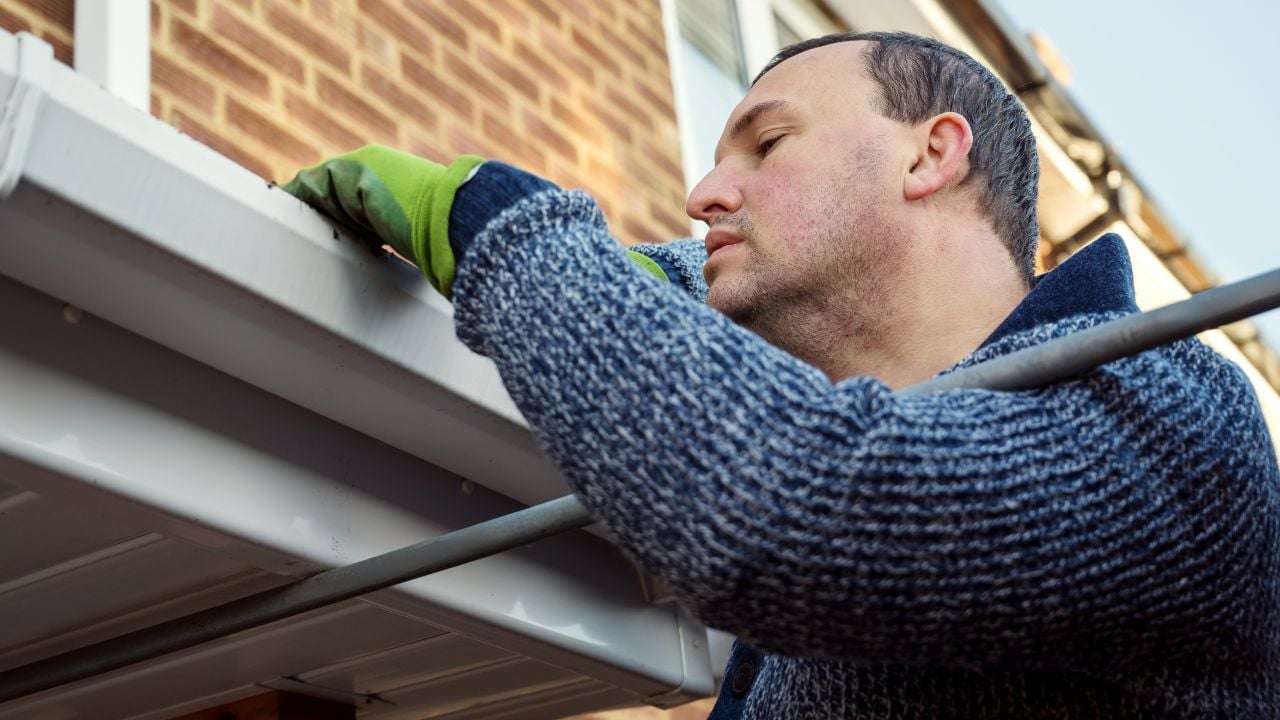
A gutter pulling away from the roofline after a hard winter in Buffalo or the rest of Western New York is easy to blame on age instead of an ice dam.
So is the brown ceiling stain a few feet in from the eaves, or the soft, crumbling wood at the fascia board’s edge.
All three are classic leftovers from an ice dam that already forced water up under the shingles the winter before.
Catching those signs early and repairing the gutter and fascia before the next freeze-thaw stretch costs $500 to $2,600, per HomeGuide.
Write off those same signs as normal wear, and the ice dam returns every freeze-thaw stretch, driving water deeper into the roof deck each time.
HomeAdvisor prices the resulting water damage at $1,300 to $6,200, on top of $400 to $4,000, averaging $1,200, just to get the ice off the roof in the first place.
That’s before anyone patches the ceiling or repaints the wall underneath it.
3. Letting Gutters and Downspouts Clog
Clogged gutters and downspouts on a Westchester County colonial send rainwater straight down the foundation wall instead of away from the house.
Extending or replacing a downspout costs $220 to $625, a job many homeowners can knock out in an afternoon.
Cheap insurance.
Skip it for a few seasons, and that water seeps into every hairline gap in the foundation.
Foundation leak repairs then run $4,500 to $15,000.
Full basement waterproofing can run as high as $18,000, per HomeGuide.
Why New York Insurance Rarely Covers the Difference
New York homeowners insurance almost never pays for the gap between a cheap early fix and an expensive late one.
Standard policies treat a leaking roof, a slow foundation seep, or a clogged gutter’s aftermath as wear and tear, not a covered loss because insurers consider that kind of damage preventable.
Policygenius reports that even a straightforward roof leak claim gets denied once an adjuster decides years of neglect caused it, not one covered event.
That leaves the jump from a $250 downspout fix to a $15,000 foundation repair sitting entirely on the homeowner, not the insurance company.
4. Brushing off a Foundation Crack
A hairline crack in the foundation wall of a Staten Island rowhouse rarely looks urgent the first time someone notices it.
An epoxy or polyurethane injection closes it early for $250 to $800, often in a single visit.
Leave it, and water keeps working through that same crack every freeze-thaw cycle, widening it a little more each winter.
By the time the wall bows or a door stops closing right, the fix is underpinning, which runs $10,000 to $30,000 or more.
That’s a different job entirely.
5. Putting off Chimney Repointing
An older brick chimney in Albany starts shedding mortar in small chunks long before anyone worries about it.
Repointing, replacing that crumbling mortar joint by joint, costs $550 to $2,500 while the damage is still cosmetic.
Wait, and water keeps seeping behind the loose joints, working into the flue liner and the chimney’s structure.
Not cosmetic anymore.
By the time bricks are falling, the job is a full rebuild, which Forbes prices at $8,000 to $10,000.
6. Leaving Rotted Siding Unpatched
Rotted siding on an older farmhouse in the Southern Tier rarely stays a cosmetic problem for long.
Wood holds moisture longest behind gutters and window trim, exactly where homeowners look least.
Left through a single wet season, that hidden rot spreads past the first few boards into the sheathing and framing underneath, and the structural repair runs $3,000 to $10,000 or more, per HomeGuide.
A soft spot or a small crack costs $200 to $800 to patch, if it gets caught before that first wet season.
The siding was never the problem.
The moisture trapped behind it was.
Psst! Want to see exactly how much waiting costs on each of these repairs? Explore the table below and compare the numbers for yourself.
7. Ignoring a Water Heater’s Warning Signs
A water heater tank in a Yonkers basement rarely fails without warning first.
Rust-colored water from the tap, a rumbling or popping sound partway through a heating cycle, or a damp ring at the base of the tank each mean sediment has been corroding it from the inside for years.
Catching any one of those signs early enough often means only a professional flush and inspection, for $110 to $200.
Brush those signs off, and the corroded tank eventually splits or leaks outright, usually overnight and usually into a finished basement.
A new tank then costs $600 to $3,100 to install.
Water damage restoration averages $3,868 on top of that, according to Angi.
That’s the true cost of ignoring the warning signs, paid all at once.
8. Letting Tree Roots Reach the Sewer Line
Sewer lines running under the mature street trees of Syracuse crack more often than many homeowners expect, especially in homes built before plastic piping became standard.
Catch a root intrusion early, and a plumber clears it by snaking or hydrojetting for $200 to $1,400.
Ignore the slow drains and gurgling toilets that come first.
Those same roots keep widening the crack whether anyone notices or not.
Replacing the damaged section runs $2,000 to $10,000 or more, depending on how much pipe has to come out.
Nothing about that crack gets smaller with time.
9. Ignoring the Signs of a Failing Septic System
A septic system on a Suffolk County property gives warning before it backs up into the house.
Slow drains, gurgling pipes, a sewage smell near the yard, or a soggy, spongy patch over the drain field, even in dry weather, are warning signs the EPA lists for a system already in trouble.
Catching the problem at that stage often means only a pump-out, about $410, according to Bob Vila.
Chalk those signs up to an old house being an old house, and solids keep building until they overflow into the drain field, the costliest part of the system to fix.
A full septic tank and drain field replacement then runs $2,000 to $20,000, averaging around $6,000.
Nearly 70% of Suffolk County homes still run on cesspools or septic systems instead of a sewer hookup, according to the county’s own health department, which is why Suffolk now offers grants toward replacement.
Pumping stays the better deal either way.
Psst! How much do you know about New York’s historic housing stock? Take our quiz and see how many you can get right.
Quiz
New York Housing IQ
Answer these questions on New York’s historic homes and housing firsts. We bet you can’t get them all right. Prove us wrong?
New York has the oldest housing stock of any state. What’s the median age of a New York home?
9 Things New York Landlords Can Legally Do That Renters Assume Are Illegal
New York's Good Cause Eviction law spread to more than a dozen cities after it passed in 2024, leading many renters to assume the whole state now tilts in their favor.
It doesn't: landlords still have several legal moves many tenants never see coming.
9 Things New York Landlords Can Legally Do That Renters Assume Are Illegal
4 Things That Cost More in New York City Than Anywhere Else in the Country

A cramped studio isn't the only sticker shock waiting in New York City.
The five boroughs out-charge the rest of the country in a handful of categories that have nothing to do with rent.
4 Things That Cost More in New York City Than Anywhere Else in the Country
