
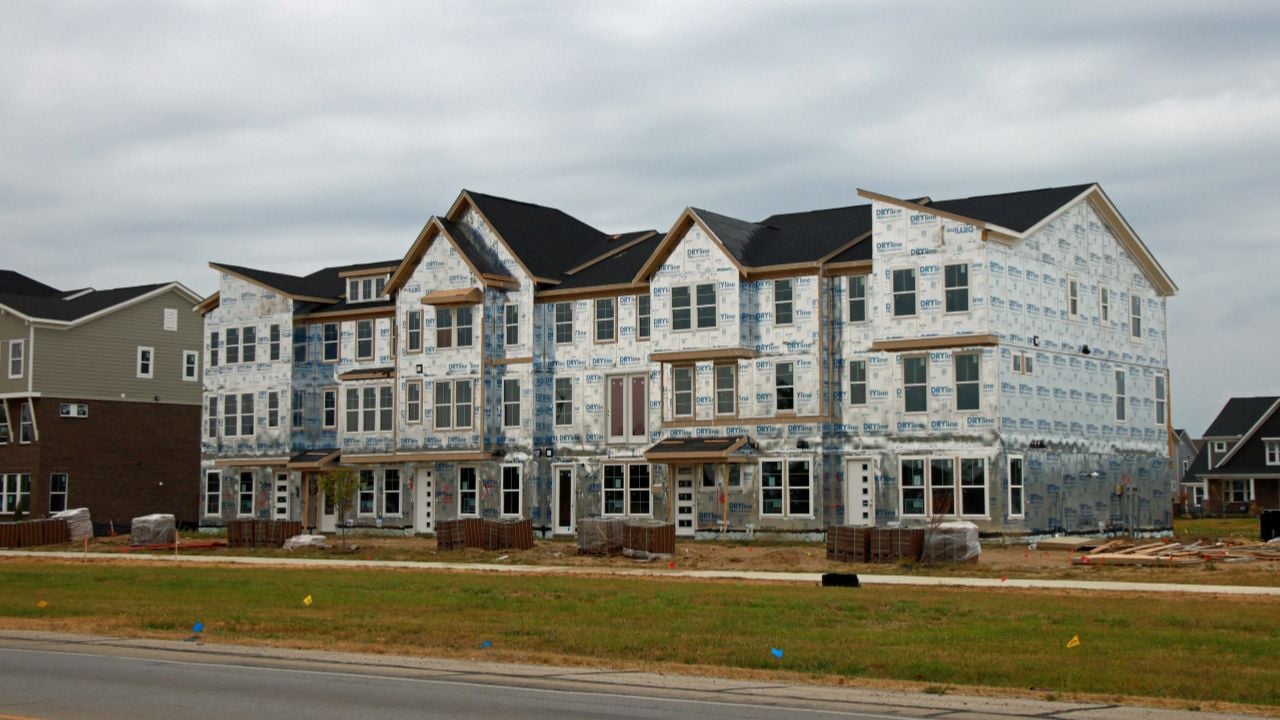
9 Indiana Towns That Look Nothing Like They Did in 1995

Some towns have grown so much that Hoosiers who’ve been away barely recognize them.
These are some of the Indiana towns that look nothing like they did in 1995.
1. Whitestown
In 2008, an Amazon distribution warehouse went up in Whitestown, at the intersection of I-65 and State Road 267.
The warehouse created 2,000 full-time jobs, the Encyclopedia of Indianapolis says.
A Medco Health Solutions automated pharmacy along I-65 added 1,300 more jobs when it opened in 2009.
The town sits in the southeast corner of Boone County, about 22 miles northwest of Indianapolis.
Credit goes to an annexation of 6,500 acres south of the historic downtown, and three large neighborhoods built there account for 77 percent of the town’s population.
If you’d counted Whitestown’s residents in 1990, you’d have found 476 people in 160 households.
The warehouse’s 2,000 jobs outnumbered the town’s 1990 residents more than four to one.
The Census Bureau counted 10,178 people there in 2020, about 21 times the 1990 figure.
Statewide, those thirty years added about 1.2 million people, from 5,544,159 in 1990 to 6,785,528 in 2020, according to the state’s data utility, STATS Indiana.
The Census years closest to 1995 are 1990 and 2000, so the comparisons below start from one of them.
Households followed, from 160 in 1990 to 4,678 in the American Community Survey estimates for 2020 through 2024.
The 1990 figures are in 1990 dollars and the 2020 through 2024 survey figures are in 2024 dollars, so the comparisons don’t account for inflation between those years.
In that survey, the median owner-occupied home was valued at $373,500, against $51,800 in the 1990 Census.
That’s more than sevenfold.
2. McCordsville
McCord Square, McCordsville’s new downtown, broke ground on its 48-acre district in 2022, according to the Daily Reporter in Greenfield.
The first phase includes two four-story buildings with 205 apartments, slated for completion in spring 2024.
The town sits in the northwest corner of Hancock County, just south of Geist Reservoir, and borders both Lawrence and Fishers, the county says.
The town’s 1990 Census profile listed 684 residents in 239 occupied homes.
By 2020, the Census Bureau counted 8,503 people.
You’d need more than twelve McCordsvilles of 1990 to match that.
Households went from 239 to 4,136 in the American Community Survey estimates for 2020 through 2024.
For every household the town had in 1990, it had about 17 in the survey.
Land area rose too.
The town measured 4.70 square miles in 2010 and 6.95 in 2020.
Psst! How much do you know about Indiana? Take our quiz and see if you can ace it.
Quiz
Indiana Pop Quiz
Answer nine questions on Indiana’s history, geography, government and national park. We bet you can’t get them all right. Prove us wrong?
Indiana ratified the 19th Amendment, giving women the right to vote, in which year?
3. Bargersville
The Encyclopedia of Indianapolis says Bargersville grew from 2.2 square miles to 18.77.
Large land annexations between 2009 and 2011 drove that.
The town sits in western Johnson County, 20 miles south of Indianapolis, and multiple strip malls dot State Road 135.
The 1990 Census recorded 1,681 residents in Bargersville, and the 2020 Census recorded 9,560.
Johnson County, where Bargersville sits, had 135,563 acres in farms in 1997, the farm census nearest 1995.
By 2022, the Census of Agriculture, run by the federal Agriculture Department, counted 122,228.
That's about 21 square miles fewer in farms across the county, so you shouldn't credit all of it to one town.
The median owner-occupied home was valued at $56,300 in 1990 and $438,900 in the Census Bureau's American Community Survey estimates for 2020 through 2024.
That's nearly eightfold.
4. Winfield
Winfield was incorporated in August 1993 after a neighboring municipality planned to annex it, the town says.
The town sits between Crown Point and Valparaiso.
Start counting in 1990, and you're starting three years before the town existed.
At incorporation, it covered 12.5 square miles and had an estimated population of just under 1,000.
Indiana American Water brought municipal water to Winfield in 1998.
The 2020 Census recorded 7,181 residents on 12.40 square miles.
By those two figures, the footprint is about the same size.
Its population grew roughly sevenfold.
The town also says the late 1990s and early 2000s brought significant residential growth, along with commercial development on Randolph Street near 109th Avenue.
5. Zionsville
How does Zionsville, home to 30,603 people in 2020, still count as a town?
Zionsville sits in Boone County, northwest of Indianapolis along State Road 334, also called 116th Street, the Encyclopedia of Indianapolis says.
If you lived there in 1990, you were one of 5,281 residents.
Voters in Zionsville and Perry Township approved a merger in 2014, the Indiana Business Journal reports.
The merger adds 15 square miles of land to Zionsville.
The merger also landlocked Whitestown within Zionsville.
The median owner-occupied home was worth $142,100 in 1990 and $587,800 in the Census Bureau's American Community Survey estimates for 2020 through 2024.
That's more than four times the 1990 figure.
Size isn't the test.
Zionsville's Legal Status
Zionsville is a town under Indiana Code, which sorts every municipality as a city or a town.
A town can have any population.
A town with fewer than 2,000 people can't switch to a city at all.
A larger town changes status only if a majority of the voters voting on a ballot question say yes.
Residents start that process with a petition signed by registered voters equal to 10% of the votes cast in the town for secretary of state at the last election.
6. Avon
Avon sits in eastern Hendricks County, about 14 miles from Monument Circle in Indianapolis, the Encyclopedia of Indianapolis says.
The town says it incorporated in 1995, though the encyclopedia gives 1996.
The first Census taken after that, in 2000, recorded 6,248 people in Avon, according to the state's data utility, STATS Indiana.
The 2010 Census counted 12,446.
In 2020, the Census counted 21,474, a gain of 15,226 since 2000.
Avon more than tripled.
Avon is still a town in the Census Bureau's tables.
Hendricks County's farmland fell by 51,805 acres between the 1997 and 2022 farm censuses, from 167,228 to 115,423, according to the federal Agriculture Department.
That's about 81 square miles, and it's a county figure, not an Avon one.
When you drive US-36 through Avon, you're on a corridor the encyclopedia describes as busy and lined with dining establishments and retail outlets.
7. Yorktown
Yorktown pushed its northern edge out to State Road 332 with two voluntary annexations in 2005 and 2006, the town says.
Together they took in more than 2,100 parcels, 3,500 acres and 4,000 residents.
That's about 5.5 square miles.
Head east from Yorktown in western Delaware County, and you reach the western limits of Muncie.
The 1990 Census counted 4,106 people in Yorktown, and the 2010 Census counted 9,405.
By 2020, the Census Bureau's count was 11,548.
By the town's count, the annexations alone brought in about as many people as Yorktown had in 1990.
The median owner-occupied home was valued at $42,300 in 1990 and $186,700 in the Census Bureau's American Community Survey estimates for 2020 through 2024.
8. St. John
St. John has over 20 parks and sits 24 miles southeast of Chicago, the town says.
The 1990 Census counted 4,921 people in St. John, and the 2020 Census counted 20,303.
That's 15,382 more people.
At 20,303 people, St. John is still a town in the Census Bureau's tables.
If you lived there in 1990, odds are you owned your home, since 1,433 of the 1,526 occupied homes were owner-occupied.
The Census Bureau's American Community Survey estimates for 2020 through 2024 found 7,844 households and an owner-occupied rate of 97.4%.
The median home value went from $117,700 in 1990 to $406,300 in that survey, more than triple.
9. Brownsburg
Brownsburg's Hendricks Regional Health hospital opened in January 2018, the Encyclopedia of Indianapolis says.
The town sits in Hendricks County, about 17 miles west of Indianapolis, and a 2011 annexation added 2,200 acres.
That's about 3.4 square miles.
Households nearly quadrupled between 1990 and the Census Bureau's American Community Survey estimates for 2020 through 2024, from 2,841 to 11,345.
Count heads, and you'd find 7,628 in 1990 and 28,973 in 2020.
At 28,973 people, Brownsburg is still a town in the Census Bureau's tables.
A median home that was worth $69,700 in 1990 was valued at $309,400 in that survey, more than four times as much.
The Census Bureau lists the town's land at 11.08 square miles in 2010 and 16.27 in 2020.
That's nearly half again as much ground.
When a Town Becomes a City
Not every fast-growing town stayed a town.
Westfield incorporated as a town in 1848 and as a city in 2008, the city's fact sheet says.
That's 160 years as a town.
Westfield had 3,304 people in 1990 and 46,410 in 2020.
Look either place up in a Census Bureau table today, and you'll see “city” in the label.
Fishers waited until 2015.
Fishers incorporated as a town in 1891, the Encyclopedia of Indianapolis says, and had only 344 people in 1960.
The 1990 Census counted 7,508 people in Fishers, and the 2020 Census counted 98,977.
In 2012, Fishers voters rejected a modified-city option and chose second-class status.
Fishers became a second-class city on January 1, 2015, with its town manager elected as the first mayor.
5 Indiana Basketball Traditions That Baffle the Rest of the Country

Many out-of-staters struggle to see why a whole state stops for a high school game.
The traditions behind that devotion are the part that baffles them.
5 Indiana Basketball Traditions That Baffle the Rest of the Country
10 Things Hoosiers Do That Confuse Everyone Who Moves to Indiana

Hoosiers tend to leave their habits unexplained for the people who move in.
Many Hoosiers would sooner let you work it out than embarrass you.
10 Things Hoosiers Do That Confuse Everyone Who Moves to Indiana
