

9 Michigan History ‘Facts’ Michiganders Learned in School That Aren’t True

“That’s what they taught us in school,” someone says, and the whole Thanksgiving table nods along.
A few of those classroom lessons don’t hold up as well as you’d expect.
These are the Michigan history “facts” many Michiganders learned in school that aren’t true.
1. Wolverine Nickname
Hear ‘Wolverine State’ and you’ll often picture wolverines in the northern woods.
The University of Michigan’s Bentley Historical Library says there has never been a verified trapping of a wolverine inside the state’s borders.
The library dates the first verified sighting of a wild wolverine in Michigan to February 2004.
Where the nickname came from isn’t certain.
One story points to wolverine pelts that passed through Michigan and often bore ‘Sault Ste. Marie, Michigan’ on their shipping labels.
Another holds that Ohioans gave Michigan the nickname around 1835, during a dispute over the Toledo strip.
2. Model T Colors
What color was the Ford Model T?
Many people say black.
In the model’s early years, you could choose from multiple colors, the Henry Ford museum says.
Ford didn’t institute a black-only policy until 1914.
Black paint was inexpensive and durable, and a single color simplified manufacturing.
The black Model T you picture belongs to the years from 1914 until color options returned in 1926.
3. Toledo War
Lots of people call the Toledo War bloodless.
No one died in the war, but you can’t call it bloodless.
On July 15, 1835, an Ohioan stabbed Monroe County deputy sheriff Joseph Wood as Wood tried to arrest him in Toledo.
Wood recovered from the wound.
Michigan’s militia arrested some Ohio officials and fired a few shots over the heads of others as they ran out of the area.
In September 1836, a Michigan convention rejected the proposal to give up the Toledo Strip for part of the Upper Peninsula.
A second convention approved it that December, the Michigan Manual says.
4. Ford and the First Car
Many people credit Henry Ford with inventing the automobile.
The museum that bears his name says Ford didn’t invent the automobile.
Ford was one of the scores of people working in barns and small shops to make horseless carriages.
He read about those other efforts in magazines.
His Quadricycle, finished in 1896, was his first attempt at a gasoline-powered car.
Ford Motor Company, incorporated in 1903, was his third automobile venture.
You can credit Ford with the Model T, which the museum says was designed to be affordable for the average American.
5. Oldest Town
Detroit is often called Michigan’s oldest town.
Antoine de la Mothe Cadillac established the Detroit site on July 24, 1701.
Another town is older.
Father Jacques Marquette founded Sault Ste. Marie in 1668, which the Michigan Manual calls the first permanent settlement on Michigan soil.
If you’ve called Detroit Michigan’s oldest town, you can move the title north to the Upper Peninsula.
The Sault Ste. Marie Tribe of Chippewa Indians says Anishinaabeg gathered for the summers at places like Bahweting, now Sault Ste. Marie.
The tribe says they lived that way for hundreds of years, until Europeans arrived in the 1600s.
6. Ford and the Assembly Line
A lot of credit for the assembly line goes to Henry Ford.
The Henry Ford’s research guide says Ford’s engineers saw that the disassembly line principle used in slaughterhouses could be adapted to building automobiles.
If you credit Ford with the whole idea, you skip over the slaughterhouses his engineers borrowed from.
The Detroit Historical Society says Ransom E. Olds began mass production of his car using a stationary assembly line.
Ford’s version moved.
Ford Motor Company began building magnetos on a crude moving assembly line in April 1913.
The guide says a Model T was being produced every 93 minutes, down from 12½ hours per car under the old stationary methods.
7. Five-Dollar Day
Many people remember Ford’s Five-Dollar Day as a raise.
On January 5, 1914, Ford Motor Company announced it would double its workers’ wages to five dollars a day.
But the pay increase was a profit-sharing plan, not a raise.
If you made $2.30 a day before the plan, you kept that wage.
Meeting all of the company’s requirements added a $2.70 bonus.
The company’s chronology says the $5 day reached women workers in October 1916.
What Ford’s Five-Dollar Day Required
Ford’s Five-Dollar Day came with conditions at home as well as on the job.
Workers had to abstain from alcohol.
Workers couldn’t physically abuse their families.
Workers couldn’t take in boarders.
Workers had to keep their homes clean.
Workers had to contribute regularly to a savings account.
The company set up a Sociological Department to monitor its employees’ habits beyond the workplace.
Ford Motor Company inspectors came to workers’ homes, asked probing questions, and observed general living conditions.
Workers didn’t receive the full bonus until they corrected the problems inspectors found.
8. University of Michigan’s Birthplace
More than a few people think the University of Michigan began in Ann Arbor.
The university says it was founded in Detroit on August 26, 1817.
It reorganized in 1821, but funding never matched the founders’ plans.
After Michigan became a state in 1837, a Board of Regents re-established the university in Ann Arbor.
The university says that in 1930, the Michigan Supreme Court ruled that it had been a continuous legal entity since its founding in Detroit.
The date on the university’s seal later changed from 1837 to 1817.
If you count the university’s age from 1817, you’re counting from Detroit.
Psst! How much do you know about Michigan’s past? Take our quiz and see if you can ace it.
Quiz
Michigan History Quiz
Answer these questions on Michigan history and geography. We bet you can’t get them all right. Prove us wrong?
After the fire of June 11, 1805 leveled Detroit, which of these was among the few things left standing?
9. Mackinac Bridge Record
Some people call the Mackinac Bridge the longest suspension bridge in the world.
The Mackinac Bridge Authority's FAQ says suspension bridges are commonly measured by main span length, the distance between towers.
By that measure, the FAQ puts the bridge 27th in the world.
The ranking has moved.
The bridge stayed among the four longest suspension bridges for more than 40 years, until bridges built since 1998 passed its main span.
The Authority says the bridge's suspended length, 7,400 feet from bent pier to bent pier, is the longest in the Western Hemisphere.
If you've told out-of-staters it's the longest in the world, you can say Western Hemisphere instead.
12 Things From a 1970s Michigan Childhood That Kids Today Won't Believe

Michiganders who grew up in the 1970s have stories that can stop a younger crowd mid-scroll.
Some of them sound more like a movie than a memory now.
12 Things From a 1970s Michigan Childhood That Kids Today Won't Believe
6 Michigan Rules That Decide Who Owns the Beach in Front of a Lake House
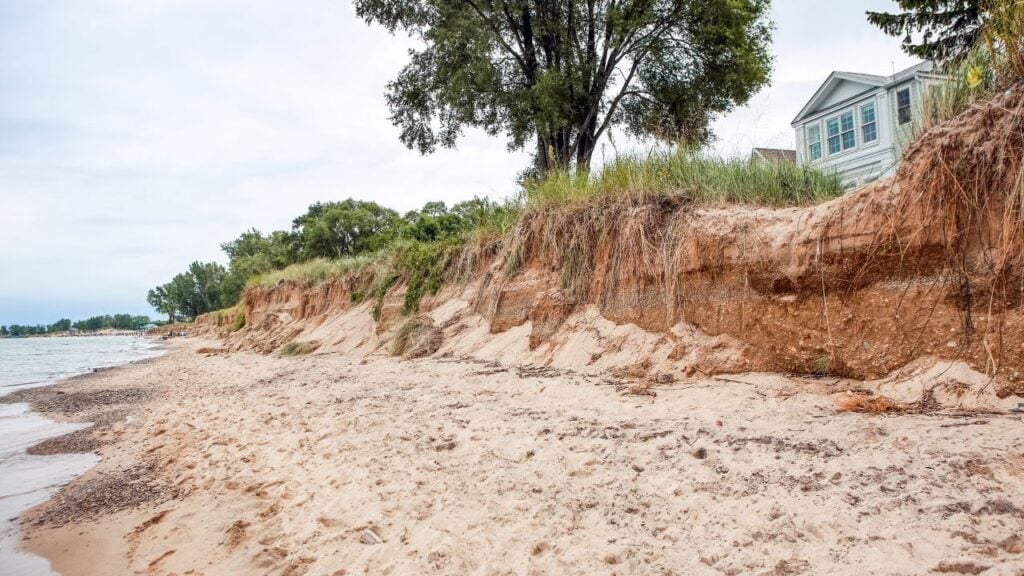
Buying a lake house can feel like buying a private stretch of beach.
In Michigan, that sand may not be as private as your deed says, especially on the Great Lakes.
6 Michigan Rules That Decide Who Owns the Beach in Front of a Lake House
