
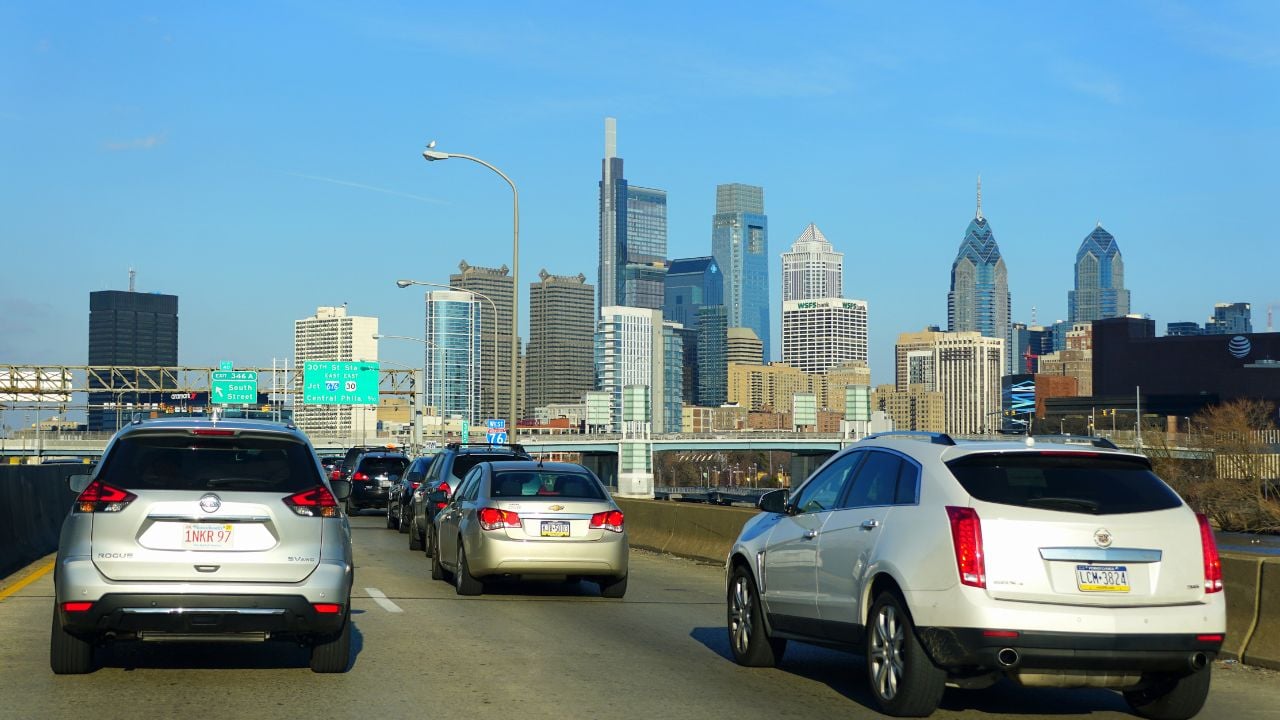
9 Pennsylvania Bridges and Roads Locals Avoid at All Costs

PennDOT recorded more than 2,000 crashes in five years along one Pennsylvania highway.
Commuters still merge onto it every single day because turning back costs time they don’t have.
Other Pennsylvania roads and bridges earn that same kind of dread.
These are the Pennsylvania roads and bridges locals avoid at all costs, and the reasons why.
1. Schuylkill Expressway
The Schuylkill Expressway is one of Pennsylvania’s most congested roads, pushing 163,000 vehicles a day through Philadelphia County alone, plus another 109,000 in Montgomery County.
Locals call it the Surekill Expressway.
Not entirely a joke.
The Schuylkill Expressway opened in 1958, decades before modern interstate design standards existed, so its ramps run short, its lanes run narrow, and its shoulders barely fit a bicycle, let alone a stalled car.
The worst stretch runs from Belmont Avenue to the Conshohocken Curve, where rock-cut banks pinch one side of the road and a steep drop-off pinches the other.
Heavy rain floods the low points near the river bridges because old trees along the eastbound lanes clog the drains almost every storm.
Many Philadelphians ride SEPTA, the region’s transit system, or loop through Conshohocken on local streets rather than touch the Schuylkill at rush hour.
2. Fort Pitt Tunnel and Bridge
Fort Pitt Tunnel and Bridge push crash rates on the Parkway West to four times the statewide average, part of PennDOT’s case for a planned Banksville interchange rebuild.
“I always avoid going that way,” Pittsburgh driver Emily Franco told WPXI, the city’s Channel 11 news station. “I go down Greentree Road or the West End just because I hate getting stuck in the tunnel traffic.”
PennDOT calls this stretch the most heavily traveled corridor in western Pennsylvania, squeezing 100,000 cars onto the Parkway West every single day.
Drivers exit total darkness and hit Pittsburgh’s full skyline in about a second, a view the New York Times once called the best way to enter an American city.
Then they’ve got maybe three seconds to pick a lane for downtown, the South Side, or Station Square.
Big mistake.
Now you’re circling a neighborhood you never planned to visit.
Longtime Pittsburghers get into position before they even enter the tunnel.
3. Roosevelt Boulevard
Roosevelt Boulevard carries a nickname Philadelphia’s own transportation planners don’t dispute: The corridor of death, a title the twelve-lane road earned by accounting for 10% to 13% of the city’s traffic fatalities each year before the pandemic.
Twelve lanes split into inner and outer local drives, and a pedestrian can face a crossing longer than a football field that takes four full light cycles to finish.
Not a quick trip.
Philadelphia installed automated speed cameras at eight Roosevelt Boulevard intersections in June 2020, and speeding dropped more than 91% within the first year, city and parking authority officials said.
Drivers caught going more than 100 mph fell from 70 incidents to 7 over that same stretch, according to PennDOT data shared with the Bicycle Coalition of Greater Philadelphia.
Gov. Josh Shapiro signed a law on December 15, 2023, making those cameras permanent, since losing them meant losing the one thing that had worked.
Philadelphia’s own transportation planners have fielded resident complaints about drivers abandoning Roosevelt Boulevard for parallel side streets to dodge the cameras, often driving just as recklessly a block over.
“Roosevelt Boulevard is consistently the most deadly street in Philadelphia,” said Erick Guerra, a University of Pennsylvania researcher who co-authored a study on the camera program’s impact.
4. Pennsylvania Turnpike
One driver told the Delaware Valley Journal she avoids the Pennsylvania Turnpike like the plague and takes every back road she can find rather than pay the toll, even when the trip runs longer.
The math backs her up.
One bridge on the Pennsylvania Turnpike charges $8.20 a mile, the single highest per-mile toll of any interstate road, bridge, or tunnel in the country, on its short connector to the New Jersey Turnpike.
Statewide, Pennsylvania’s average toll on interstate roads runs $1.73 a mile, the second-highest rate in the nation behind only Virginia, according to a LendingTree analysis of federal toll data.
The Turnpike Commission says that per-mile figure reflects the connector’s short length rather than an unusually high toll.
Pennsylvania Turnpike commissioners voted in July 2026 to raise tolls again on January 3, 2027, a 3.5% hike and the 19th straight year of increases.
Some of that toll money never touches the pavement at all.
That’s money drivers pay whether or not they ever ride transit themselves.
Where Pennsylvania Turnpike Tolls Go
The Pennsylvania Turnpike sends part of every toll dollar to transit systems that have nothing to do with the road drivers are avoiding.
A 2007 law called Act 44 requires the transfer, unrelated to any construction or maintenance project.
The Turnpike has sent more than $8.1 billion to those transit systems since the law took effect.
5. Smithfield Street Bridge
Smithfield Street Bridge has carried traffic across the Monongahela River since 1883, which makes it Pittsburgh’s oldest river bridge and the second-oldest steel bridge still standing in the country.
Engineer Gustav Lindenthal designed its double lenticular trusses, the lens-shaped kind, and they still carry the longest spans of that design left in the United States.
A 1996 renovation raised the bridge’s weight limit from just 3 tons to 23 tons.
Still not much.
Loaded delivery trucks, buses, and heavy equipment have to find another way across the Monongahela, usually the Liberty Bridge or the Fort Pitt Bridge a few blocks over, even though Smithfield Street sits closer to their route.
Pittsburghers on foot or in a sedan cross it constantly and barely think about its age. Anyone driving something heavier plans around it on purpose.
Psst! How much do you know about Pennsylvania’s bridges and tunnels? Take our quiz and see how many you can get right.
Quiz
Pennsylvania Bridges IQ
Answer these questions on Pennsylvania’s bridges, tunnels, and rail crossings. We bet you can’t get them all right. Prove us wrong?
A 2003 tornado tore through a Pennsylvania railroad viaduct that had once been the tallest and longest in the world. What does the site offer visitors today?
6. Vine Street Expressway
Vine Street Expressway is a sunken road that runs about 26 feet below street level, cutting straight through the top of Center City Philadelphia in a trench many drivers don't notice until they're already in it.
Crews had to keep about 80,000 vehicles a day moving through the work zone while they dug the trench and built its four depressed lanes, six local lanes, and 17 cross-street bridges.
The lanes stayed narrower than modern standards even after Vine Street Expressway opened in 1991.
Still not enough room.
PennDOT is still replacing sections of that original concrete decades later, installing precast slabs over an aging stretch that carries well over 100,000 vehicles a day.
Close one cross-street bridge for repair, and Vine Street Expressway backs up for a mile in either direction.
Philadelphians who need to cross town often surface onto Spring Garden Street or Arch Street instead, trading a few stoplights for the trench's chronic backups.
7. P.J. McArdle Roadway
P.J. McArdle Roadway is a narrow, winding road that climbs Mount Washington from the Liberty Bridge up to Pittsburgh's most famous overlook, and the hillside above it keeps giving out.
Falling rock forced the city to shut the roadway down again in February 2026, one of several closures in recent years tied to loose material sliding off the slope above the pavement.
Pittsburgh also closes P.J. McArdle Roadway on purpose for days at a stretch, clearing debris before it can slide on its own schedule instead.
Nobody gets much notice.
Mount Washington residents who need a predictable commute lean on the Duquesne Incline or the longer route around Grandview Avenue, saving the scenic drive for days the hillside behaves.
8. Route 22
Route 22 carries more than 110,000 vehicles a day down a stretch of road through the Lehigh Valley, and its shoulders were never built to handle a breakdown safely.
The left shoulder runs just 4 feet wide in stretches, against a 12-foot standard for a highway carrying this much traffic.
PennDOT recorded 2,050 crashes on Route 22's mainline between 2020 and 2024, with more than 60% of the westbound lanes and 78% of the eastbound lanes running above the statewide average crash rate.
That's not a fluke stretch.
It's most of the road.
Allentown and Bethlehem drivers who grew up on Route 22 still time their trips around it, favoring Route 100, Airport Road, or the older Route 309 whenever the schedule allows.
9. Route 30 and Route 222
Police reported a rise in crashes near the Route 30/222 interchange in Manheim Township after PennDOT closed the dedicated turn lane from eastbound Route 30 to northbound Route 222 in May 2025.
PennDOT is rebuilding the whole interchange for $72 million, a project that won't finish until September 2027.
Weekend closures have sent eastbound Route 30 traffic through North Duke Street in Lancaster city and pushed westbound drivers miles out of their way on Route 222 north.
It's the same detour, many weekends.
Outlet shoppers, Amish horse-and-buggy traffic, and tour buses all compete for the same lanes on an ordinary day, construction or not.
Lancaster County residents who know the area well plan their errands around the interchange entirely, running west on Route 462 or north on Route 501 before they ever touch Route 30 near the outlets.
Locals will keep taking that detour until the interchange's $72 million rebuild wraps in September 2027, not one day before.
9 Pennsylvania Property Tax Breaks Retirees Leave on the Table

Pennsylvania recently raised its property tax rebate to $1,000, the biggest check the program has ever cut.
Nearly 376,000 Pennsylvanians are receiving a rebate check this year, yet eligible retirees still often skip the one-page form that unlocks it.
9 Pennsylvania Property Tax Breaks Retirees Leave on the Table
9 Things Pennsylvania Landlords Can't Legally Do to Renters in 2026
A renter in Scranton gets home from a shift, and her key won't turn.
Her landlord swapped the lock that afternoon over two months of unpaid rent. She broke her lease. He broke the law.
9 Things Pennsylvania Landlords Can't Legally Do to Renters in 2026
