
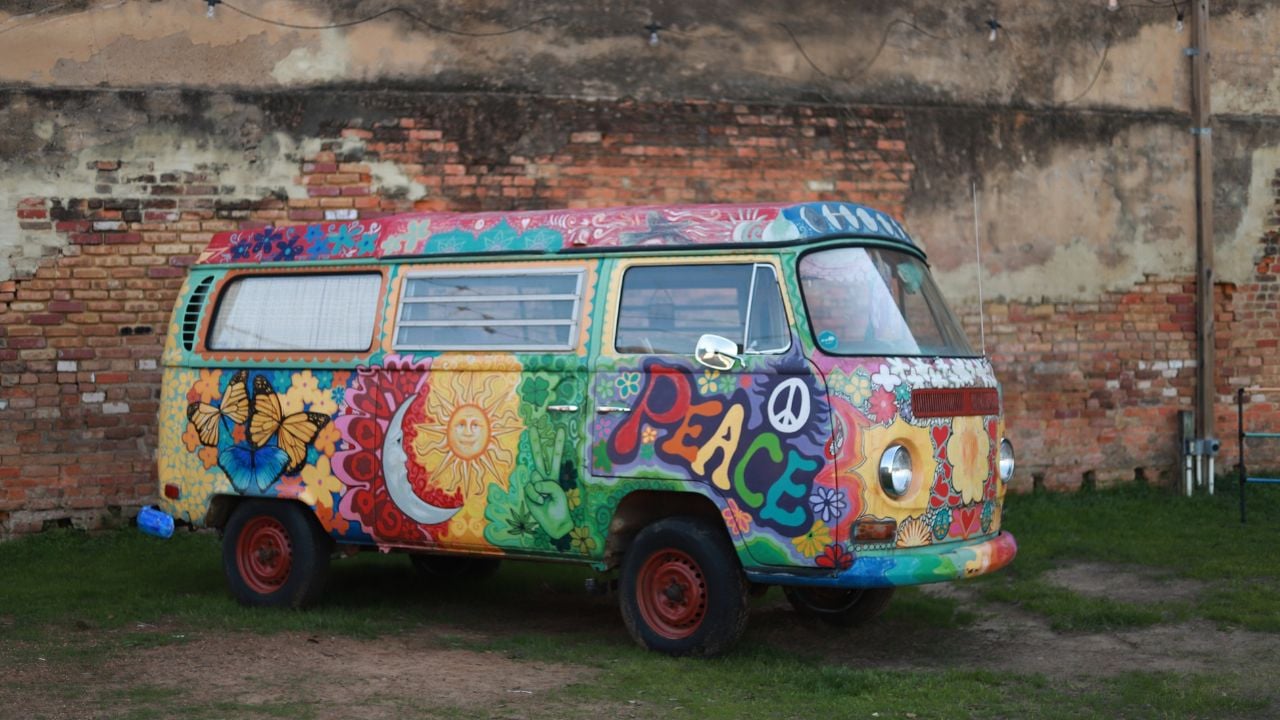
9 Slang Words From the 1960s That Make Young Pennsylvanians Cringe

A black-and-white rerun flickers on during a family dinner in Erie, and somebody’s dad repeats the punchline out loud a half-second before the actor on screen gets there.
He meant it, back in the day.
The kids at the table just look at each other.
These are the 1960s phrases that turn a family dinner in Pennsylvania into a wince.
1. Groovy
Pennsylvania teenagers reached for groovy on transistor radios and in record shops across much of the 1960s, the one word that could describe a new song, a new haircut, or a new pair of bell-bottoms.
The word didn’t start with hippies, though.
Musicians were already calling a great performance groovy back in the 1930s jazz scene, when players talked about locking into the rhythm, or “in the groove.”
A grandparent calls a new haircut groovy at Sunday dinner in Allentown.
The table goes still for a beat, then somebody changes the subject.
Nobody at that table would reach for the word themselves, not even as a joke.
What Counts as 1960s Slang Here
1960s slang on this list means a word the whole country was saying while the decade played out, not necessarily a word invented that year.
Groovy is the clearest example.
It started as 1930s jazz-club slang for a great performance, decades before any hippie touched it.
The 1960s just made it famous enough to become the whole era’s calling card, which is why it earns a spot on this list.
2. Far Out
Pennsylvania coffeehouse regulars and college students leaned on far out all decade long, the default reaction to anything astonishing, strange, or both at once.
Beatniks and jazz musicians used the phrase first, coining the slang sense by 1954 to describe genre-pushing music.
Hippies grabbed it next and stretched it to cover strange, otherworldly, even a hallucinogenic trip.
It stuck to that decade so tightly that language writers now name it as one of the exact phrases that sounds extremely dated to younger listeners.
Say it with a straight face at a Pittsburgh coffee shop today.
Watch the wince.
3. Sock It to Me
Sock it to me became the phrase Pennsylvanians heard shouted out of nearly every television set once Rowan & Martin’s Laugh-In hit the air in 1968.
The variety show turned the exhortation into a national catchphrase, repeated by cast members every single episode.
It got so famous that presidential candidate Richard Nixon agreed to say it on camera that September, a five-second cameo that took the producer six takes to land.
Even Nixon sounded unsure.
A teenager scrolling through old clips online stumbles on Nixon’s cameo and has no idea why the crowd is laughing.
Sock it to me reads as nonsense to that teenager, not an invitation to anything.
4. Fab
Fab landed in Pennsylvania right alongside the British Invasion, short for fabulous and imported to the United States in 1963 with the Beatles’ own nickname, the Fab Four.
Teenagers filling the Civic Arena in Pittsburgh for the Beatles’ only Pittsburgh show one year later already had the word down cold.
It described a record, a haircut, a pair of boots.
Everything got the fab treatment.
Would a young Pennsylvanian call anything fab today?
Almost never, and if they heard it, they’d assume you were quoting an old British sitcom rerun instead of complimenting anything.
5. Boob Tube
Boob tube described the television set sitting in Pennsylvania living rooms across much of the 1960s, U.S. slang from 1959 that welded “boob,” a put-down for a dim-witted viewer, to “tube,” the vacuum tubes that powered every early TV set.
A television columnist for the United Press International (UPI) wire service popularized the phrase in his own resignation column that year, and newspapers across the country reprinted it.
The put-down stuck.
Tell a young Pennsylvanian to turn off the boob tube today, and the phrase doesn’t land as a TV joke at all.
In British and Australian slang, those same two words describe a strapless tube top, the kind that shows up constantly on a teenager’s shopping app.
So the reaction isn’t laughter.
It’s a confused double take, then somebody explaining what the words mean to them now.
Psst! How many of these 1960s slang myths can you spot? Tap each card and see how many you get right.
6. Fuzz
The fuzz became the word Pennsylvania teenagers reached for anytime a patrol car rolled past a house party in the 1960s.
Older than the decade.
Print references to “fuzz” as underworld slang for police go back to 1929, decades before any counterculture teenager used it.
The 60s just gave it a second life as the go-to put-down for authority.
Would a young Pennsylvanian call the police “the fuzz”?
Never, unless they’re quoting an old cop movie for a laugh.
7. Chick
Chick was standard 1960s Pennsylvania slang for a young woman, dropped into casual conversation constantly and without a second thought.
It had already been building steam for decades, moving from 1920s Black slang through 1940s jazz clubs and 1950s beatnik hangouts before the 60s made it mainstream.
Almost every young woman heard the word aimed at her at some point.
The word never fully disappeared, but decades of coverage now flag it as dated at best and patronizing at worst.
Not a compliment anymore.
A young Pennsylvanian hearing an older relative call a woman a chick usually just changes the subject.
8. Flower Power
Flower power showed up on protest signs and record sleeves across Pennsylvania by the back half of the 1960s, the rallying cry of the peace movement.
Poet Allen Ginsberg coined the phrase in a 1965 essay, urging Vietnam War protesters to hand out flowers to police and politicians instead of shouting.
It caught on fast.
Few young Pennsylvanians would use flower power to describe an actual belief.
To them, it’s a costume category, not a cause, the fastest way to signal a decade rather than a movement.
9. A-Go-Go
Advertisers tacked a-go-go onto everything trendy in Pennsylvania by 1960, from sweaters and pajamas to the dance clubs where teenagers went to go-go.
Reading’s own newspaper carried a January 1966 ad for “Hullabaloo Boots” promising “kooky heels and zipper backs” for the Go-Go Getter, proof the suffix had made it from nightclub names onto a Pennsylvania shopping page.
For a while, it worked.
A retro-themed diner in Harrisburg names its milkshake special “Shakes A-Go-Go.”
Young customers read it as kitschy branding, not a genuine description of anything trendy.
Nothing about the suffix reads modern anymore.
How Philadelphia Exported the Decade’s Slang
Pennsylvania didn’t just pick up 1960s slang from somewhere else.
Philadelphia manufactured a good share of it.
The city started it.
American Bandstand broadcast live from a studio on Market Street in West Philadelphia every weekday afternoon, 1957 to 1964, reaching a national audience years before the show ever left the city.
Philadelphia teenagers dancing on camera picked up new phrases first.
The rest of the country picked them up a week later, off the same TV screen.
Philadelphia’s Twist Went National Too
Philadelphia’s dance crazes spread just as fast as its slang.
The city’s own Cameo-Parkway Records pressed Chubby Checker’s version of “The Twist” in the summer of 1960, and the song hit number one twice on the national charts.
Twice over.
Checker, born Ernest Evans, grew up in South Philadelphia before the world knew him by his stage name.
Cameo-Parkway’s Locust Street studio recorded the whole track in about 45 minutes.
The Library of Congress added that recording to the National Recording Registry in 2012.
9 Pennsylvania Property Tax Breaks Retirees Leave on the Table
Pennsylvania recently raised its property tax rebate to $1,000, and nearly 376,000 residents are collecting one this year.
Eligible retirees still skip the one-page form that unlocks it, along with several other breaks sitting unclaimed.
9 Pennsylvania Property Tax Breaks Retirees Leave on the Table
9 Things Pennsylvania Landlords Can’t Legally Do to Renters in 2026
A landlord who swaps the locks on a Scranton renter over unpaid rent has broken the law, whatever the tenant owes.
These are the moves Pennsylvania landlords can’t legally pull on a renter in 2026.
9 Things Pennsylvania Landlords Can’t Legally Do to Renters in 2026
