
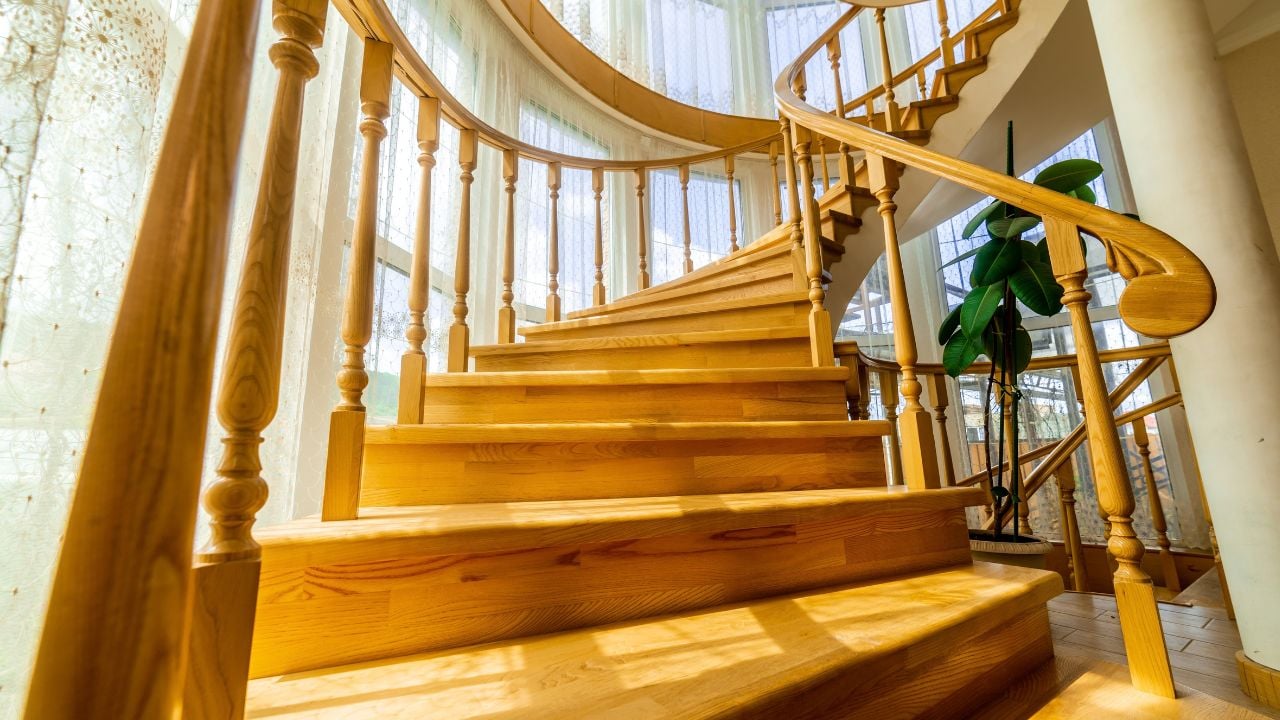
9 Stair Problems That Turn a New York Home Into a Hazard

New York State’s Department of Health reported more than 1,800 fall deaths among residents 60 and older in 2023, a number that’s risen 25% in just five years.
Not all of those falls happened outside.
These are the stair problems that turn a New York home into a hazard.
Note: This is general information, not legal advice. Building code requirements are subject to change, so confirm the current standards with the New York State Department of State’s Division of Building Standards and Codes.
1. Risers Creeping Past Code
A stair riser has a hard ceiling under New York law.
The Residential Code of New York State sets that limit, as part of the state’s Uniform Fire Prevention and Building Code.
A stair riser, the vertical part between one step and the next, can’t run past 8¼ inches.
It also can’t jump around from one step to the next.
A contractor pouring a new basement stairway, or a homeowner squeezing an extra step into a tight stairwell, sometimes stretches that number without meaning to.
Your foot notices first.
A foot that’s used to the size of the last step comes down early on a taller one.
That’s exactly the moment people trip near the top of a flight.
New York’s Department of Health ties more than 1,800 deaths in 2023 to falls among residents 60 and older.
That yearly count has grown by a quarter over just five years.
That figure counts only the fatal falls, leaving out every trip that sent someone to the hospital instead.
2. Shallow Tread Depths
The tread is the flat part of a stair step, and the state code sets a floor for how deep it has to be.
That floor is 9 inches deep at minimum, measured front edge to back edge.
Older homes sometimes shave that number down when a stairway gets rebuilt to fit a new layout.
A tight row house does the same thing when it squeezes a half-flight into a finished attic.
A grown adult’s shoe barely fits on a tread that thin.
Barely enough room.
Going down is where it bites hardest because a heel that hangs off the back edge of a shallow tread has nothing solid under it on the next step.
3. A Handrail Too Fat to Grab
Grip size on a stair handrail comes with a separate set of rules, apart from riser height and tread depth.
A graspable handrail runs roughly 1¼-2 inches across if it’s round.
A non-circular rail works too, as long as its perimeter measures between 4 and 6¼ inches.
A lot of older homes have the opposite.
A thick, decorative newel-post-style rail built for looks can be too wide for a hand to close all the way around it.
That’s not graspable.
A hand that can’t close around a rail can’t catch a fall in progress.
The hand just slides along the top until the fall is already happening.
Measure Your Stairs
Grab a tape measure, and five minutes is enough to check the numbers yourself.
A tape measure laid across a tread, front edge to back edge, should clear 9 inches.
A riser measured straight down between two steps should land at 8¼ inches or under.
For the handrail, close a hand around it.
A round rail should measure roughly 1¼-2 inches across, and a wider rail needs a hand-sized groove cut into its underside to count as graspable.
None of it needs a permit or an inspector, just five minutes and a tape measure.
4. No Rail on Either Side
Any stairway with four or more risers needs a graspable rail on at least one side.
That rail has to run continuous from above the top step to above the bottom one.
One side isn’t optional.
Many older homes never got a rail, especially a basement or attic stairway added after the house was built.
A formal staircase can lose its rail too, pulled for a remodel and never replaced.
The state Department of Health lists a lack of stair railings among the fall-risk factors it tracks for older residents.
A missing rail costs you on the way down, when a stumble has nothing to grab before it turns into a fall.
5. Guardrail Gaps You Can Fall Through
There’s a size limit on how big a gap in a stair guard is allowed to be, and it’s smaller than a lot of people would guess.
On an open staircase, the code caps any gap in a guard or between balusters at a sphere 4⅜ inches across.
That gap widens to 6 inches only in the triangle formed where a step meets the bottom rail.
A small foot fits through.
Older open staircases often have widely spaced wooden balusters or a single cable rail running the length of the flight.
Those were built before anyone measured that gap at all.
A kid’s foot, a cane tip, or a dropped shoe can slide right through a gap that size.
On an open stairway, that’s a straight drop to the floor below.
Psst! How fall-ready is your staircase? Run through this checklist and see where you stand.
6. A Bottom Step With No Landing
A flight of stairs is supposed to end on a landing, not straight onto the floor, and New York’s code makes that a requirement, not a nicety.
New York’s code requires a landing at both the top and the bottom of every flight.
That landing has to be at least as wide as the stairs themselves, and at least 36 inches deep on a straight run.
There’s nowhere to catch yourself.
Basement stairs are the usual offender, especially a set added after the house was built.
The last step often lands straight onto a concrete floor, with no flat space to plant a foot first.
A missing landing makes the final step one of the riskier parts of the flight, since there’s no flat space between the stairs and solid ground.
7. A Missing Second Switch
Six is the magic number for stairway lighting under the state code.
Once a stairway hits six risers, the rule requires a wall switch at both the top and the bottom, not just one.
Nobody wants to guess.
Many older houses only wired one switch at the bottom of a basement or attic stairway.
The only way up is a few steps taken in the dark before a hand finds the string.
A licensed electrician can usually add the missing switch without opening up a wall for a full rewire.
8. Ice-Glazed Steps Every Winter
Winter weather is the one hazard no building code can regulate.
Exterior steps facing north, sitting in shade, or built from stone or concrete hold onto ice long after the sidewalk nearby has cleared.
A freeze-thaw cycle can turn a wet step into a sheet of glass overnight.
Salt buys you time.
New York State leaves the exact timing up to local rule.
New York City spells it out: Property owners get four hours after snow stops falling to clear it, excluding 9 p.m. to 7 a.m.
Four hours disappears fast on a morning when the first person down the stairs is heading to work before sunrise.
9. Stair Clutter
Not every hazard on this list needs a building code to exist, and clutter is the plainest example.
It’s common enough that the state Department of Health names clutter in walkways and on stairs among the risk factors it tracks for falls at home.
Slippery or inconsistent flooring makes that same list.
Clear it before dark.
A phone charger cord across a tread or a laundry basket on the third step turns a normal trip into a guess.
A loose stair runner is easy to miss, since it looks secure standing still.
It only slides the moment your full weight hits it, usually mid-step.
8 Reverse Mortgage Terms New York Homeowners Find Out About Too Late

New York homeowners are sitting on a record amount of home equity, and a reverse mortgage is one way to turn part of it into cash.
These are the reverse mortgage terms New York homeowners commonly find out about only after signing.
8 Reverse Mortgage Terms New York Homeowners Find Out About Too Late
8 Home Insurance Discounts New York Owners Qualify For and Never Receive
New York homeowners pay close to $1,660 a year for home insurance, and a chunk of that bill is more negotiable than many policyholders realize.
These are the home insurance discounts many New York owners already qualify for and don’t always receive.
8 Home Insurance Discounts New York Owners Qualify For and Never Receive
