
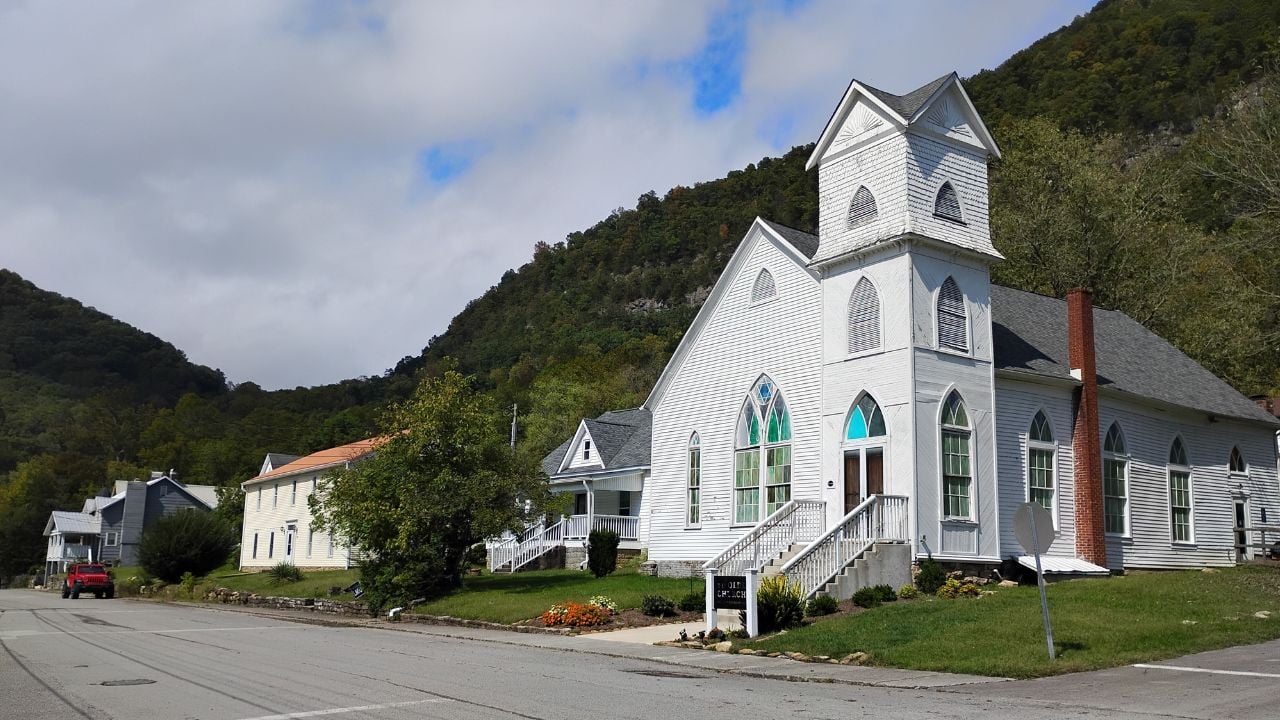
9 Tennessee Mountain Towns Locals Hope Tourists Never Find

Ask a new arrival to name a Tennessee mountain town, and you’ll hear the same three answers.
All three sit on one stretch of US-441.
Tennessee’s mountain country runs from the Georgia line to the Virginia line, though, and the towns worth a tank of gas sit nowhere near that strip.
These are the Tennessee mountain towns locals love and hope tourists never find.
1. Ducktown
Ducktown sits in the Copper Basin, the broad mountain valley where Tennessee, Georgia, and North Carolina nearly touch.
Rafting shuttles run US-64 through the Ocoee River gorge all summer, and drivers rarely climb State Route 68 into town.
Tennesseans do.
The Ducktown Basin Museum stands on the old Burra Burra Mine site, ten buildings across 17 acres that served as headquarters for the Tennessee Copper Company from 1899 to 1975.
Copper came out of the basin from 1847 until 1987, and the smelter fumes left these hills stripped to bare red clay.
Crews planted it back, tree by tree.
The photographs on the museum walls look nothing like the green ridges outside its windows, which is why a Polk County family walks visiting cousins through the exhibits before anything else.
2. Beersheba Springs
Fewer than 500 people live in Beersheba Springs, and hikers all over Tennessee know the address by heart.
Highway 56 runs through town to Stone Door Road, and Stone Door Road ends at the western rim of the Cumberland Plateau.
At the end of it, there’s a crack in the rock roughly 10 feet wide and 100 feet deep, a natural staircase down into Savage Gulf that travelers used long before anybody nailed up a trail sign.
The natural area at its heart covers 15,590 acres of gorges and sandstone cliffs, and Tennessee made Savage Gulf a stand-alone state park in 2022.
The town grew up around a mineral springs resort in the 1800s, and the old assembly grounds still host the Beersheba Springs Arts and Crafts Fair, set for August 22 and 23 this year.
That’s one weekend a year.
The other fifty-one belong to the families on the mountain and the Tennesseans who drive up to walk the Stone Door.
3. Cumberland Gap
Of all the mountain towns Tennesseans keep to themselves, Cumberland Gap is the one inside a national park, all 300 or so residents of it.
A four-mile road runs up from the visitor center to the Pinnacle overlook at 2,440 feet, where Kentucky, Tennessee, and Virginia all show up in a single glance.
From the parking area, the walk to the railing runs 150 yards on pavement.
That’s the whole hike.
Down in town, Gap Creek Coffee House sits on Pinnacle Alley, and the streets below the gap trace the Wilderness Road that Daniel Boone’s axemen opened in 1775.
Tennessee families with a whole afternoon take the Tri-State Trail instead, a 2.4-mile round trip to a marker where you can stand in three states without moving your feet.
4. Wartburg
Wartburg holds roughly 850 people at the last count in Morgan County, and the National Park Service keeps a visitor center on its North Maiden Street.
The Obed carries the state’s only National Wild and Scenic River designation, handed down in 1976, and nothing else in Tennessee has earned it since.
Climbers work sandstone bluffs inside gorges that run 500 feet deep, and Knoxville paddlers make the hour’s drive out whenever a good rain fills them.
Six miles out of town, Frozen Head Mountain rises to 3,324 feet inside Frozen Head State Park, one of the tallest points in Tennessee west of the Smokies.
That same park is where forty runners from fifteen countries started the Barkley Marathons on February 14 this year.
Not one of them finished.
5. Monterey
One exit off I-40 between Nashville and Knoxville, Monterey sits near 1,900 feet on the eastern edge of the Cumberland Plateau.
Bee Rock Overlook sits about half a mile from the parking area, a sandstone cliff above the Calfkiller River valley and Stamps Hollow.
Locals bring folding chairs.
Before the railroad arrived, the settlement went by Standing Stone, named for a boulder that crews dynamited in 1893 to clear the line.
A local society rescued a fragment, engraved it, and set it atop a monument in the city park in 1895, where you can still put a hand on it.
Out at Muddy Pond, the Mennonite community’s mill presses sorghum cane every September and October on Tuesdays, Thursdays, and Saturdays, and Middle Tennessee families plan the fall drive around those three days.
Psst! How much do you know about the Appalachians? Take our quiz and see if you can ace it.
Quiz
Appalachian IQ
Answer these questions on the Appalachians and the Great Smoky Mountains. We bet you can’t get them all right. Prove us wrong?
The only lodge inside Great Smoky Mountains National Park has no road to it. What hauls its food and linens up the mountain?
6. Sneedville
Sneedville anchors a Tennessee county where about 30 people share each square mile.
Clinch Mountain forms one side of Hancock County, Newman's Ridge the other, and the Clinch River passes through the edge of town.
Roughly 1,300 people live in Sneedville.
Seven miles south on State Route 31, a gravel turn with a wooden sign leads to Elrod Falls, three tiers dropping more than 100 feet through the trees.
You have to know it.
A swimming hole sits at the base of the first tier, a five-minute walk from where you leave your car, and Hancock County families have been cooling off in it since long before anybody thought to post a photo of it.
7. Tracy City
A bakery on Tracy City's Main Street predates the pavement in front of it, and about 1,400 people live on the Cumberland Plateau around it in Grundy County.
Swiss immigrants John and Louise Baggenstoss opened Dutch Maid Bakery in 1902, and their family ran it until 2003, which makes it Tennessee's oldest bakery.
Baker Cindy Day bought it in 2005 and still turns out bread on the original equipment.
Minutes from that counter, Grundy Lakes anchors the day-use side of Fiery Gizzard State Park, which Tennessee split off from South Cumberland in 2025.
The Tennessee Coal and Railroad Company lined the water with 120 coke ovens in the 1870s, and what's left of them sits on the National Register of Historic Places.
Grundy Forest, a few minutes the other direction, holds the trailhead for the Fiery Gizzard Trail, and Tennessee hikers build entire weekends around that one route.
Wear the good boots.
8. Huntsville
Huntsville anchors Scott County with 1,270 residents at the last census, and it puts a Tennessee family twenty minutes from the edge of the Big South Fork.
The park covers 125,000 acres of the Cumberland Plateau, gorge after gorge of sandstone bluff and free-flowing river.
That's nearly 200 square miles.
Riders haul trailers up from as far as Chattanooga for the horse trails, climbers work the bluff lines, and paddlers put in whenever the water comes up.
Many Tennessee trips start at the Bandy Creek campground, where the sites fill on fall weekends and the loudest thing after dark is a generator somebody forgot to shut off.
9. Mountain City
No incorporated town in Tennessee sits higher than Mountain City, the seat of Johnson County at 2,418 feet.
Iron Mountain rises to the north, Forge Mountain to the east, and Doe Mountain to the southwest, with the Virginia and North Carolina lines both a short drive out.
Winters at that altitude get serious.
On December 30, 1917, a thermometer in town read minus 32 degrees.
Nobody has beaten it.
Music is the town's other claim to fame.
The first Mountain City Fiddlers Convention took place in 1925, and it helped shape what the rest of the country would later call country music.
The convention runs again at the Heritage Hall Theatre, back since 2023 after a pandemic pause, and on a show night half the town of 2,400 seems to be in the room.
Where the Crowds Land
Tennessee's mountain visitors concentrate in a handful of places, and the counts name them.
Great Smoky Mountains National Park logged 11,527,939 recreation visits in 2025, more than any other national park in the country and more than double the total at second-place Zion.
That's one park.
The Blue Ridge Parkway drew more than that, 16.5 million visits, the biggest figure for any site the National Park Service tracks anywhere.
One of the busiest stops inside that park is Kuwohi, the highest point in Tennessee at 6,643 feet, drawing more than 650,000 visitors a year on its own.
In September 2024, the U.S. Board on Geographic Names restored that Cherokee name at the request of the Eastern Band of Cherokee Indians, and the park still closes the summit three half days a year so Cherokee schools can have the mountain to themselves.
11 Things Tennesseans Are Tired of Explaining

Somebody who moved down last spring asks a question a Tennessean has answered more times than they can count.
The answers come out pre-worn, and a couple of them still start an argument at the table.
11 Things Tennesseans Are Tired of Explaining to Everyone Who Moves In
Does Tennessee Tax Retirement Income?

Retirees crossing into Tennessee keep hunting for the catch in a state with no income tax.
What the state leaves alone surprises them, and so does the one bill that shows up anyway.
Does Tennessee Tax Retirement Income? What Retirees Keep in 2026
