
9 Things Florida Neighbors Judge You For Without Ever Saying It

Florida caps a homeowners association fine at $100 a violation and $1,000 total.
That’s not what keeps a Florida street in line.
Long before a violation notice goes out, the neighbors already have an opinion, and they’ve had it for a while.
These are the things Florida neighbors judge you for without ever saying it out loud.
Note: This is general information, not legal advice. HOA rules, city and county codes, and the dollar figures in this article are subject to change, so confirm current requirements with your community association or local code enforcement office.
1. Sprinklers on the Wrong Day
A neighbor two doors down sometimes knows your Florida watering day better than you do.
Water management districts assign one to every address.
In the South Florida Water Management District, even-numbered addresses water on Tuesdays, Thursdays, and Sundays.
Odd-numbered addresses get Mondays, Wednesdays, and Saturdays.
Sprinklers can’t run during the district’s banned watering hours, 10 a.m. to 4 p.m., no matter the address.
A few exceptions apply, including hand watering with a self-canceling nozzle, reclaimed water, brand-new landscaping, and irrigation repairs.
A routine cycle at 2 p.m. isn’t one of them.
Not this time.
A system that clicks on at 2 p.m. on the wrong Tuesday doesn’t usually draw a complaint.
A neighbor remembers it instead, right up until the next dry spell turns every other yard brown at the same time and one lawn stays suspiciously green.
2. Boat Still in the Driveway
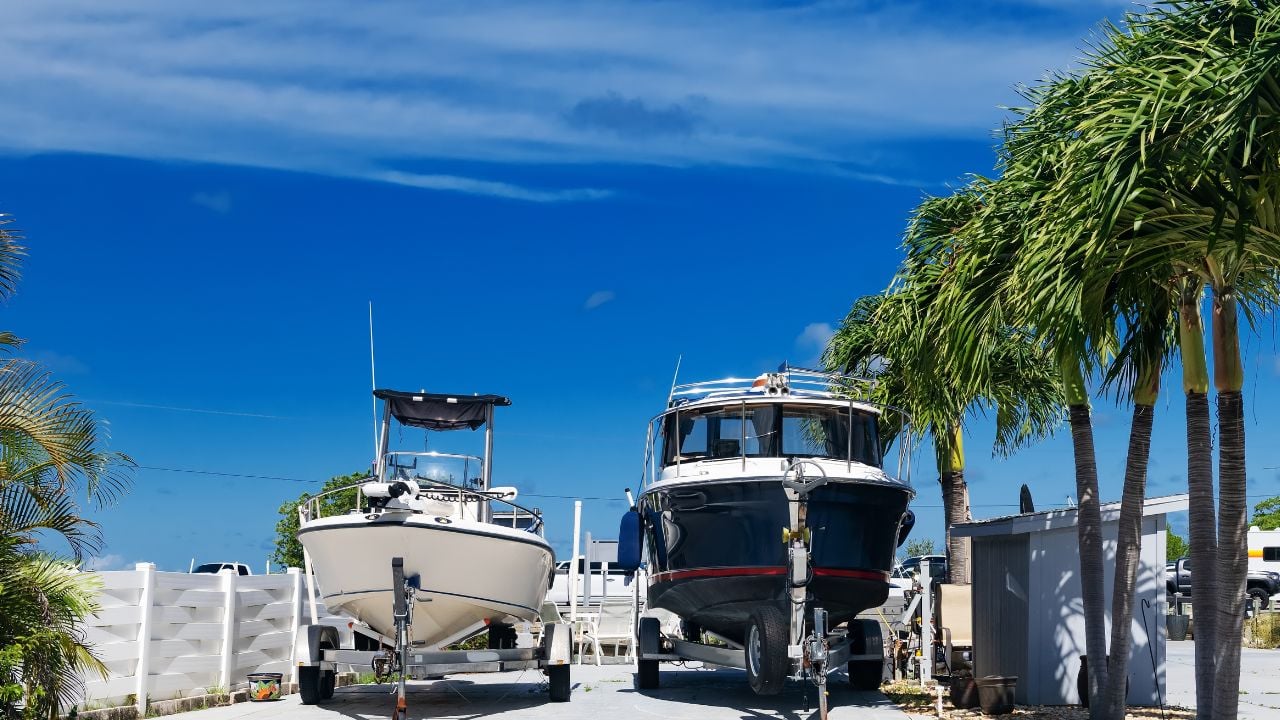
A boat sitting in the driveway is protected under Section 720.3045, a 2024 Florida law, but only if it can’t be seen from the street, a neighbor’s yard, a shared common area, or a community golf course.
Leave it in plain sight from any of those spots, and it’s exactly as citable as it was before the law passed in 2024.
Same violation.
Neighbors clock the difference fast, even when a boat’s owner insists the new law covers them.
A tarp thrown over the bow doesn’t change what’s underneath.
What Florida’s 2024 Law Protects
Florida’s 2024 homeowners association (HOA) law only shields a boat, recreational vehicle (RV), or work trailer that stays out of view.
Park it where the street, a neighbor’s yard, or a community golf course can see it, and an HOA can still cite it exactly like before 2024.
3. Ladder Rack on the Work Truck
A ladder rack bolted to the truck bed and a company logo on the door don’t cost a Florida homeowner the right to park that truck in the driveway.
Florida’s 2024 parking protections cover any work vehicle short of a heavy commercial rig topping 26,001 pounds.
Company signage doesn’t change that.
A landscaper’s pickup sitting bare might pass without a second look.
The same truck with a rack of pipe and a trailer chained behind it draws a second look from every neighbor on the block.
4. Blue Tarp Past Hurricane Season
A blue tarp on a Florida roof is supposed to be temporary, not a second roof.
The Army Corps of Engineers runs Operation Blue Roof after major storms, covering damaged roofs with reinforced sheeting until permanent repairs happen.
It’s meant as a bridge, not a destination.
A tarp still stapled down well into the next hurricane season reads differently to the neighbors next door.
Half a year, sometimes longer.
By then, storm damage isn’t the likely explanation anymore.
An insurance fight, a contractor backlog, or a house nobody’s living in full time usually is.
5. Swale Nobody Mows
Many Florida cities count on homeowners to mow the swale, the shallow dip between the sidewalk and the street that carries stormwater away in a downpour.
That job falls on the homeowner even though the grass often sits inside the road right-of-way, not fully on private property.
Palm Coast’s rules put the job on the adjacent homeowner: mow the swale, clear the culvert pipe, and keep the water moving.
Their job.
Not fully their land.
Skip it, and the grass grows shaggy right up to a driveway that’s otherwise edged to a hairline.
That gap is hard to miss from the sidewalk.
Neighbors walking the dog notice exactly where a lawn crew’s contract seems to end.
Psst! How much of a neighborhood nitpicker are you? Run through this checklist and see where you land.
6. Black Streaks on the Roof
Black streaks running down a Florida tile or shingle roof are hard to miss from the street.
Those are Gloeocapsa magma, an airborne bacteria that spreads roof to roof and feeds on the limestone packed into the shingles.
It’s not dirt.
It’s not something a good rain washes off, either.
A homeowner who lets it climb for years ends up with a roof that looks two decades older than it is.
Neighbors two doors down notice exactly whose roof still looks new.
7. Lawn Gone Brown on Purpose
A lawn that’s half brown by August can still be within the rules for a Florida homeowner, as long as it’s the right kind of brown.
Since 2009, Florida-Friendly Landscaping legislation has kept a homeowners association (HOA) from forcing every yard into thirsty turf grass instead of native, drought-tolerant plants.
An HOA can still set some standards, keeping plants suited to the site and beds properly mulched.
What it can’t do is ban a native yard outright just because it isn’t a uniform green.
Not neglect.
A choice, backed by state law, that looks a lot like neglect to a neighbor used to a solid green block down the street.
8. House Numbers You Can’t Read
A house number ought to be readable from a Florida street, not just from the driveway.
Florida cities increasingly write that into code.
In South Pasadena, on Florida’s Gulf Coast, the fire code sets it in writing: Numbers at least three inches tall, in a color that contrasts with the house, posted somewhere visible from the street.
Many Florida cities and counties carry some version of the same rule.
A faded number, or one painted the same shade as the siding, doesn’t usually draw a citation on its own.
It draws something else.
Every neighbor who’s ever tried to guess which dark house is expecting the ambulance remembers exactly whose numbers they couldn’t find.
9. Storm Shutters Closed Past June
Hurricane shutters still up on a Florida home in the middle of June usually mean one of two things.
Either nobody’s home, or nobody’s taken them down since the last storm warning lifted.
Many communities put a deadline on it in writing.
Keys Gate, a community in Homestead, gives homeowners seven days to open or remove panels once a storm passes or a hurricane watch lifts.
A homeowners association (HOA) can’t fine much for missing that window, capped at $100 a violation and $1,000 total under Florida law.
The fine was never the deterrent.
The giveaway isn’t the shutters.
It’s the driveway that hasn’t moved a car in weeks, the same flyer stuck in the same spot on the walkway, the mailbox a neighbor started emptying so it wouldn’t overflow.
7 Reasons People Are Leaving Florida in 2026
Florida gained just 22,517 residents from other states last year, way down from 183,646 two years earlier.
The households that stayed are running new numbers on property taxes, condo bills, and hurricane season.
7 Reasons People Are Leaving Florida in 2026
9 Things Florida Homeowners Get Wrong About Amendment 3 as We Head Towards November
The property tax amendment on your November ballot borrows its name from a law you already have, and that’s the least confusing part.
Many homeowners are reading a $250,000 headline and doing math the fine print doesn’t support.
9 Things Florida Homeowners Get Wrong About Amendment 3 as We Head Towards November
