
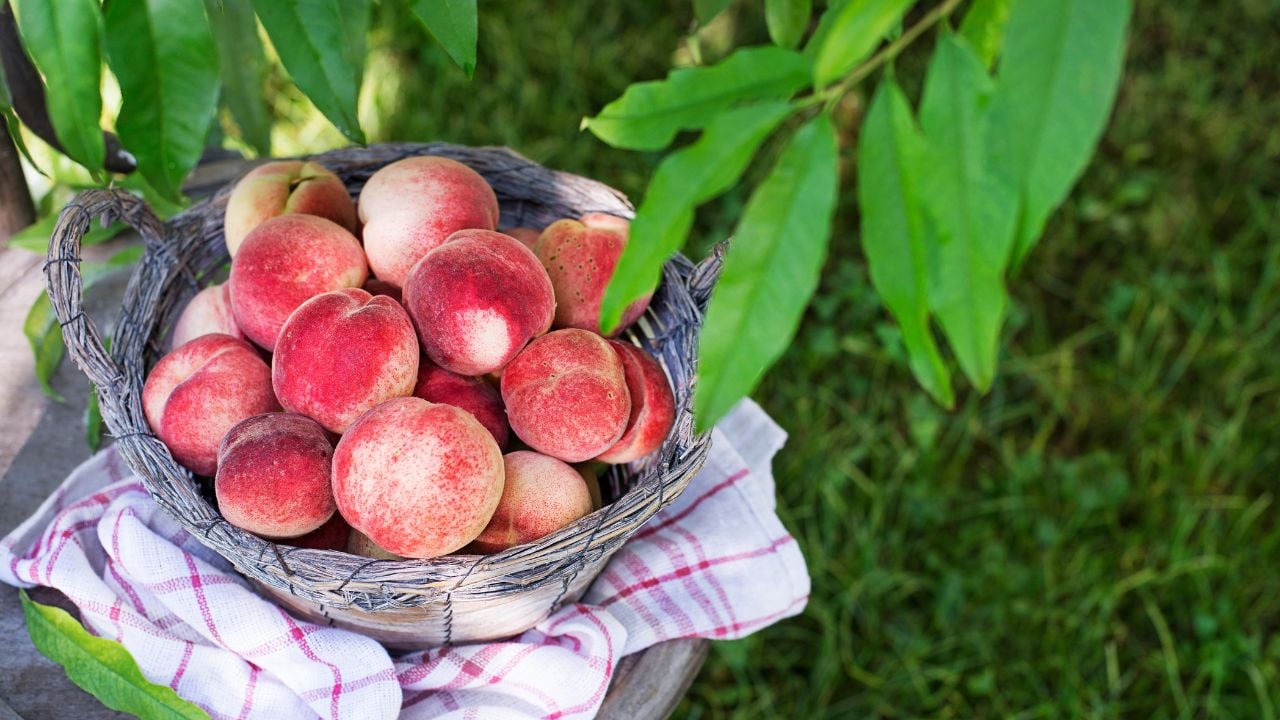
9 Things Georgia Peach Farm Stands Do That Tourists Never Expect

University of Georgia Extension calls 36 to 46 degrees the killing zone for a peach, the band that causes chilling injury within five to seven days.
A home refrigerator sits right in the middle of that temperature range.
Locals running Georgia’s farm stands know that.
These are the things Georgia peach farm stands do that tourists never expect.
1. Priced by the Peck
Historic Dickey Farms sells its Georgia peaches by the box, not the per-pound scale a grocery store relies on.
Its half-bushel box holds close to 25 pounds of fruit, anywhere from 50 to 70 peaches depending on size.
There’s no scale involved.
Jaemor Farms hands out peck-sized bags on its summer U-pick days, half of a half-bushel and roughly what one family carries home in a single trip.
A shopper used to bagging fruit by the pound has to guess how much they’re carrying home.
2. Riper Fruit at the Register
Six to eight pounds of pressure is about as tender as a peach can get before it still needs careful handling.
That is the firmness range in which a Georgia peach stand picks fruit bound for its bins, more tender than fruit picked for a distribution truck.
University of Georgia (UGA) Extension’s postharvest guide backs up the number.
Growers pick peaches bound for a local farm market in the 6-to-8-pound firmness range, already close to ready to eat.
Growers pick fruit bound for a distant grocery chain twice as firm, in the 12-to-16-pound range, so it survives the ride without bruising.
Buy straight from a farm stand, and the peach in your bag has spent less time engineered for a truck and more time ripening on the tree.
3. No Refrigeration for the Fruit
Georgia peach stands warn customers away from one common habit: Putting the fruit straight into the refrigerator.
A ripe peach left on the counter keeps ripening and sweetening for another day or two.
A stand would rather sell that flavor than lose it to the cold.
The advice comes from postharvest science, not habit.
Why the Fridge Ruins a Peach
University of Georgia Extension calls the range between 36 and 46 degrees the “killing zone” for peaches, the temperature band that causes chilling injury within five to seven days.
The flesh turns mealy and browns near the pit, and it never ripens properly again, even after it warms back up.
A typical home refrigerator sits right inside that range: The Food and Drug Administration recommends keeping one 40 degrees or below, and Consumer Reports calls 37 degrees the ideal setting.
A peach on the counter is safer than a peach sitting next to the milk.
4. Sorted by the Pit
Two kinds of peach share the bins at a Georgia peach stand: Clingstone, whose flesh holds tight to the pit, and freestone, whose flesh slides free.
University of Georgia (UGA) Extension’s variety charts show clingstone varieties concentrated in the earliest weeks of the season, from May into June.
Freestone varieties take over as the season goes on.
By midsummer, freestone varieties are common in the bins a stand sells for fresh eating.
A shopper scanning the table can’t tell clingstone from freestone that way, since the two look nearly identical from the outside.
A worker sorting bins by hand can, though: The stem end alone gives it away, a tell many shoppers never learn to spot.
5. The Apple Takeover of the Tables
Jaemor Farms, a fixture for Georgia peaches in the foothills near Alto, doesn’t stop selling fruit once its peach harvest ends.
The farm grows Ginger Gold and Arkansas Black apples, picked in late September and early October, right as the peach bins clear out.
It isn’t all local.
Jaemor says outright that it brings in other popular varieties, like Honeycrisp and Gala, from partner farms once its apple harvest can’t keep the market stocked.
A visitor grabbing a bag of apples off a Georgia peach farm’s table might be holding fruit from an orchard three counties over.
6. The Off-Limits Orchard
Dickey Farms keeps its peach orchard closed to visitors, even at the height of harvest.
The farm’s FAQ page says its food safety protocol keeps the public out of the field.
The packing house and farm market next door stay open the whole time for browsing and buying.
A visitor can still watch workers pack the peaches inside the market, then buy the same fruit at the counter a few steps away.
7. Ships Nationwide, With Two Exceptions
Pearson Farm, based in Fort Valley, sends its peaches well past the people who show up in person.
The farm ships peaches and pecans nationwide through United Parcel Service (UPS), under its posted shipping policy.
Two states never get a box, though.
Pearson Farm’s shipping policy blocks orders of fresh peaches and in-shell pecans to California and Arizona, citing agricultural regulations that keep the fruit from crossing those state lines.
A shopper ordering from Vermont can get a box of Georgia peaches delivered to their door, while a shopper in Los Angeles cannot order the same box at all.
8. The Focus Shift to Pecans
Peaches aren’t the only crop Lane Southern Orchards depends on.
The Fort Valley farm has grown peaches and pecans since 1908.
Lane Southern Orchards stays open year-round instead of closing once the last peach sells.
Workers swap the front tables over once the peach bins run dry, filling them with pecans, preserves, and pies instead.
A visitor who shows up expecting a peach stand in October finds a shelf built around a completely different crop.
9. Seal to Prove It’s Georgia’s
Georgia Grown is the certification a peach stand needs to prove its fruit grew in-state.
Georgia Grown is run by the Georgia Department of Agriculture.
Only verified in-state producers can put its seal on a sign or a box.
The logo isn’t decoration.
It marks the difference between a farm that grew the fruit itself and a stand that resells whatever showed up on a truck that morning.
Psst! How much do you know about Georgia peaches? Take our quiz and see how many you can get right.
Quiz
Georgia Peach IQ
Answer these questions on Georgia peach history and trivia. We bet you can’t get them all right. Prove us wrong?
Georgia’s Peach Blossom Festival, held in Fort Valley in the 1920s, once featured a pageant with which live animal on stage?
Peaches' Small Slice of Georgia's Harvest
Georgia's peach crop was worth $124.7 million, according to the most recent economic impact analysis from the University of Georgia's Center for Agribusiness and Economic Development.
That number looks smaller next to the rest of the state's harvest.
Chicken alone brought in $6.1 billion in the same analysis.
Peanuts topped $877 million.
Blueberries cleared $382 million.
Both figures comfortably clear the fruit that put Georgia's nickname on its license plates.
Pecans beat peaches too.
Pecans brought in $274 million in that analysis, more than double what peaches managed, even though many Georgia orchards grow both trees side by side.
A farm stand's peach bins empty out weeks before its pecan crop even hits the ground.
7 Farmers Market Mistakes That Cost Georgians Money Every Saturday
Farmers markets promise fresh, local savings, and shoppers tend to assume every hand-lettered sign at the table is telling the truth.
Nobody checks one of the most common signs before the market opens, and it isn't the only mistake costing shoppers money every Saturday.
7 Farmers Market Mistakes That Cost Georgians Money Every Saturday
8 Medicare Enrollment Mistakes That Cost Georgia Retirees All Year

A missed Medicare deadline can follow a retiree for the rest of their life, not just one enrollment period.
Some retirees carry a surcharge that runs close to $487 a year, and one overlooked date is all it takes to get stuck with it.
8 Medicare Enrollment Mistakes That Cost Georgia Retirees All Year
