
9 Toll Mistakes That Cost Florida Drivers Money Every Month

Think a missing SunPass transponder just means one bigger toll?
It doesn’t.
Florida adds its own administrative fee to that bill, and the cycle resets with every new invoice.
These are the mistakes that turn a single missed toll into a monthly bill some Florida drivers keep paying.
Note: This is general information, not financial or legal advice. Toll rates, fees, and vehicle registration rules are subject to change.
1. Letting Your SunPass Account Run Dry
Florida drivers who let a SunPass account run dry lose the one advantage the program gave them.
SunPass drivers save an average of 25% compared with Toll-By-Plate, according to Florida’s Turnpike.
That discount lasts only as long as the account stays funded.
Florida’s Turnpike bills any vehicle with no funded transponder as Toll-By-Plate instead, and a SunPass sticker with nothing left behind it counts as unfunded.
SunPass’s own Easy Pay feature refills the account automatically once the balance drops below a $10 threshold, the program’s default trigger point.
Skip that enrollment, and nothing catches the balance before it hits zero.
No warning arrives first.
A prepaid Toll-By-Plate account skips the $2.50 fee that a mailed invoice adds, but it still runs at the higher rate, since only an actual transponder unlocks the discount.
Forget to refill a SunPass account, and the same trip that used to cost the discounted rate goes back to the pricier one, invoice after invoice.
The Math Behind SunPass and Toll-By-Plate
SunPass and Toll-By-Plate charge two different prices for the exact same stretch of Florida road.
SunPass drivers save an average of 25% compared with Toll-By-Plate customers.
Toll-By-Plate also adds a $2.50 administrative fee on top of that higher rate, charged once per 30-day invoice.
A funded Prepaid Toll-By-Plate account erases that $2.50 fee, but the 25% rate gap stays in place either way.
2. Driving a Managed Lane With No Transponder
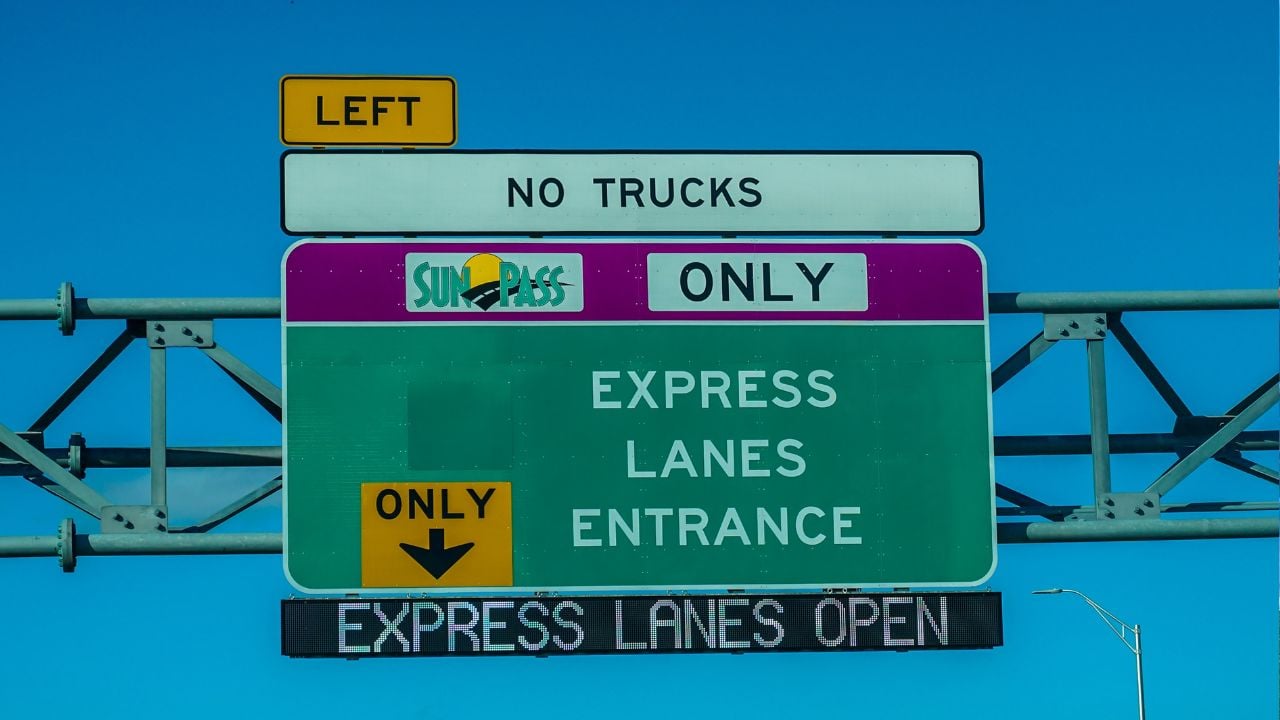
Florida drivers who treat 95 Express or I-4 Ultimate like any other cashless toll road are in for a surprise.
Those managed lanes don’t accept Toll-By-Plate billing at all.
A driver without SunPass or another accepted transponder can’t just accept a pricier photo bill there.
Enter one of those lanes unregistered, and Florida charges the toll plus $25 for every 24-hour period the violation continues, according to 95 Express.
That’s a fine.
The citation follows the vehicle’s plate, not the lane.
A commuter who takes that shortcut a few mornings a month without ever getting a transponder racks up a fresh violation each time, not one bigger bill.
3. Letting a Toll Enforcement Invoice Slide
Florida drivers who ignore a Toll Enforcement Invoice trade one small problem for a much bigger one.
Skip paying it, and the unpaid toll can turn into a citation carrying a mandatory $100 fine on top of the toll itself, under state law.
Drivers can elect to pay $30 to the clerk of court instead, plus the toll, and avoid points on their license, but that window closes fast.
Miss it entirely, and Florida can refuse to renew that vehicle’s registration until the debt clears.
None of that resets.
A driver who treats each new invoice the same way, setting it aside instead of opening it, faces a fresh version of this every billing cycle a toll goes uncollected, each one its own citation with its own fine.
Psst! How much do you know about Florida’s toll road history? Take our quiz and see how many you can get right.
Quiz
Florida Turnpike Trivia
Answer these questions on Florida’s toll road history. We bet you can’t get them all right. Prove us wrong?
What was Florida’s Turnpike originally called when it opened in 1957?
4. Missing Your Bridge's Rebate Cutoff
Some Florida toll roads pay frequent drivers back, but only after they cross a hard monthly line.
Card Sound Bridge in the Florida Keys refunds 40% to SunPass drivers who log 28 paid trips in a calendar month, an all-or-nothing threshold.
Fall one trip short, and the rebate disappears completely, not partially.
No partial credit.
Mid-Bay Bridge in Okaloosa County runs a similar deal, crediting frequent SunPass drivers back the following month once they clear 32 valid trips.
One trip short, and the whole month's rebate is gone again.
Regular bridge commuters who don't track their count against the SunPass statement leave that money on the table every single month, without ever realizing there was a count to hit.
5. Driving Florida's Express Lanes at the Wrong Time
Florida commuters who merge onto 95 Express or I-4 Ultimate without checking the toll sign first let the worst moment of traffic set their price.
Both lanes charge by the minute, not by a flat rate.
The sign decides the price.
Roadside sensors track how many cars are using the express lane and push the price up as it fills, then back down as it clears, according to 95 Express.
The rate locks in the instant a driver passes the overhead sign, not when they exit.
Shift the same drive by even fifteen minutes, and that sign often shows a very different number.
Drivers who never glance at it before merging pay the peak price on repeat, commute after commute.
6. Renting a Car Without Your Own SunPass
Florida renters who assume a rental car handles tolls the same way their own car does pay for that assumption fast.
A renter with no toll plan of their own ends up billed through the rental company's toll program instead.
Those programs charge their own markup on top of the toll.
Hertz, for one, adds a $9.99 daily administrative fee on any day a renter triggers a toll without opting into its unlimited pass, charged at the toll authority's highest undiscounted rate, according to SunPass's own rental vehicle guidance.
Bringing a personal SunPass Portable transponder skips that markup entirely.
That's the whole fix.
SunPass and Prepaid Toll-By-Plate customers can add a rental's plate to their own account online, before the tolls even start rolling in.
Frequent renters, snowbirds flying in every few weeks and business travelers picking up a new car every month, pay that same rental markup on repeat when they skip the step.
7. Assuming Your Transponder Is Always Being Read
Florida drivers who mount a SunPass transponder once tend to assume it works forever.
It doesn't always.
Certain windshields, including several Land Rover, Mercedes-Benz, and BMW models, contain metal oxide in the glass that can block a transponder from being read at all, according to SunPass.
A transponder that isn't detected reads exactly like no transponder, funded account or not.
SunPass's own guidance is blunt about it: A transponder that isn't always being read when a driver passes through a SunPass lane means a call to customer service, not a wait-and-see approach.
Skip that call, and the same missed reads keep generating Toll-By-Plate invoices and their fees, month after month, on a driver who already paid for a working transponder.
8. Carpooling Without Registering for the Toll Exemption
Florida commuters who carpool without registering the carpool first are still paying full price, even with three people in the car.
95 Express waives the toll only for carpools of three or more registered with South Florida Commuter Services.
Three people isn't enough.
Registered drivers still have to shield their SunPass transponder properly, or the system reads it anyway and charges the toll, according to 95 Express.
No registration means no exemption, no matter how many people are in the car.
A regular carpool that never files that paperwork pays full toll on the same commute, trip after trip.
9. Assuming Your SunPass Covers Every Florida Expressway
Florida drivers who assume their SunPass account covers every toll road in the state are wrong about Orlando.
Orlando's expressways, State Road 408, 417, 429, and 528 among them, belong to the Central Florida Expressway Authority (CFX), a completely separate agency from Florida's Turnpike that runs its own E-PASS transponder program.
A SunPass or Toll-By-Plate account opened through the Turnpike doesn't automatically settle up with CFX.
CFX bills separately.
Drive one of those Orlando roads without an accepted transponder.
CFX mails its own Pay By Plate invoice, billed at double its regular electronic rate.
That bill runs on its own 30-day clock, separate from anything already owed to SunPass.
Miss it, and CFX moves toward its own violations and fines, same as any other Florida toll agency.
A driver who never opens a second account keeps paying that doubled rate on every Orlando trip, month after month.
A working transponder from SunPass, E-PASS, or LeeWay already reads correctly on any of these roads, since Florida's toll agencies interoperate across the state.
It's the drivers relying on a mailed photo bill instead of an actual transponder who end up with two separate invoices instead of one.
9 Things Florida Homeowners Get Wrong About Amendment 3

Florida's Amendment 3 borrows its name from a property tax law homeowners already think they understand.
The math on the ballot doesn't quite match the $250,000 headline many homeowners have stuck in their heads.
9 Things Florida Homeowners Get Wrong About Amendment 3 as We Head Towards November
7 Reasons People Are Leaving Florida in 2026
Florida gained just over 22,000 residents from other states last year, a fraction of the number it added two years earlier.
These are some of the biggest reasons people are packing up and leaving Florida in 2026.
