
9 Virginia Boating Rules That Cost Newcomers a Fine

A boat trailer from Pennsylvania rolls onto the Chesapeake Bay bearing a home-state registration sticker that’s still perfectly valid.
Ninety days later, Virginia stops recognizing it.
Virginia enforces that cutoff no matter which state’s plate is on the trailer, and newcomers rarely learn where the line sits until a conservation police officer draws it for them.
These are the Virginia boating rules newcomers break without meaning to, and the fines waiting on the other side.
Note: This is general information, not legal advice. Boating rules and penalties are subject to change, so confirm the current requirements with the Virginia Department of Wildlife Resources.
1. Skipping the Boater Education Card
Virginia has required nearly every operator of a motorboat with a motor of 10 horsepower or more, or any personal watercraft, to carry a completed boating safety course card since July 1, 2016.
No age carve-out survives.
Many other states still grandfather in older boaters, exempting anyone born before a set cutoff year from ever taking the course.
Virginia dropped that exemption for good in 2016.
Skip the card, and a Virginia conservation police officer can write you up for a $100 civil penalty on the spot.
A first-time boat buyer who’s driven a car for thirty years without a single ticket can still walk away with this fine.
What Exempts You From Virginia’s Boater Card
Virginia’s boater education requirement doesn’t disappear just because you rented the boat for the afternoon.
A rental company can stand in for the card only when the renter signs an agreement naming them as operator and the marina documents real, on-site instruction, not a quick wave toward the controls at the dock.
Bring your own boat from out of state instead, and Virginia only waives the card requirement for 90 days.
That waiver only covers a boat still carrying a valid registration from home.
2. Misjudging Virginia’s BUI Limit
Virginia calls this boating under the influence (BUI), and it sets the blood alcohol limit at 0.08%, the exact number it uses behind the wheel of a car.
Newcomers who assume the water runs looser than the road find out otherwise the hard way.
A conviction is a criminal misdemeanor, not a warning, and it can carry a fine up to $2,500 plus up to a year in jail.
On top of that, a first conviction bars the operator from running any boat on Virginia’s water for 12 months.
A second conviction within ten years stretches that ban to three years.
Steep price.
It’s a bad trade for a six-pack on a Saturday afternoon on Smith Mountain Lake.
3. Handing a Teen the Wheel
Virginia holds boat operators under 21 to a zero-tolerance line many newcomers never hear about.
A blood alcohol reading of 0.02% or higher is enough to violate the law, a fraction of the 0.08% threshold adults face.
That’s roughly one drink for many teenagers, sometimes less.
Families vacationing from states with looser youth boating rules let a teenager take the wheel after a beer at a cookout without thinking twice.
Virginia doesn’t see it that way.
Zero tolerance means exactly that.
The penalty tops out at a $500 fine, plus a six-month denial of boating privileges that follows the teen, not just the boat.
4. Riding Out the Registration Clock
An out-of-state boat gets exactly 90 consecutive days in Virginia before the state stops recognizing its home registration.
After that, the boat needs its own Virginia title and registration.
No extensions.
A family that trailers the same boat down for an extended stay on the Chesapeake Bay can blow past that window without noticing, especially when the boat only leaves the water a handful of times.
Virginia enforces the 90-day window no matter how little the boat gets used.
Run past day 90 without registering here, and Virginia’s general penalty for boating-code violations applies: A Class 4 misdemeanor, with a fine of up to $250.
New residents who keep boating on an old home-state sticker trip over the same rule.
5. Packing the Wrong Life Jackets
Virginia requires a wearable, Coast Guard-approved life jacket for every person aboard, plus a throwable device on any boat 16 feet or longer.
Kids under 13 face a stricter rule.
They have to wear a life jacket, not just keep one within reach, any time the boat is underway.
That rule comes from the U.S. Coast Guard, not from Virginia’s own boating code.
The federal requirement, found in the Code of Federal Regulations (CFR) at 33 CFR 175.15, applies on any federally regulated water, which covers the Chesapeake Bay, its tidal rivers, and many of the state’s other popular boating lakes anyway.
Newcomers from states that only require life jackets to be on board, not worn, leave a child’s vest tucked under a seat and call it compliant.
Not compliant either way.
Skip the rule, and Virginia’s conservation police enforce it as a Class 4 misdemeanor, the same $250-cap fine that covers many equipment violations under its boating code.
Psst! How boating-ready is your Virginia trip? Run through this checklist and see where you stand.
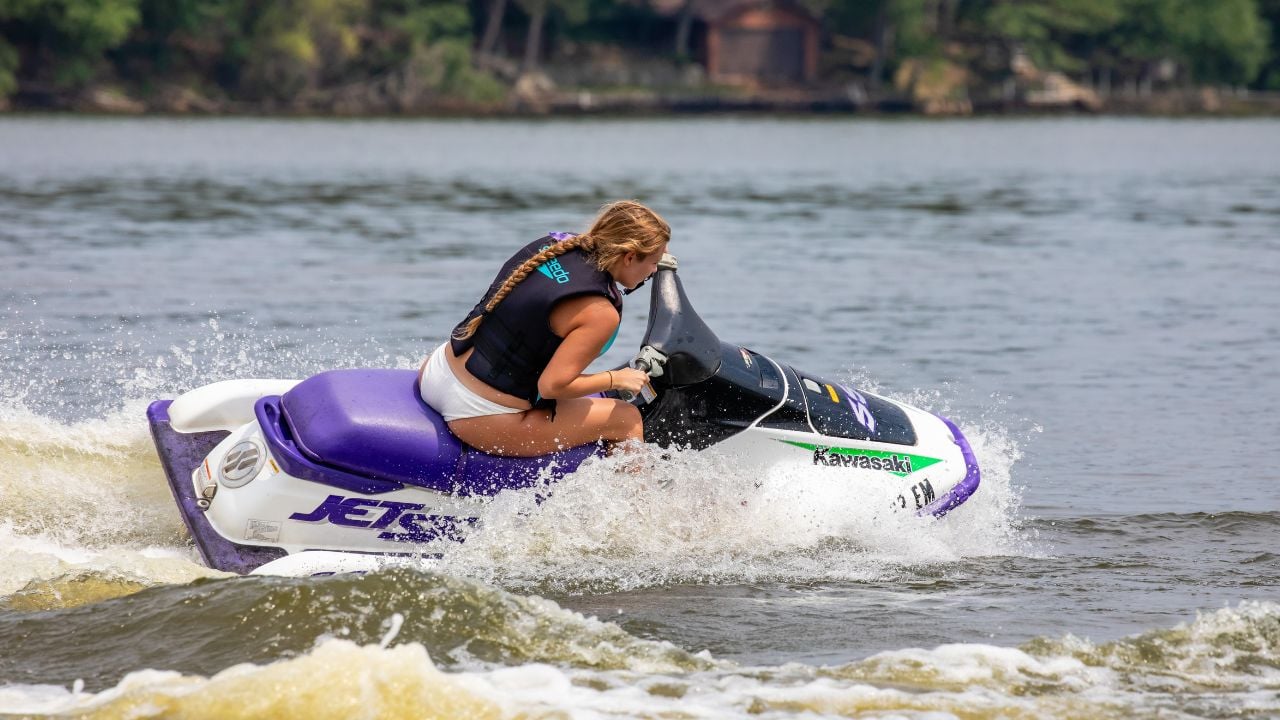
6. Renting a Jet Ski Too Young
Personal watercraft riders in Virginia must be at least 16, with one narrow exception.
Riders who are 14 or 15 can legally operate a personal watercraft, but only after completing the same boating safety course adults need, card in hand.
Many other states set the bar lower.
A family renting jet skis for a 13-year-old on a lake back home can turn around and find that same age illegal a few hours south, on Virginia’s water.
The rental counter doesn’t always catch it.
The citation does.
That’s a Class 4 misdemeanor, with a fine of up to $250.
7. Chasing a Sunset PWC Ride
Virginia bans personal watercraft (PWC) from the water between sunset and sunrise, even though a regular motorboat can run all night with the right lights on.
Tourists booking a golden-hour jet ski tour rarely know that rule exists until a rental shop cuts the trip short.
Renters push for one more loop as the sun drops.
Virginia enforces the cutoff regardless of how good the sunset looks.
Sunset means sunset.
Under that same section of the boating code, riding a personal watercraft after dark carries the same Class 4 misdemeanor exposure as riding a personal watercraft underage, up to a $250 fine either way.
8. Ignoring a Patrol Boat’s Lights
Virginia’s boaters have their own version of the move-over law drivers already know.
Pass within 200 feet of a law enforcement or emergency vessel running its lights, and the rule requires dropping to no-wake speed, the same slow crawl required near a dock or a swimmer.
Many newcomers never connect a patrol boat’s flashing lights to a speed rule at all.
They know the highway version and assume the water works differently.
The water follows suit.
A violation is a Class 3 misdemeanor, up to a $500 fine, and the court can also order a boating safety course on top of it.
9. Shrugging off a Minor Bump
Virginia treats a scraped hull or a bent propeller as more than an embarrassing story once the damage runs high enough.
Cross $2,000 in damage to the boat or its equipment, and the operator has to file a written accident report with the Department of Wildlife Resources within 10 days.
An injury or a death shortens that window to 48 hours.
Now it’s official.
Boaters who’ve owned a boat for years somewhere else bring the same instinct to Virginia’s water: Trade insurance information at the dock, apologize, and call it settled the way they would after a parking-lot scuff back home.
Virginia’s boating code requires the report anyway.
Skipping it becomes its own separate misdemeanor, stacked right on top of whatever caused the bump in the first place.
3 Virginia Historical Markers That Got History Wrong
A roadside marker outside Hampton stood for two decades before a Hampton History Museum researcher proved part of it wrong.
These are the Virginia roadside markers the state had to rewrite to get its history right.
3 Virginia Historical Markers That Got History Wrong
11 Words Virginians Use That Confuse Everyone Else

A new hire at a Roanoke office layers up for her first Blue Ridge winter and asks a coworker where she can grab a toboggan.
These are the words Virginians use without a second thought that confuse everyone else.
