
9 Things That Confuse First-Time Visitors to New York

A woman on her first trip to New York walks into a supermarket outside Albany with a dinner list that ends in one word: Wine.
She’s leaving without it.
New Yorkers learned that split between the supermarket and the liquor store decades ago, and nobody thinks to warn a visitor.
That empty line on her list is only the first thing that confuses first-time visitors to New York.
1. Parkways Aren’t for Trucks
First-time visitors to New York run into a road category most states skip.
It’s called a parkway.
The Southern State Parkway on Long Island and the Taconic State Parkway up the Hudson Valley both look like ordinary highways from the on-ramp.
They aren’t.
New York bans commercial vehicles from every state parkway.
The stone overpasses explain why.
Posted clearances run as low as 6 feet 11 inches, since crews built those overpasses in the 1920s and 1930s for cars and nothing taller.
Rent a box truck for a move, follow your phone onto the Southern State Parkway in Nassau County, and you can peel the roof off the truck.
Anything with a company logo belongs on the Long Island Expressway instead.
2. Where the Adirondack Park Starts
Visitors driving north through New York look for the entrance to the Adirondack Park and never find it.
The boundary is a blue line on a map and nothing else.
You just drive through.
The park covers roughly 6 million acres, and about half of that belongs to private owners.
Towns, farms, gas stations, ski areas, and year-round residents all live inside the park.
There’s no gate and no park-wide admission, though individual campgrounds and attractions inside the boundary charge their own fees.
The public half carries a label written into the state constitution back in 1894: Forever wild.
Under that wording, New York can’t log it or sell it off, which is rare protection for a stretch of land this size.
3. Right on Red Flips
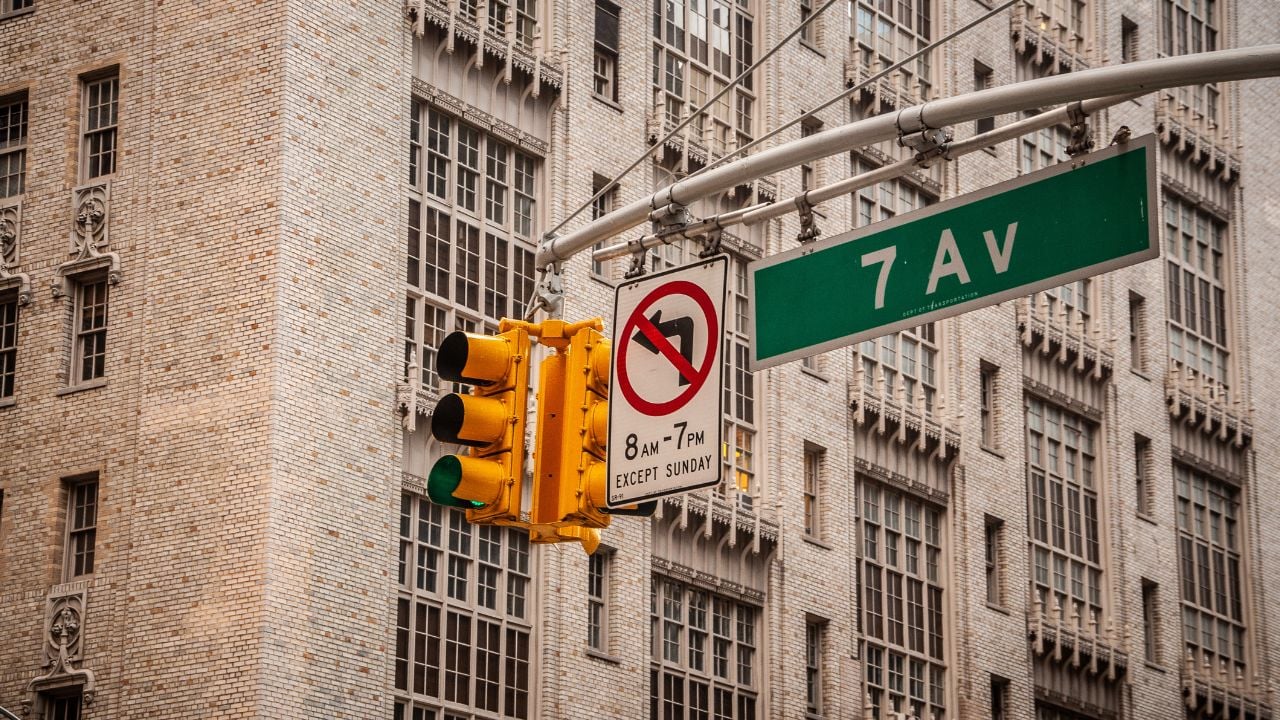
Red lights work one way across most of New York and the opposite way in New York City.
Outside the five boroughs, you can turn right on a steady red after a full stop, the same as almost everywhere else in the country.
Then you cross the New York City line.
New York City does the opposite.
You can’t turn on red anywhere in New York City unless a posted sign allows it.
A driver from Vermont makes that turn on instinct.
That’s a ticket.
One rule holds everywhere: A red arrow means no turn at all, whether you’re in New York City or the Finger Lakes.
School bus drivers carrying students can’t turn right on any red light in New York either.
4. No Wine in Groceries
Dinner shopping in New York splits into two errands.
Visitors find that out at the checkout.
Supermarkets sell beer and cider.
They don’t stock wine or liquor because the state puts those behind a separate license.
So, the steaks come from the store, and the cabernet comes from the shop next door.
The split runs both directions, too.
A liquor store will sell you a bottle of Finger Lakes riesling and a bottle of bourbon.
But it can’t legally sell you a six-pack of beer.
The timing gets stranger on Sunday.
A liquor store can open at 10 a.m., and the supermarket beer cooler opens later on Sunday mornings.
Locals hit the liquor store first.
5. Clothing Under $110
How much does a jacket cost in New York?
That depends on which side of $110 the price tag lands on.
Clothing and footwear priced under $110 per item skip the state’s 4% sales tax.
New York City drops its own local sales tax on those items too.
So a $109 pair of sneakers rings up with nothing added at the register.
Push that same pair to $110, and you pay tax on the whole price, not just the dollar that crossed the line.
One dollar matters.
Counties decide the local half for themselves.
Many of them still charge their own tax on that $109 jacket.
Cross a county line on the drive home, and you’ll pay a different total for the identical sweater.
6. Villages Sit Inside Towns
You can stand in two places at once in New York, and both names on the sign are correct.
A town in New York works more like a township, a slice of a county holding farmland, hamlets, and sometimes an entire village inside it.
That village keeps its own mayor, its own budget, and its own tax bill.
Anyone living in the village stays a resident of the surrounding town at the same time, and pays both tax bills.
The Village of Lake George sits inside the Town of Lake George, up in Warren County.
It’s two governments, one name.
Hamlets have no government whatsoever and borrow every service from the town they sit in, which is why a hamlet can have a post office, a firehouse, and no mayor.
Psst! How well do you know New York? Take our quiz and see if you can score 100%.
Quiz
New York State IQ
Answer ten questions on New York’s history, geography, and state symbols. We bet you can’t get them all right. Prove us wrong?
New York’s official state fossil is what kind of creature?
7. Cash Won't Pay Tolls
New York pulled the toll booths off the New York State Thruway years ago and never put them back.
Drivers new to the state still reach for a wallet on the approach.
The Thruway runs fully cashless.
Camera gantries sit over the lanes where the toll plazas used to stand.
Drivers pass under them at highway speed and never slow down.
You'll get the bill either way.
With an E-ZPass, the charge comes off the account.
Without one of those tags, the Thruway Authority looks up the registered owner through motor vehicle records.
That invoice arrives 30 to 45 days after the trip.
Renters have it worse.
Many rental companies pay the toll for you and add a daily service fee for the favor.
8. Nickels on Your Bottles
Buy a bottle of water anywhere in New York, and the total runs a nickel over the shelf tag.
That's the deposit.
State law adds 5 cents to soda, beer, plain water, and wine cooler containers holding less than a gallon.
You get the nickel back at the redemption machines parked near the supermarket doors, one bottle at a time.
Non-carbonated juice, iced tea, and sports drinks carry no deposit at all.
Half your cooler gets the nickel, and the other half doesn't.
Many visitors from Pennsylvania, where no deposit law exists, leave the empties in the hotel room.
Locals keep a bag in the trunk.
9. Food Names Change by City
Lunch across New York depends entirely on which part of the state you're standing in.
Order a garbage plate in Buffalo.
You'll get a blank stare.
That belongs to Rochester: Home fries and macaroni salad go under a couple of cheeseburgers, buried in meat sauce.
Nick Tahou Hots filed for the trademark in 1991, so rival kitchens sell the same pile as a trash plate, a junkyard plate, or a sloppy plate.
In Buffalo, beef on weck means roast beef piled on a kimmelweck roll crusted with salt and caraway seeds.
Cooks in Syracuse boil small potatoes in heavily salted water, drown them in butter, and call them salt potatoes.
In Binghamton, lunch is a spiedie: Marinated cubes of meat grilled on a skewer and pushed off into a slice of bread.
Buffalo and Rochester sit about 75 miles apart and can't agree on lunch.
Zero National Parks Statewide
New York holds more than 20 National Park Service sites and not a single National Park.
The federal list runs to monuments, historic sites, battlefields, the seashore on Fire Island, and the Statue of Liberty.
None of them carry that particular title.
That designation comes from Congress.
What New York built instead was a state park system.
The Oldest State Park
New York started its state park system at a waterfall.
Niagara Falls State Park opened in 1885, the oldest state park in the country.
Frederick Law Olmsted and Calvert Vaux drew the plan for it, and the state bought the land back from the mills and souvenir stands crowding the gorge.
Walking in still costs nothing.
Parking, the boat ride, and the elevator down to the gorge all carry their own price.
Olmsted's plan is why the American side still has a walkable shoreline and a stand of trees instead of a wall of hotels.
Goat Island, the sliver of ground between the American and Horseshoe falls, has stayed public since that 1885 purchase.
14 Things Upstate New Yorkers Are Sick of Explaining to Downstaters

Upstate New Yorkers field the same questions from downstate every summer, starting with where upstate even begins.
Nobody agrees on that line, and the answers get sharper from there.
14 Things Upstate New Yorkers Are Sick of Explaining to Downstaters
9 New York Tenant Rights Landlords Hope Renters Never Learn

A rent increase in New York comes with a notice deadline, and the number of days depends on how long you've lived in the apartment.
Renters who never learned that rule sign the new lease anyway.
