
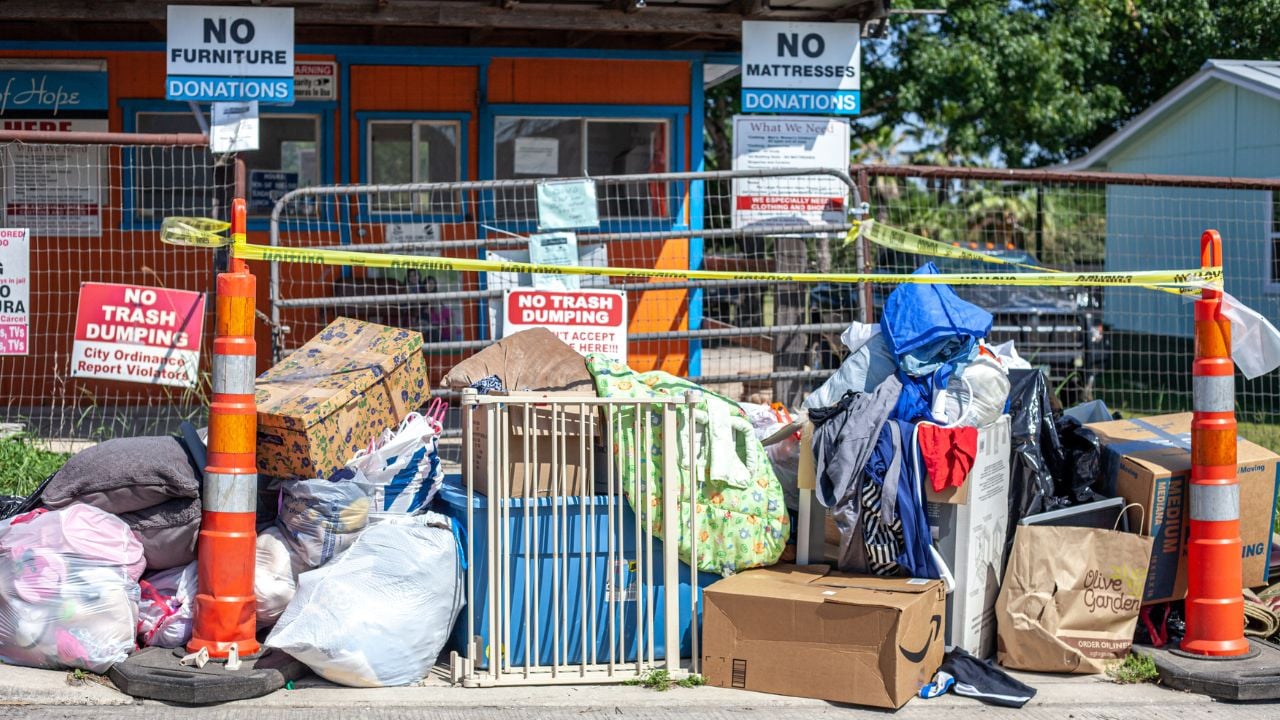
10 Texas Curbside Finds That Aren’t Necessarily Free for the Taking

Spot a couch, a busted mini fridge, and a stack of scrap metal sitting on the curb and figure it’s finders keepers?
Texas law says otherwise.
These are the Texas curbside finds that carry a legal catch, no matter how much they look like straight-up garbage.
Note: This is general information, not legal advice. City ordinances, state statutes, and their penalties are subject to change.
1. Curbside Recycling Bins
Curbside recycling bins in Texas carry more legal weight than the blue lid suggests.
Dallas’s own city code makes it a criminal offense for anyone besides the resident, city crews, a contracted hauler, or a registered charity to collect recyclable material set out at a house.
It’s not a technicality.
Texas law caps that kind of ordinance violation at $500, though a city can push higher fines for certain health and sanitation violations under its own code.
San Antonio and Austin run comparable rules through their own solid waste departments, since that same material is often tied to contracts that pay the city for it.
The paper and cans on top of a bin are worth money to somebody, just not to the stranger walking by.
2. Trash and Recycling Carts
Trash and recycling carts sitting at a Texas curb usually belong to the city, not the house in front of them.
Austin’s solid waste code states that carts issued by the city remain city property at all times, something a resident can’t sign over to a stranger even when moving out for good.
It’s not yours to give away.
Cities buy these carts by the thousand and track them by serial number, swapping them out block by block as households come and go, so the city tends to notice when a cart goes missing off a random Tuesday’s collection.
A resident who wants to keep an old cart has to ask the city first, not hand it to whoever likes the color.
3. Unmarked Curbside Couches
Couches left at a Texas curb send two different signals, depending on who’s looking.
To somebody furnishing an apartment, it reads as a free haul. To Texas law, it might still belong to whoever set it out ahead of a garage sale or a donation pickup that hasn’t happened yet.
Texas’ theft statute lists no abandoned-property defense.
Consent decides it, not appearance.
Value only determines which charge applies once a case gets that far, starting at a Class C misdemeanor under $100 and climbing from there.
A missing “free” sign isn’t the same thing as an owner saying take it.
What Counts as Abandoned in Texas
Texas treats abandonment as a choice an owner has to make on purpose, not a guess a passerby makes from the sidewalk.
A “free” sign, an actual city collection day, or somebody saying take it out loud are the kinds of proof that hold up.
Appearance alone proves nothing.
The dollar value of an item only decides which misdemeanor a theft charge lands on if somebody presses the issue. It never decides whether taking the item was legal to begin with.
4. Bulk Trash Piles
Bulk trash piles outside a Texas home during the city’s scheduled pickup week look like open season.
They usually aren’t.
Dallas’s ordinance covers solid waste broadly, not just recycling, so even during the correct week, only the owner, city crews, a contracted hauler, or a registered charity may legally touch that pile.
Timing counts too, since door hangers list an assigned collection week tied to the address.
A chair pulled from three houses down, on a week that isn’t even that block’s turn, may not be headed for a truck at all. It might just be somebody’s belongings, sitting outside for a different reason entirely.
5. Junked Curbside Vehicles
Texas law gives a broken-down car on a public street only 72 hours before it earns an official label: a junked vehicle.
Once that clock runs out, Texas Transportation Code Chapter 683 lets the vehicle be declared a public nuisance, the same category as a fire hazard or a hangout that invites vandalism.
It isn’t yours to take, either.
State law requires at least ten days’ written notice to the registered owner and any lienholder before a city can act. Even then, Section 683.078 allows removal only to a scrapyard, a licensed vehicle demolisher, or a site the municipality or county runs itself.
A rough-looking car sitting three houses down might already be someone’s open nuisance case, not an open invitation.
6. Loose Scrap Metal
Loose scrap metal at a Texas curb, an old water heater, a coil of copper wire, a busted radiator, comes with its own paper trail.
Texas Occupations Code Chapter 1956 requires any metal recycling entity buying it to log the seller’s ID.
It’s on the record now.
That rule exists because so much “scrap” turns out to be somebody’s heating and air conditioning (HVAC) unit or plumbing fixture pulled mid-project rather than actual trash, so a recycler that skips the ID check risks its own registration with the state.
A curbside find that seemed harmless can trace straight back to whoever sold it. A seller who can’t produce ID typically just gets turned away with nothing.
7. Detached Catalytic Converters
Detached catalytic converters lying near a stripped car at the Texas curb aren’t a finder’s dream.
State law requires anyone selling a converter to show the vehicle’s year, make, model, and a title or other proof of ownership. Holding a converter without that proof can bring a state jail felony.
Possession alone is the crime.
It doesn’t matter whether the car itself looks abandoned or has been sitting for weeks. The converter counts as regulated property from the moment it comes off the vehicle.
A Texas metal recycler has to turn away a seller who can’t produce that documentation, so a converter pulled off a curbside car often has nowhere legal left to go.
8. Leftover Campaign Signs
Campaign signs left standing in a Texas yard weeks after an election tempt more than a few passersby.
Ordinary Texas property law still covers it, since a sign usually belongs to a candidate, a party, or the sign-rental company that placed it, not whoever wants a keepsake.
The race ended.
The claim on the sign didn’t end with it. Campaigns or sign vendors often collect their own signs for weeks after voting closes.
Taking a sign before that happens can count as theft, or as criminal mischief if someone damages it along the way.
A yard that still has a sign up a month later isn’t a signal to grab it. It just means the owner hasn’t come back yet.
9. Curbside Renovation Dumpsters
Renovation dumpsters parked at a Texas curb look like the ultimate free-for-all, cabinet doors, tile scraps, and a busted water heater all in one pile.
The container almost always belongs to the hauling company, stenciled with its name for a reason.
Full doesn’t mean forgotten.
The homeowner or contractor paying for the rental is still on the hook for what’s inside until it gets hauled away, so a stranger clearing out a load isn’t just tidying up somebody else’s project.
Texas’ theft statute draws no line between something taken off a curb and something taken out of a rented dumpster sitting on it. The same missing abandoned-property defense that covers an unmarked couch covers whatever’s tossed in that bin.
A dumpster that’s three-quarters full by Tuesday morning is still somebody’s project, not somebody’s donation bin.
10. Eviction Piles
Eviction piles stacked outside a rental door rank among the harder sights on a Texas street. The law around them catches people off guard.
State law tells the officer handling an eviction where to place a tenant’s belongings, outside the unit and never blocking a sidewalk or a street, but it never says the property becomes abandoned or the landlord’s.
No line here says abandoned.
Some cities set out a portable container the tenant can pull from for a set stretch of time before the city clears it out, so a stranger picking through that pile might be taking something its owner is still planning to come back for.
Psst! How much do you know about Texas property law and curbside quirks? Take our quiz and see how many you can get right.
Quiz
Texas Property Law IQ
Answer these questions on Texas property law, litter rules, and curbside quirks. We bet you can’t get them all right. Prove us wrong?
A Texas sheriff or constable who confiscates an illegally placed campaign sign from a road right-of-way can eventually do what with it if the owner never claims it?
Constables handle these moves on a set schedule across Texas counties. The property sitting at the curb often includes furniture, boxes, and paperwork a tenant still wants back.
A neighbor who steps in to grab a lamp off that pile, thinking it's simply trash day come early, might be picking up the one box a tenant spends the next week searching for.
9 Little-Known Texas History Stories Even Longtime Texans Haven't Heard About

Ask a longtime Texan to name every battle fought on Texas soil, and many stop at two: The Alamo and San Jacinto.
There were dozens more, plus a ranch that once covered ten counties and a U.S. Army program that swapped horses for camels.
9 Little-Known Texas History Stories Even Longtime Texans Haven't Heard About
10 Texas Summer Rules Locals Follow That Newcomers Learn the Hard Way

Think the worst thing Texas' summer can cost somebody is a high electric bill?
Ask anybody who's spent a July night in an emergency room after reaching into a woodpile they couldn't see into first.
10 Texas Summer Rules Locals Follow That Newcomers Learn the Hard Way
