
8 Late-Summer Pests Wrecking Virginia Gardens and What Stops Them

Fall armyworm pressure in Virginia peaks from mid-August into mid-September, right as tomato season, squash season, and the last mow of summer all collide.
That’s one pest, on a two-week clock.
It’s rarely the only one working overtime in a Virginia yard by late August.
Here’s what’s already working through Virginia yards this deep into summer, and how to put a stop to each pest.
1. Squash Vine Borer
Squash vine borers turn a healthy Virginia squash or pumpkin vine into a wilted heap in the space of a day, usually sometime between July and late August.
The adult moth lays her eggs at the base of the plant, and the larva tunnels straight into the stem.
You won’t see a single bite mark on the leaves.
Look at the stem instead.
The whole life cycle from egg to pupa runs about 65 days, so a moth that lays eggs in June can still be causing fresh damage well into August.
Wet, sawdust-like frass piling up near a small hole at the soil line is the giveaway that a borer is already inside.
Slit the stem lengthwise near the hole with a clean knife, fish out the white larva by hand, and mound moist soil over the wound so the vine can root again above the damage.
The vine usually survives.
A syringe of Bt, short for Bacillus thuringiensis, squirted into the hole works too.
Virginia gardeners can also pull floating row covers off young plants once flowers open so bees can reach them and pollinate the vines.
Come fall, till under any vine a borer killed and turn the soil an extra time before frost, since that’s where the next generation overwinters as a pupa.
2. Fall Armyworm
Fall armyworm caterpillars hit Virginia lawns and garden beds hardest from mid-August into mid-September, the exact stretch this article is landing in.
The moths can’t survive a Virginia winter, so a new wave migrates north from warmer states and lays eggs across lawns, sweet corn, and sorghum every late summer.
Virginia saw one of its worst outbreaks in years in 2021, with reports arriving from Richmond and Henrico County within days of each other.
A patch of grass that looks like it’s moving is the clearest sign.
The caterpillars forage across turf by the hundreds, and birds often show up to feast right behind them.
Small caterpillars are easy to kill.
Grown caterpillars aren’t.
Treat early with a pyrethroid like bifenthrin, sold as Spectracide Triazicide, or a spinosad product like Bonide’s Captain Jack’s Deadbug Brew, both stocked at Southern States and many Virginia farm-supply stores.
Scout for them at dusk with a soapy-water flush: Mix a few tablespoons of dish soap into a gallon of water, pour it over a suspect patch, and watch for caterpillars to surface within minutes.
3. Squash Bugs
Squash bugs breed continuously through the warm months, and by August, Virginia’s summer squash, zucchini, and pumpkin vines often carry overlapping generations.
Adults from the first eggs work the vines alongside nymphs from a second batch.
The adults stay experts at disappearing the moment you go looking for them.
Flip a leaf over and look for a neat cluster of copper-colored eggs.
Crush them.
Adults and the gray nymphs that hatch from those eggs suck sap from the leaves, leaving yellow spots that turn brown and dry out.
A bad infestation wilts the whole plant almost as fast as a squash vine borer does.
The board-trap technique still works: Lay a flat board near the plants overnight, and squash bugs will shelter underneath it by morning.
Flip the board over each day and squash whatever’s hiding there.
Planting in mid-June instead of May dodges the worst of the egg-laying window, and butternut squash draws far fewer squash bugs than yellow summer squash or zucchini if you want to hedge next season’s bet.
4. Tomato Hornworms
Tomato hornworms, and their more common Virginia cousin the tobacco hornworm, do their worst damage in late summer, stripping a healthy tomato plant down to bare stems seemingly overnight.
Both caterpillars grow to about 3 inches long and hide in plain sight against the foliage.
The tobacco hornworm carries diagonal white stripes and a red horn.
The tomato hornworm has V-shaped white markings and a dark blue horn.
Two different bugs, same appetite.
Dark, pellet-like droppings on the leaves below usually give away where a hornworm’s feeding before you ever spot the caterpillar.
Hand-pick them into a bucket, or spray a Bt (Bacillus thuringiensis) product like Dipel on young caterpillars before they grow too big to kill easily.
Leave any hornworm covered in small white cocoons alone.
Those are parasitic wasp pupae, and the wasps that hatch from them will go hunt down more hornworms on your behalf.
Psst! How much do you know about Virginia’s gardens and the history behind them? Take our quiz and see how many you can get right.
Quiz
Virginia Garden IQ
Answer these questions on Virginia’s gardens and the pests that plague them. We bet you can’t get them all right. Prove us wrong?
Thomas Jefferson’s vegetable garden terrace at Monticello runs how long?
5. Spider Mites
Spider mites explode across Virginia gardens the moment a hot, dry stretch settles in, which is exactly what much of August delivers.
The twospotted spider mite alone attacks more than 180 different kinds of plants, from tomatoes and beans to roses and boxwood.
A leaf that looks dusty or bronze, covered in fine stippling instead of holes, is the first sign.
Tap a suspect leaf over a sheet of white paper, and tiny specks that crawl are the mites themselves.
A strong blast of water aimed at the leaf undersides knocks populations down fast.
Insecticidal soap from a brand like Safer Brand finishes the job.
Skip carbaryl, sold as Sevin.
It kills the mites' natural predators along with everything else, and infestations often come back worse within a week or two.
Keeping plants watered through a dry spell helps too, since drought-stressed plants draw mites faster than well-watered plants.
6. Stink Bugs
Stink bugs, brown marmorated and several native species alike, reach peak numbers in Virginia gardens in late summer, right when tomatoes, peppers, and beans are loaded with fruit.
Their piercing mouthparts leave discolored, dimpled spots on tomatoes and peppers, a condition growers call cat-facing.
Nymphs are far easier to kill than the tough-shelled adults.
Scout the undersides of leaves and treat while you still see the smaller, wingless stages.
Keep weeds mowed along fence lines and garden borders, where stink bugs shelter between feeding runs.
By September, expect adults to start showing up on siding, window screens, and porch furniture as they hunt for somewhere to spend the winter.
There's no fix for that.
7. Harlequin Bugs
Harlequin bugs zero in on Virginia's cole crops, and late summer is exactly when many gardeners set out a second round of collards, kale, and cabbage for fall.
The black-and-orange shield pattern makes adults easy to spot.
Impossible to miss.
Feeding leaves white stipples that brown and turn the leaf tattered, and a heavy infestation can wilt young transplants before they ever take hold.
Two to three generations hatch in a single Virginia growing season, so a few bugs in July can turn into a bigger problem by the time fall crops go into the ground.
Check leaf undersides for the barrel-shaped, black-and-white striped egg clusters and crush them on sight.
A trap crop of cleome planted a few feet away pulls harlequin bugs off the vegetables you want to eat.
Cover new transplants with floating row covers, sold at garden centers like McDonald Garden Center and Merrifield Garden Center.
Clear out spent crop debris at the end of the season so adults have nowhere left to spend the winter.
No debris, no shelter.
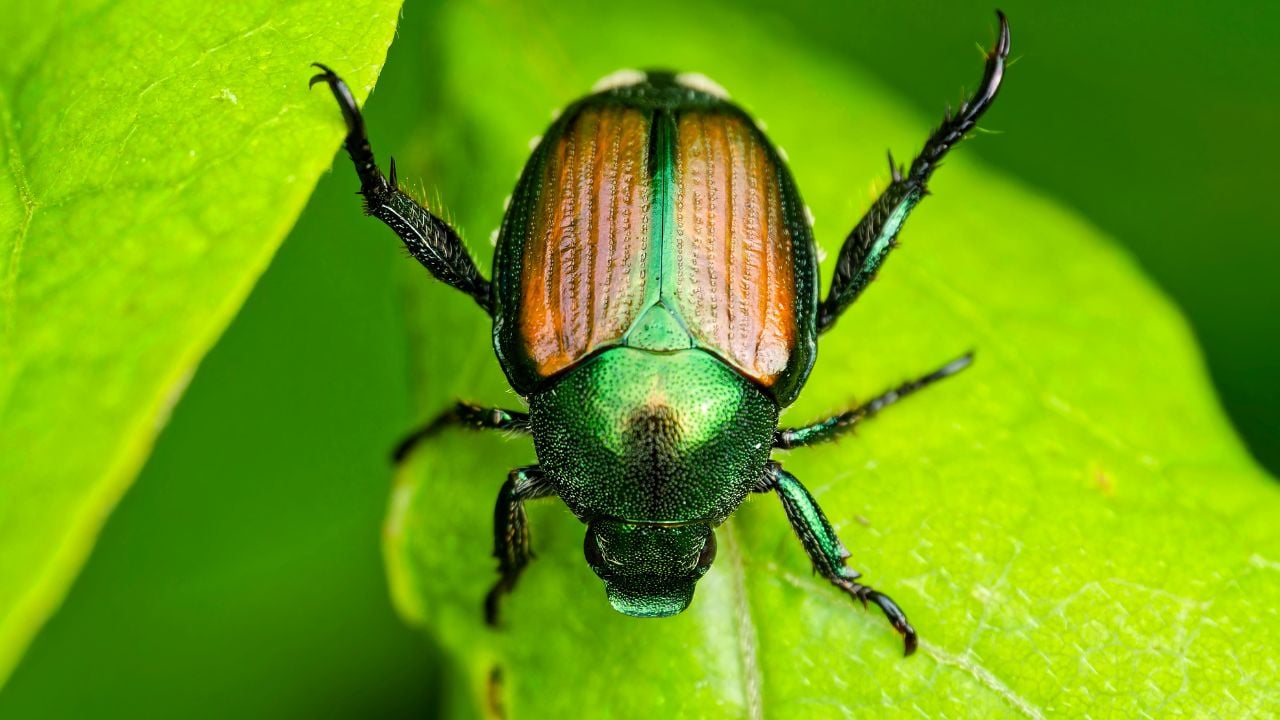
8. Japanese Beetles
Japanese beetles are still working over Virginia rose bushes, grapevines, and green beans well into August.
They skeletonize leaves down to the veins, leaving a lacy pattern behind.
Not subtle.
Hand-pick them in the cool part of the morning, when the beetles are too sluggish to fly off.
Beneficial nematodes applied to your lawn in mid-August, watered in well, target the grubs before they grow into next year's beetles.
St. Gabriel Organics, based in Orange, Virginia, sells a milky spore product through Southern States that aims at the same grub stage, though results run mixed from yard to yard.
Some Virginia gardeners set out Japanese beetle traps instead, hoping to catch the beetles before they reach the roses.
Beetle damage on beans and roses looks dramatic, but a single season of skeletonized leaves rarely kills an established plant.
The payoff shows up the following June, when a lawn treated with nematodes in August produces noticeably fewer beetles than the yard next door that skipped it.
Where a Japanese Beetle Trap Belongs
Japanese beetle traps release a scent that pulls beetles in from well beyond your own yard, and Virginia Cooperative Extension has found the traps often lure in more beetles than they ever catch.
A trap set near rose bushes or green beans backfires.
It draws extra beetles straight through the plants you're trying to protect on their way to the trap.
The fix is distance: 30 feet or more from anything you care about, ideally at the far edge of the property, so the beetles it does draw in land somewhere harmless.
10 Things Virginia Grandparents Did That Their Kids Would Never Allow Now

Virginia's grandparent generation let their kids bike across town with no phone check-in and come home when the streetlights hit.
The habits that raised that generation would get a modern parent an anxious phone call from the school.
10 Things Virginia Grandparents Did That Their Kids Would Never Allow Now
3 Virginia Historical Markers That Got History Wrong

A roadside marker outside Hampton stood uncorrected for two decades before a Hampton History Museum researcher proved part of it wrong.
Virginia has had to rewrite more of its own roadside history than many drivers realize.
