
9 Maryland Foods Nobody Makes Right in Other Parts of the U.S.

Walk into a restaurant outside the Chesapeake region advertising “Maryland-style” seafood, and the meal rarely tastes like what a native Marylander is used to.
These are the Maryland foods other parts of America keep getting wrong.
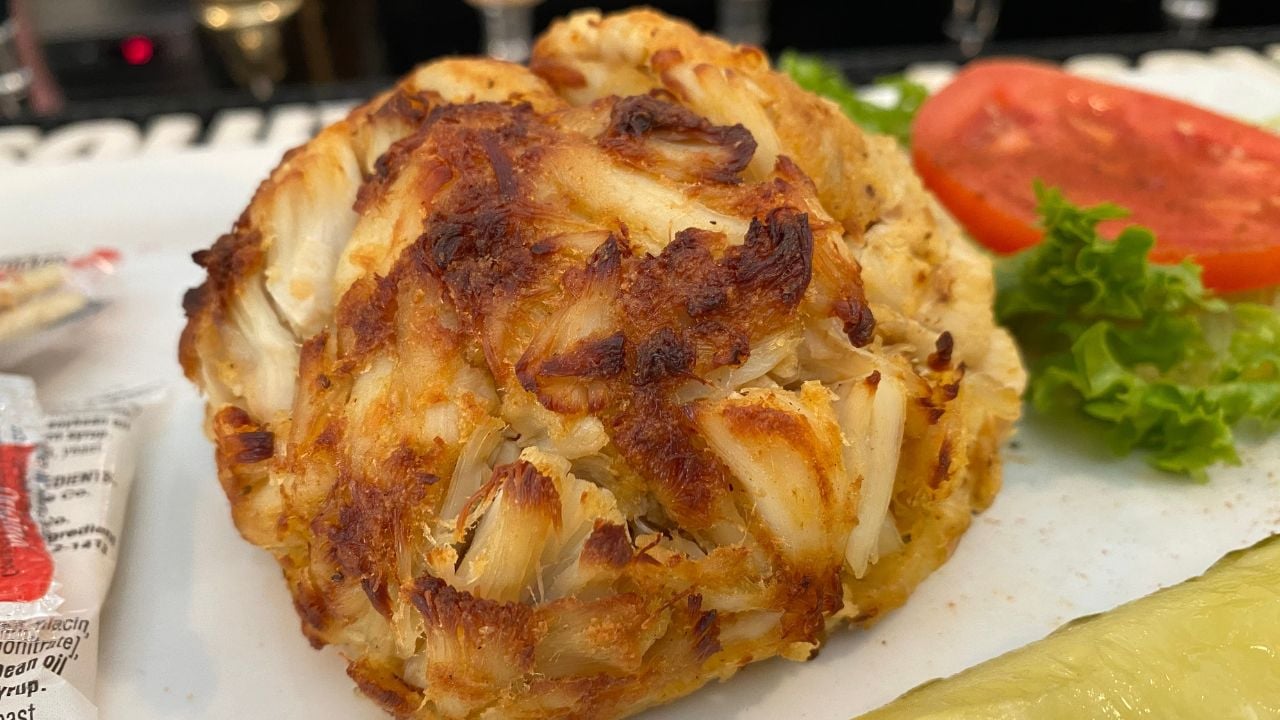
1. Maryland Crab Cakes
What holds a Maryland crab cake together?
Jumbo lump blue crab does nearly all the work, with only a few crushed saltines for binding, not a cup of breadcrumbs or a fistful of egg.
No filler. No hiding.
The Chesapeake Bay supplies roughly a third of the nation’s blue crab harvest, so cooks build a crab cake around that catch instead of stretching it with filler.
Restaurants outside the Chesapeake region often flip that ratio, breading a small amount of crab meat and deep-frying the whole cake until filler outweighs crab.
A cake built that way turns crisp and heavy instead of sweet and loose.
2. Berger Cookies
Berger Cookies get faked constantly once they leave Maryland, and the fake rarely survives a second bite.
Bakeries elsewhere spread a thin swirl of frosting on a sugar cookie, call it a Berger-style treat, and skip the one detail that defines the original.
The cookie traces back to a family bakery Henry Berger opened in East Baltimore, Maryland, in 1835, and the DeBaufre family has run the business since 1969.
The cookie itself barely factors into the equation, a thin, cake-like base built mainly to carry an enormous mound of hand-dipped fudge frosting on top.
The fudge is the point.
The Math Behind a Maryland Berger Cookie
Maryland’s Berger Cookies keep their ratio exact, not eyeballed.
Each cookie runs about 1.25 ounces total, and roughly an ounce of that weight is the fudge frosting on top.
The cake-like cookie underneath barely tips the scale at a quarter ounce.
A copycat baked outside the DeBaufre kitchen usually ignores that ratio, piling on a thin layer of icing that leaves the cookie tasting like dessert with frosting instead of a fudge-topped Berger Cookie.
3. Pit Beef
Pit beef in Maryland comes off a wide-open charcoal fire, not a smoker running low and slow for half a day.
Roadside stands along Pulaski Highway in Baltimore started serving it this way back in the 1970s, and the method hasn’t changed since.
The outside chars almost black while the center stays rare, then a worker slices it paper thin for a kaiser roll.
Horseradish, not sauce.
Once pit beef leaves the Baltimore area, cooks tend to treat it like Texas or Carolina barbecue and reach for a smoker instead of a hot grill, which changes the texture completely.
4. Coddies
Coddies are Maryland’s answer to a crab cake, pairing salt cod and mashed potato into a small fried patty, then sandwiching the whole thing between two saltine crackers with a smear of mustard.
One origin story credits the Cohen family with popularizing coddies, selling them for a nickel out of a delivery truck around Baltimore starting in the early 1900s, though Baltimore’s own historians also point to a Catholic parish kitchen, a Bohemian family recipe, and enslaved cooks working with cheap salt cod as competing claims.
Five cents was dinner.
Coddies never traveled far.
The dish stayed so tied to Baltimore that many other regions never built a version of it at all, so outsiders who attempt a coddie today usually plate a fried fish patty on its own, skipping the cracker-and-mustard sandwich that defines it.
The cracker replaces the bun entirely.
5. Smith Island Cake
Smith Island Cake became Maryland’s official state dessert on October 1, 2008, under a law passed to protect the recipe’s identity.
The traditional version stacks eight to ten layers of yellow cake, each one baked separately and thin enough to see through before the chocolate frosting goes on.
Thin layers, never thick slices.
Try to build a Smith Island Cake far from Maryland, and the layers usually shrink to three or four ordinary-thickness slices cut from a bigger cake, which saves hours of work but misses the entire point.
6. Maryland Fried Chicken
What makes Maryland fried chicken different from every other bucket in the country?
Done right, it’s pan-fried in a heavy skillet and finished with a milk-and-pan-drippings cream gravy poured right over the top.
Chicken à la Maryland was even on the Titanic’s first-class lunch menu that same day the ship struck the iceberg.
No gravy, no deal.
A nationwide chain called Maryland Fried Chicken has sold something else under that name since 1961, when a restaurant owner in Orlando, Florida, built the business around a pressure-fried recipe of his own.
The chain’s pressure-fried chicken, breaded with a 21-spice blend and cooked in peanut oil, looks nothing like the pan-fried, gravy-topped dish it borrowed its name from, and its founder was from Delaware, not Maryland.
7. Old Bay Seasoning
Old Bay gets home-blended wrong outside Maryland more than almost any other spice mix in the country.
Recipe developers spend weeks tweaking a copycat batch chasing the same roughly 18 spices, and even food writers who publish their best attempt admit it only comes close, not exact.
Close still isn’t Old Bay.
The seasoning came out of a Baltimore, Maryland, spice grinder’s kitchen in 1939, built by Gustav Brunn, a German-Jewish immigrant who survived a Kristallnacht arrest and two weeks at Buchenwald before his family emigrated to escape the Nazis.
Brunn blended up to 18 different spices into the mix, and paprika is still the hottest thing in the tin.
Outside Brunn’s own blend, homemade versions usually lean hard on paprika and cayenne for color and heat, while the quieter celery salt and warm-spice notes that balance it get lost.
8. Maryland Crab Soup
Maryland crab soup builds its broth from tomatoes, corn, potatoes, celery, and lima beans, all simmered together with lump crab meat and Old Bay.
That’s a completely different soup from she-crab soup, the cream-based bisque South Carolina claims as its own, thickened with crab roe instead of vegetables.
Two soups, two states.
Order “crab soup” at a seafood restaurant far from the Chesapeake, and a cream-based bisque shows up instead of the vegetable-packed original.
The vegetables are the whole point, and a bisque skips them entirely.
9. Baltimore Snowballs
Snowballs in Baltimore, Maryland, start with ice shaved so fine it turns fluffy, not the coarse, crunchy ice packed into a snow cone.
Kids chasing ice delivery wagons through the city in the mid-1800s begged for shavings to cool off, and mothers started sweetening them with a homemade egg custard syrup.
Snowballs earned the nickname “penny sundae” during the Great Depression, when the treat’s low price kept it within reach.
Egg custard, not blue raspberry.
A snowball stand far from Baltimore routinely reaches for coarse machine-shaved ice and bottled corn-syrup flavors instead, which turns the fine, syrup-soaking texture of a snowball into an ordinary snow cone.
Psst! How much do you know about Old Bay, Chesapeake crabs, and Maryland’s other food symbols? Take our quiz and see how many you can get right.
Quiz
Maryland Food IQ
Answer these questions on Old Bay, Chesapeake crabs, and Maryland’s other food symbols. We bet you can’t get them all right. Prove us wrong?
Maryland’s state boat, the skipjack, is the last commercial sailing fleet in North America. What did watermen use it to dredge for?
