

6 mPerks Rules That Cost Kentucky Meijer Shoppers the Discount

Meijer’s app puts more than $1,000 in mPerks savings in front of shoppers every week.
There’s work you need to do on your end, though.
mPerks can help you save money, but no rewards program is perfect.
These are the mPerks rules we think cost Kentuckians the most at Meijer.
1. Skipping the Digital Clip
Meijer’s mPerks app splits every digital coupon into two separate steps, finding it, then clipping it, before that price has any chance of hitting the register.
Nothing happens on its own.
A shopper who spots a promo on the shelf and assumes Meijer’s system will catch it automatically at checkout loses that price every time.
Shop and Scan, the app’s scan-as-you-shop checkout tool, speeds up a trip through the store, but it doesn’t touch coupons. A shopper still has to clip those in the coupon tab, not at the shelf.
Outside that feature, a normal register scan in Richmond or Lexington rings up an unclipped coupon at full price, no exceptions.
Meijer’s app puts more than $1,000 in mPerks savings in front of shoppers every week, and none of it applies to an item still sitting unclipped.
2. Forgetting Your mPerks Number
At every Meijer checkout, a purchase only earns mPerks credit when that account’s number reaches the register.
No number, no credit.
A shopper punches the phone number into the self-checkout screen, or hands it to the cashier at a staffed lane, and a personal identification number (PIN) confirms the account belongs to them.
Meijer’s app offers a shortcut around that PIN: Scanning the mPerks barcode straight from the phone.
Skip both the number and the barcode, and a cart full of clipped coupons rings up at full, unclipped price.
When does that happen most?
On a rushed trip, when a cashier is moving fast or a self-checkout line is backing up behind someone in a hurry.
The same mPerks login works in Florence, Richmond, or Lexington, so a number forgotten at one register is just as easily forgotten at the next.
3. Letting Points Expire
Meijer resets an mPerks balance that sits idle, and the window is shorter than many shoppers assume.
Grocery Dive’s coverage of the 2023 overhaul put the new clock at 90 days, up from just 45.
A separate report on that same rollout put it at 95 days instead, and Meijer’s own site doesn’t spell out a current number for shoppers to check today.
Nothing carries over.
A Kentucky household that banks points every couple of months can watch a whole balance disappear before it ever reaches a reward, and the countdown simply starts over empty with the next purchase.
Psst! How much do you know about Meijer’s history and Kentucky trivia? Take our quiz and see if you can ace it.
Quiz
Meijer and Kentucky IQ
Test yourself on Meijer’s roots and Kentucky trivia many shoppers never learn. We bet you can’t get them all right. Prove us wrong?
Before opening his first store in 1934, what was Hendrik Meijer’s trade?
4. Never Choosing a Reward
Meijer's 2023 mPerks redesign left points sitting until a shopper actively redeems them, instead of applying automatically.
A balance can sit in the app for weeks, technically available, while nothing comes off any receipt because nobody tapped redeem.
Nobody notices.
At checkout, nothing applies that reward automatically. A Meijer shopper has to open the app, pick a reward, and apply it before the total prints.
Skip that step often enough, and the same points that could have covered a meaningful chunk of a grocery run just expire instead.
5. Misjudging the 1,000-Point Floor
Meijer pays shoppers 10 mPerks points for every dollar spent, and the first reward doesn't unlock until that balance crosses 1,000 points.
A Kentucky shopper ringing up $65 a trip earns 650 points, not the full 1,000 the reward needs.
Not enough.
That shopper needs a second trip before the register even offers a dollar off, and anyone who assumes one normal grocery run clears the floor ends up leaving that dollar on the table.
Cross that line, and Meijer knocks exactly one dollar off the next total, no matter how far past 1,000 the balance grows before it's redeemed.
The Math Behind Meijer's Dollar Reward
Meijer's 10-points-per-dollar rate means 1,000 points equals exactly $100 spent at the register, not $100 saved.
A shopper who redeems right at that first threshold earns back one percent of what they spent.
That rate doesn't improve with a bigger balance, either.
6. Trading Points for Gas
At Meijer's pumps, mPerks points buy far less than they do at the register, and the gap catches shoppers who assume every point works the same everywhere.
Ten thousand points buys exactly one dollar off a gallon at a Meijer gas station. That's ten times the point cost of that same dollar taken off a grocery total.
That's a steep trade.
A Kentucky shopper who redeems a fresh 1,000-point balance at the pump gets a dime knocked off one gallon instead of a full dollar off the cart.
A full tank of gas rarely runs past fifteen gallons, so even a large fuel redemption tops out well under what the same points would have covered at the register.
A Meijer Express pump takes those points at that same steeper price no matter which Kentucky store issued them, from Florence to Richmond to Lexington.
Redeeming a fresh balance at the register instead turns it into money off the cart the same day, no gallons required.
9 Things That Change the Second You Cross From Ohio Into Kentucky
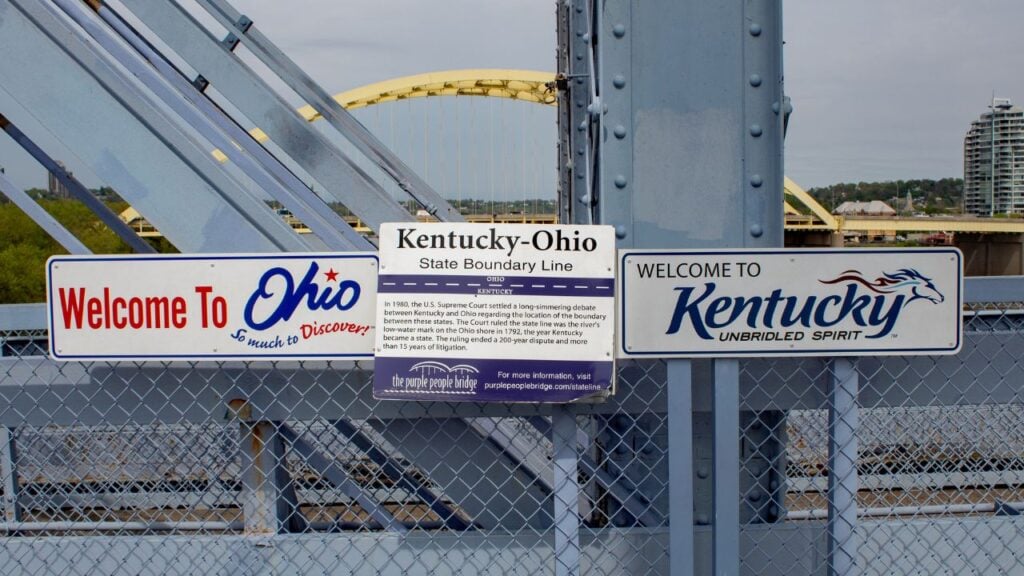
The Roebling Suspension Bridge carries drivers from Cincinnati into Covington, Kentucky, and almost nothing about the view gives away what just changed.
Built in 1867 as the longest suspension bridge on Earth, it also served as a prototype for the Brooklyn Bridge. It still marks a line where the tax on a receipt and the price at the pump both shift before the engine even cools down.
9 Things That Change the Second You Cross From Ohio Into Kentucky
9 Kentucky Foods That Horrify the Rest of the Country

Northern Kentucky's goetta is a pork-and-beef mixture stretched with steel-cut oats, a recipe German immigrants carried into the region generations ago, and one company, Glier's, still controls roughly 90 percent of the market.
Kentucky keeps a short list of dishes that read like a dare to everyone visiting from somewhere else.
