
6 Tree Laws Virginia Homeowners Only Learn About After a Dispute

In 2007, a neighbor’s tree roots cracked a masonry wall, worked into the water and sewer lines, and pushed up through the patio brick.
That fight reached the Virginia Supreme Court.
The lines the court drew that day are ones many homeowners don’t know exist.
These are the tree laws Virginia homeowners only learn about after a dispute.
Note: This is general information, not legal advice. Virginia’s tree laws and local tree ordinances are subject to change.
1. Self-Help Without Permission
Virginia lets a homeowner cut back a neighbor’s overhanging branches and invading roots without asking first.
That right predates the case many homeowners cite for it, Fancher v. Fagella, which the Virginia Supreme Court decided in 2007.
Those roots were the facts in front of the court.
The court preserved the self-help right in that ruling instead of creating it.
Homeowners still don’t need to prove the branches or roots are causing damage, and they don’t need the neighbor’s sign-off.
Trim at the property line, and Virginia law already backs the homeowner up.
2. Nuisance’s Proof of Harm
Virginia courts won’t order a neighbor to remove a whole tree just because it drops leaves, blocks a view, or hangs over a fence.
The same 2007 ruling set the bar higher: A tree only counts as a legal nuisance once it causes actual harm or poses imminent danger to the property next door.
Overhang alone won’t cut it.
Once cracked foundations or clogged gutters add up to provable damage, a homeowner can sue for an injunction, or ask a court to make the neighbor pay to fix it.
Courts also step in when the danger is imminent, even before anything breaks.
What Self-Help Covers in Virginia
Virginia’s self-help right covers only the homeowner’s side of the property line.
Cross onto the neighbor’s yard to do the actual cutting, and the job turns into trespass, self-help right or not.
The homeowner pays for that trim, too.
Self-help doesn’t shift that cost onto the tree’s owner unless the tree meets the actual-harm standard from Fancher v. Fagella and a court orders reimbursement.
3. Fallen Trees, No Automatic Fault
A falling tree in Virginia doesn’t automatically make its owner liable for whatever it lands on.
The Virginia Supreme Court settled that question in Cline v. Dunlora South, a 2012 case over a decayed tree that fell from private land and struck a passing driver on the road below.
The court ruled 4-3 that a landowner owes no duty over a tree’s natural decline, not even when the landowner already knew the tree was dying.
Knowledge alone doesn’t create the duty.
Liability turns on whether the landowner took an affirmative act that made the tree more dangerous than nature alone would have.
What the landowner knew, or should have known, plays no part in it.
Grading that undercuts a trunk’s roots or a cutting job left half finished both count as that kind of act.
A tree that simply dies on its own doesn’t.
That’s why Virginia homeowners lean on homeowner’s insurance for storm-felled trees instead of suing a neighbor, since the law rarely gives them a case.
Psst! How much do you know about Virginia’s biggest and oldest trees? Take our quiz and see how many you can get right.
Quiz
Virginia Tree IQ
Answer these questions on Virginia’s biggest, oldest, and newest tree news. We bet you can’t get them all right. Prove us wrong?
Virginia has more nationally recognized champion trees than any other state. About how many does it hold?
4. Triple Charges for Cutting a Tree
Virginia charges triple for cutting down a tree that wasn't the cutter's to cut.
Under Virginia law, anyone who cuts down another person's tree without permission owes three times the timber's value on the stump.
Once that trespass is proven, the burden shifts to whoever did the cutting.
That penalty applies whether the cutter is a landscaping crew, a contractor clearing a lot, or a neighbor who assumed a leaning pine was on their side of the line.
There's an exception: A homeowner who acted prudently, under a genuine claim of right, doesn't owe the triple penalty.
Picture someone who honestly believed a surveyor's stakes put a leaning pine on their side of the line.
5. The Same Act as a Crime
Virginia treats the exact same act as a crime, not just a lawsuit waiting to happen.
Cutting, injuring, or destroying someone else's tree, shrub, or plant without written permission is a Class 3 misdemeanor, separate from any civil case over the timber's value.
A criminal charge stacks on top of a civil case.
Police rarely step in over a few trimmed branches.
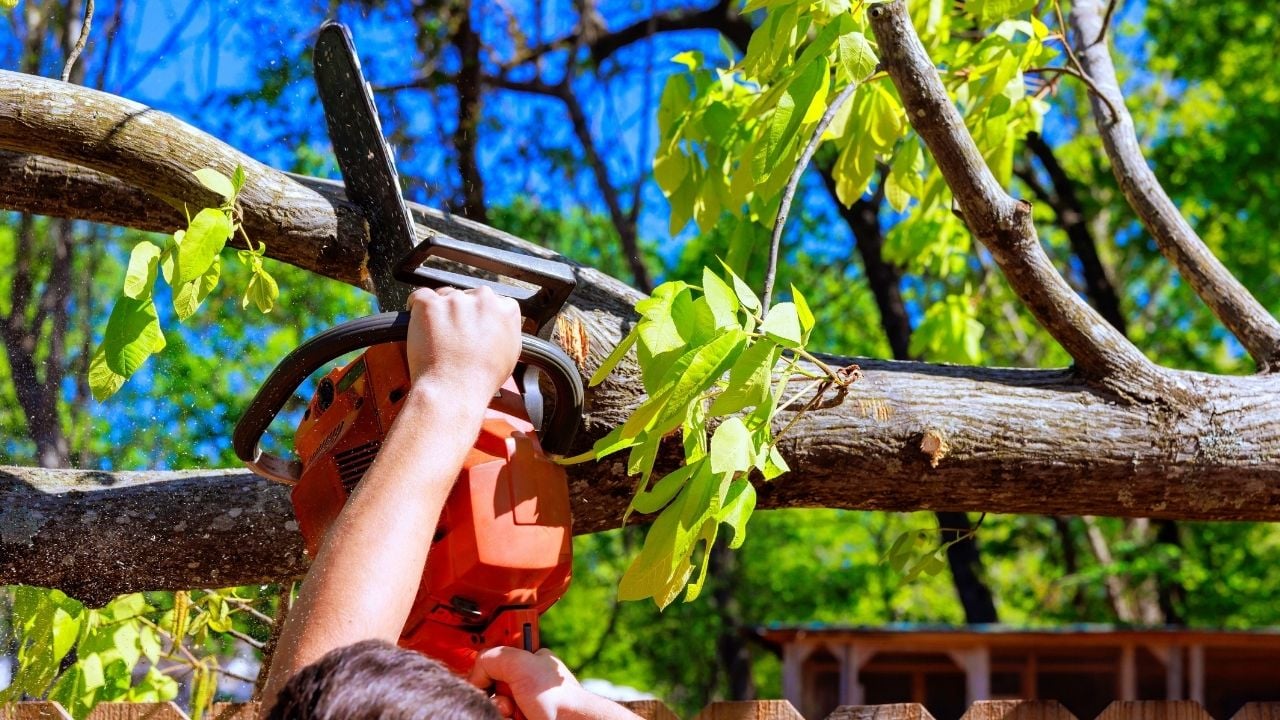
A homeowner who takes a chainsaw to a neighbor's tree without asking is exposed on both fronts anyway.
Written permission is the fix, and it can be as simple as a text message the homeowner keeps.
6. Trees That Can't Be Touched
Virginia leaves its biggest tree protections to city and county halls, not the General Assembly.
In Arlington County, a privately owned tree can earn Heritage, Memorial, or Specimen status.
A Specimen nomination has to score at least 75% of the smallest tree of its species already on Arlington's Notable Tree List for trunk size, height, and crown spread.
Heritage and Memorial nominations skip that math.
A Heritage tree needs documented historic or cultural significance, and a Memorial tree needs a documented event behind it.
Either path comes with conditions attached.
The county needs the owner's sign-off before it designates a tree on a single-family lot.
Nothing in Arlington's nomination materials says whether that protection carries over when the house sells to someone new.
Damage or remove a protected tree without the county's approval, and the civil penalty can reach up to $2,500 for each violation, the maximum Virginia law allows.
The Fast-Starting Clock
Virginia doesn't hand over triple damages automatically once a tree gets cut down.
The landowner has 90 days from discovering the cutting, and from learning who did it, to notify the responsible party and name a timber estimator.
If you miss that window, the case shifts from a fast, summary claim to an ordinary lawsuit, still possible but slower and more expensive.
Ninety days isn't long.
The accused cutter then gets 30 days to name an estimator or dispute the trespass.
The two estimators get another 30 days to agree on a number before either side can head to court.
The Exception, Not the Rule
Fairfax County is one of several Virginia localities that runs a similar program.
Fairfax handles it the same way Arlington does: Nobody gets special tree status without asking for it first.
The county never assumes that status on a homeowner's behalf.
A homeowner who never nominated a tree can cut down an ordinary oak or maple without a county permit standing in the way.
The paperwork only exists for the small number of trees somebody flagged.
Anyone unsure can call the county's urban forestry office directly, since the designation itself is what controls, not anything printed on a deed.
Arlington's Notable Tree page highlights only around 17 trees, a small fraction of everything growing on private land countywide.
All of those nominations came from a property owner who wanted the protection, not from a county inspector making the rounds.
9 Virginia Easement Mistakes That Cost Rural Property Owners the Most
Think a driveway a family has used for forty years automatically comes with a legal right to keep using it?
Not always. Virginia courts have sent rural landowners into years of litigation over exactly that kind of assumption, some all the way to the state's highest court.
9 Virginia Easement Mistakes That Cost Rural Property Owners the Most
9 Virginia Well Water Rules Rural Homeowners Get Wrong
More than 1.6 million Virginians drink water pulled from a private well, about a fifth of the state.
There's a lot of confusion about the rules that come with owning a well, and rural homeowners run into that confusion at the worst possible time.
