
11 Things Hoosiers Should Photograph Before Starting Storm Cleanup

Storms tore through more than 50 Indiana counties over an August week beginning Tuesday, August 11, and the Federal Emergency Management Agency (FEMA) approved an emergency declaration within days.
That part moved fast.
The next part, not so much.
What a Hoosier gets back from an insurer, or from FEMA, comes down to what they photograph before anyone touches a shovel.
These are the things Hoosiers should photograph before starting storm cleanup.
Note: This is general information, not insurance or legal advice. Coverage terms and FEMA deadlines are subject to change, so confirm the current details with your insurer, agent, or FEMA.
1. Roof and Siding
A Hoosier’s roof and siding get exactly one clear look before a tarp, a dumpster, or a fresh bundle of shingles covers up what the storm did.
Walk the outside of the house and photograph all four sides from the ground.
Get close enough on any hail bruising, cracked shingles, or torn siding that the damage fills the frame.
No blurry driveway shots.
The Indiana Department of Insurance tells homeowners to take photos and videos of storm damage before meeting with an adjuster.
Gutters and downspouts count too, since a section torn off the fascia shows up as a separate line on a wind claim.
2. Trees That Hit Something
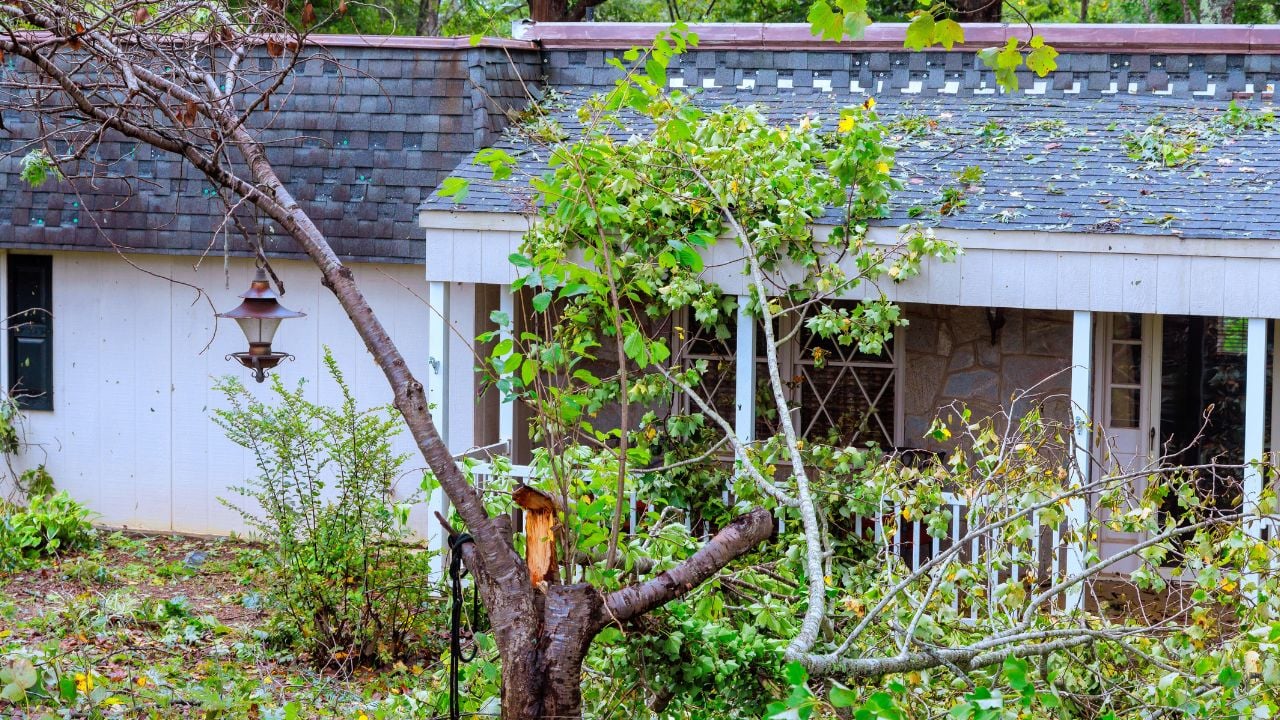
For a Hoosier staring at a downed tree, one fact decides the payout before the chainsaw ever starts: What the tree hit.
A tree that snapped a fence, crushed a porch, or came through the roof usually triggers covered removal, per Allstate’s claims guidance.
A tree that fell in the yard and hit nothing usually isn’t covered at all, not even the cleanup.
The point of impact decides the outcome.
Photograph exactly where the trunk or a limb made contact, the point of impact on the house or the fence, and the rest of the tree lying across the yard.
3. High-Water Line
Hoosiers who watched water rise inside their home are filing a flood claim, not the claim their homeowners policy covers.
Many homeowners insurance policies don’t cover flood water.
A flood claim runs through a separate National Flood Insurance Program policy instead.
Photograph the water line on the walls, the baseboards, and the furniture, both inside and outside the house, before anyone starts drying things out.
The line is the evidence.
Just 0.58% of Indiana homes carry an active flood insurance policy, per state insurance data, so a lot of Hoosiers are about to learn this distinction firsthand.
Indiana’s Two Different FEMA Declarations
Indiana’s storms produced two separate FEMA declarations, and they don’t cover the same ground.
An emergency declaration, approved August 15, covers 53 counties and pays for debris removal and other protective measures, not an individual homeowner’s claim.
A major disaster declaration came later and reached only 21 of the 54 counties Governor Braun requested, and it carries the 60-day window to register for individual FEMA assistance.
A Hoosier in one of the roughly 32 counties with only the emergency declaration doesn’t have that 60-day registration window at all.
4. Every Room
Every room in a Hoosier’s house needs a phone camera pass before anyone carries a single soaked box or broken lamp to the curb.
FEMA’s guidance is direct about it: Photograph the inside of the house room by room, including damaged belongings, before removing anything.
Closets and the garage count too.
Video helps.
A phone video walking through the house captures more than a stack of still photos, and it takes about the same amount of time.
5. Appliance Serial Numbers
The easiest documentation in the whole claim disappears the moment a Hoosier’s ruined washer or water heater goes out to the curb.
The room-by-room walkthrough catches an appliance in the frame, but it won’t catch what proves its value: The serial tag.
FEMA’s guidance names the exact appliances worth a close-up: Washers, dryers, water heaters, kitchen appliances, TVs, and computers, each with its make, model, and serial number visible in the shot.
The serial tag matters most.
A Whirlpool water heater and a Samsung TV file differently once that number is gone.
State Farm’s home inventory guidance calls for noting the manufacturer, the date and place of purchase, and the price too, since that rebuilds a claim a receipt alone can’t.
6. Damaged Vehicles
A car that sat in a Hoosier’s driveway or under a tree during the storm falls under a policy that has nothing to do with the house.
Homeowners insurance doesn’t cover a vehicle, ever, even when a tree from the yard is the thing that crushed it.
That claim runs through the comprehensive part of an auto policy instead, if the driver carries it.
No comprehensive coverage means no payout.
Photograph the car from all four sides, the dents, the cracked glass, and the vehicle identification number (VIN) plate on the dashboard, before it moves an inch.
Psst! Tornado records and FEMA trivia trip up more people than you’d think. See how many you can nail.
Quiz
American Storm IQ
Answer these questions on storm history, weather records, and how disaster relief works. We bet you can’t get them all right. Prove us wrong?
Which single event still holds the record as the deadliest tornado in U.S. history?
7. Fences and Detached Structures
Hoosiers with a wrecked fence, a collapsed shed, or a damaged detached garage are dealing with a smaller, separate pot of money than the coverage that pays for the house.
Many homeowners policies set what's called other structures coverage at about 10% of the dwelling limit, per Allstate's policy breakdown, which covers fences, detached garages, in-ground pools, and gazebos.
A $300,000 dwelling limit leaves roughly $30,000 for everything that isn't attached to the house.
Ten percent doesn't stretch far.
Photograph every fence panel that's down, the shed's roof and walls, and any pool damage separately from the house photos, since adjusters total them separately from the house damage.
8. Broken Windows and Doors
Hoosiers who find a shattered window or a door knocked loose after a storm are looking at damage that gets worse by the hour, not just by the day.
Every pane and every frame gets a separate photo.
Rain gets in, and so does anything else.
Photograph the break, the frame around it, and the mess it made inside before anyone sweeps up the glass.
A cracked pane and a blown-out window file differently, so get close enough that the difference shows.
9. Temporary Fix
Tarping a roof or boarding up a broken window is exactly what insurers expect from a Hoosier, but only if it can be proven.
The Indiana Department of Insurance tells homeowners to stick to emergency repairs and save every receipt for temporary work, since permanent repairs wait until an adjuster has inspected the damage.
Keep every invoice.
Photograph the tarp or the plywood once it goes up, so there's proof the fix was temporary and not a permanent repair made without an adjuster's sign-off.
10. Flooring and Carpet Samples
Hoosiers ripping out ruined carpet or warped flooring are about to throw away evidence right along with the padding underneath.
FEMA's guidance calls for more than a photo here: Keep physical samples of ruined carpet, flooring, wallpaper, or drapes for the adjuster to see firsthand.
A photo shows the stain.
A swatch shows exactly how far the water soaked through, which a picture alone can undersell.
Cut a square before it goes in the dumpster.
11. Debris Pile
Storm debris hauled to a Hoosier's curb takes the last physical proof of the damage with it.
In Hamilton County, curbside crews began collecting flood debris within days of the August storms, and crews can't step onto private property to grab anything left behind.
Curbside pickup happens exactly once.
Sort the pile the way the county asks, yard waste in one heap and appliances in another, but photograph each pile before pickup day, not after.
A dated photo of the pile is the only thing standing between a genuine loss and a guess.
No Waiting for Cleanup
A common belief among Hoosiers sitting in a half-flooded house is that FEMA or an adjuster has to show up before cleanup can start.
That belief costs them time they don't have.
Not true.
FEMA's fact sheet says the opposite: Residents don't need to wait for a home inspection or an insurance adjuster before beginning cleanup.
They just need to have already applied for help and documented the damage first.
Mold sets in within days, no matter where a claim stands.
Cushioned furniture, pillows, and soaked clothing left standing for a couple of days can turn into a health problem on top of a financial loss.
Photograph the moldy items quickly, then pull them out.
Bag each piece before it leaves the house, since a moldy cushion dragged through a hallway spreads spores to everything it touches.
8 Ways Out-of-Staters Break Buc-ee's Etiquette Before They Reach the Brisket
“Fresh, hot brisket on the board!” crackles over the loudspeaker inside a Buc-ee's, and half the store turns toward the barbecue counter at once.
Regulars already know the drill, but out-of-staters tend to learn Buc-ee's etiquette the hard way, one dirty look at a time.
8 Ways Out-of-Staters Break Buc-ee's Etiquette Before They Reach the Brisket
