
8 Louisiana Dishes That Change Two Parishes Over

Think a bowl of gumbo tastes the same no matter which Louisiana parish it’s ladled in?
Evangeline Parish gumbo runs on chicken and sausage.
Cross into the bayou parishes of Terrebonne and Lafourche, and Louisiana’s coastal cooking leans on seafood instead, a pattern 64 Parishes traces back generations.
These are the Louisiana dishes that change two parishes over.
1. Boudin Rouge’s Last Strongholds
Boudin rouge, the blood-based version of Cajun boudin, has declined in popularity across Acadiana, according to 64 Parishes.
Cross from Lafayette Parish into St. Martin Parish, and Breaux Bridge is still home to one of the last people making it the old way.
Babineaux’s Slaughter House has kept making red boudin there for generations, one of the last makers of it left in the area, according to the Southern Foodways Alliance.
Cottonport, in Avoyelles Parish, keeps the tradition going too.
T-Jim’s Grocery & Market in Cottonport is one of the few places left in Cajun country that still makes and serves it, according to the Houston Chronicle.
Everywhere else, white boudin, pork and rice with no blood at all, is what fills the case.
Not by accident.
State rules on handling blood tightened over the decades, and fewer butchers wanted the extra paperwork.
The red recipe faded out parish by parish while white boudin spread.
Today it mostly shows up folded into a gravy or served alongside a plate of cracklins.
Two towns held on anyway.
2. Henderson’s Tomato-Free Étouffée
Crawfish étouffée as many Cajun cooks make it today traces back to one kitchen in Henderson, a St. Martin Parish town on the edge of the Atchafalaya Basin.
In the late 1940s, a cook there stripped the tomatoes and garlic and celery out of a tomato-based courtbouillon, according to 64 Parishes.
In their place went butter, a light roux, and crawfish tails.
That version became the Cajun standard.
Rarely any tomatoes at all.
Head into New Orleans, and some Creole kitchens never dropped the tomatoes.
Cooks there still build étouffée on a butter roux with tomatoes stirred back in, the same base the Henderson recipe was built to replace.
3. Prairie Gumbo, Bayou Gumbo
Gumbo’s proteins have tracked Louisiana’s geography for generations, prairie parishes leaning on poultry while parishes along the water leaned on seafood, according to 64 Parishes.
Evangeline Parish, the prairie parish that includes Ville Platte and Mamou, still cooks its gumbo that old way: chicken and sausage in a dark roux.
Head south toward Terrebonne and Lafourche, and the bayou parishes’ easier access to oysters, crab, and shrimp shaped a different pot, 64 Parishes says.
Ross Lafleur, a chef at Kary’s Roux in Ville Platte, has said friends of his from Houma and Thibodaux grew up without chicken or sausage in gumbo at all.
Those friends leaned on seafood instead, the same pattern the rest of the coast follows, according to Country Roads Magazine.
Same bowl, different coast.
Gumbo’s Lenten Cousin
Louisiana gumbo takes a third form during Lent: gumbo z’herbes, an all-green stew built without meat or seafood.
Afro-Creole and German communities in Louisiana built it from mustard, collard, and turnip greens during Lent, according to 64 Parishes.
German households there traditionally served it on Holy Thursday, according to the same encyclopedia.
It’s still gumbo, just a version built for a fasting table instead of a boucherie.
4. LaPlace’s Smokier Andouille
Andouille sausage tastes different once a shopper crosses into St. John the Baptist Parish, home to LaPlace and the rest of the River Parishes.
Smokehouses there cure it longer and cut it coarser than the andouille sold almost anywhere else in the state, according to New Orleans Public Radio.
Grocery store versions outside the River Parishes tend to run milder.
Bigger and smokier.
That extra time in the smoke is the difference.
The River Parishes Tourist Commission has built a whole self-guided route around the tradition, called the Andouille Trail, that runs through St. Charles, St. James, and St. John the Baptist parishes.
Psst! How much do you know about Louisiana food history beyond gumbo and jambalaya? Take our quiz and see how many you can get right.
Quiz
Louisiana Food IQ
Answer these questions on Louisiana food history and trivia. We bet you can’t get them all right. Prove us wrong?
New Orleans coffee got its chicory habit from a wartime shortage. Which war?
5. Ville Platte's Plain Sausage
Smoked sausage and tasso change flavor again once a shopper leaves Evangeline Parish, home to Ville Platte's meat markets.
Butchers there season with only salt and red pepper, nothing else.
Just outside that stretch of prairie, in Lafayette, Alexandria, or Lake Charles, smokehouses add black pepper, paprika, garlic powder, and onion powder too.
Country Roads Magazine documented the split after visiting butcher shops on both sides of the parish line, including Ville Platte's Teet's Food Store.
Same cut of meat.
Different spice rack.
6. Jambalaya's Red and Brown Divide
Jambalaya splits into two camps depending on which side of the state a cook grew up on.
New Orleans keeps its jambalaya red, built with tomatoes, the way Creole cooks have made it for generations.
Head west into Acadiana, and Cajun cooks generally skip tomatoes, favoring a deeply browned base instead, according to 64 Parishes.
Red versus brown.
Same rice, same pot, two different results depending on which parish taught the cook.
7. King Cake's Savory Turn
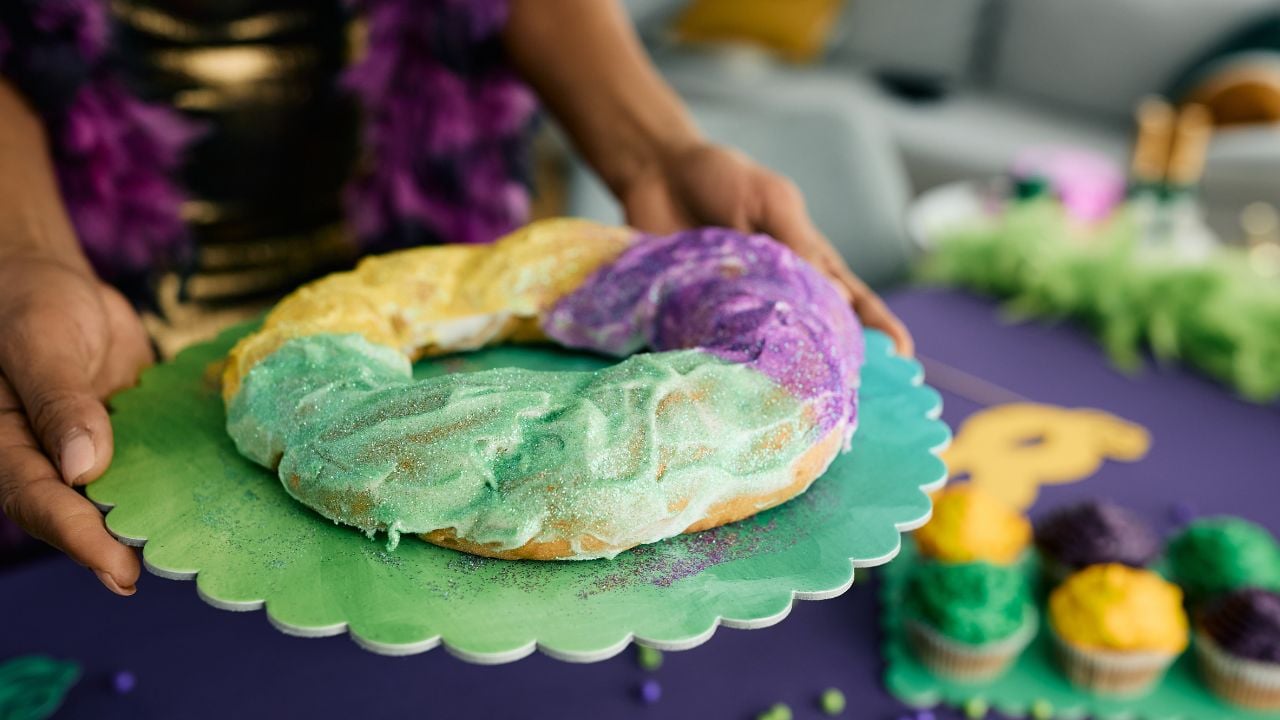
King cake changes filling once a baker crosses out of Orleans Parish and into Lafayette Parish.
New Orleans bakeries mostly stick to sweet brioche, filled with cream cheese or praline pecan.
Lafayette Parish bakeries sell that version too, plus something New Orleans rarely touches: savory king cakes stuffed with boudin, pepper jack, and tasso, according to The Advocate.
Boudin, under dough.
It turns the cake into something closer to a plate lunch than a dessert.
8. Two Kinds of Praline
The praline changes texture once a cook leaves New Orleans, the city that built the confection into the pecan candy the state is known for.
New Orleans pralines fold chopped pecans into a boiled mixture of sugar, butter, and milk or cream, according to 64 Parishes.
That mixture cooks down into a fudge-like disc.
Rural Louisiana kitchens skip the milk or cream, and what's left sets up stickier and chewier, still made from the same sugar and pecans.
Same pecans, different bite.
New Orleans pralines carry a history too, sold from baskets along city sidewalks by Black vendors called pralinières after the Civil War, according to 64 Parishes.
Psst! How many Louisiana food myths have you always assumed were true? Tap each card to see if it holds up.
What Barely Changes at All
Not every dish splits by parish.
Red beans and rice started as a Monday tradition in New Orleans, tied to wash day, according to 64 Parishes.
A slow-cooked pot needed little tending while the laundry got done.
The habit spread statewide long ago, and it never split into rival regional camps the way gumbo and jambalaya did.
A cook might swap in bacon drippings instead of a ham bone, or add a splash of tomato, but the dish itself travels parish to parish largely intact.
One pot, all 64 parishes.
Camellia Brand, a Louisiana company, has packaged the same red kidney beans that fill the pot for generations, according to 64 Parishes.
Louis Armstrong made the dish central to his life, and he'd head straight for a favorite New Orleans restaurant to eat it whenever he came home.
8 Louisiana Sayings That Leave Out-of-Towners Completely Lost
Louisiana calls every one of its 64 divisions a parish, not a county, the only state in the country built that way.
Spend a weekend with a Louisianan, and a handful of everyday words can sound like a different language.
8 Louisiana Sayings That Leave Out-of-Towners Completely Lost
9 Louisiana Towns Visitors Skip Because They Never Leave New Orleans
Louisiana has 64 parishes, and New Orleans sits inside just one of them.
The other 63 rarely make it onto a French Quarter itinerary, from steamboat towns to a strawberry capital an hour up the road.
9 Louisiana Towns Visitors Skip Because They Never Leave New Orleans
