
8 Ohio Church Festival Foods That Only Exist for One Weekend

Ohio’s food-safety code gives a festival kitchen five days at most before it has to operate like a full, year-round restaurant.
Church festivals stay inside that window.
Parish crews set up once a year on that five-day clock, using recipes that live nowhere but a family’s kitchen the other 360 days.
These are the Ohio church festival foods that only exist for one weekend.
1. Koulourakia at Akron’s Greek Festival
Koulourakia, a twisted butter cookie, is the reason Annunciation Greek Orthodox Church in Akron turns its social hall into a bakery every September.
Parish volunteers who’ve baked there for years run the operation.
They don’t make a small batch, either.
A single batch of dough starts with ten pounds of butter.
The crew mixes a dozen batches across several workshop days, landing close to 10,000 cookies before the festival opens.
Then it’s gone again.
The church runs a weekly Gyro Thursday the rest of the year.
The koulourakia stays a festival-only tradition, tied to the three days the parish spends together each fall.
2. Loukoumades at Columbus’s Greek Festival
Annunciation Greek Orthodox Cathedral fries loukoumades fresh for its Greek Festival in Columbus, honey-soaked dough balls served warm straight out of the oil.
Many Greek bakeries sell baklava and kourabiedes cold, off a shelf, any day of the week.
Loukoumades don’t keep that way.
They only work fried to order, so the cathedral keeps a fryer running for its Sept. 4-7 festival, alongside gyros, souvlaki, and moussaka.
No Columbus restaurant lists loukoumades on a menu.
The cathedral’s fryer is the only one making them in the city that weekend.
3. Koshari at the Egyptian Festival
St. Mary Coptic Orthodox Church in Columbus builds its Egyptian Festival around koshari, a layered dish of lentils, rice, pasta, and fried onions under a spiced tomato sauce.
You won’t find it on a menu around the city.
Not anywhere close.
The church runs the festival Friday through Sunday each August, alongside macaroni bechamel, grape leaves, and kebabs.
Central Ohio has few, if any, restaurants built around Egyptian home cooking.
The festival kitchen is the closest thing the region has to an Egyptian restaurant.
It’s open only for that one weekend a year.
Ohio’s Five-Day Rule for Festival Kitchens
Ohio’s food-safety code gives a festival kitchen a legal name, a temporary operation, defined as an operation running five consecutive days or fewer.
Cross that line, and the operation needs the same license as a standing restaurant.
That’s why a parish sets up a kitchen once, staffs it with volunteers instead of a paid crew, and takes it down again before Monday.
Many of the festivals on this list run two or three days for exactly that reason, well inside the five-day limit and gone before the week starts.
4. Tulumbi at the Macedonian Festival
The Macedonian Festival at Reynoldsburg’s Macedonian Orthodox Cathedral of the Dormition of the Virgin Mary fills its dessert case with tulumbi, a fried dough finger soaked in syrup, every September.
Nobody sells it the rest of the year.
The cathedral runs the festival over three days in September, with cevapi, cheese and spinach burek, stuffed cabbage, and a crepe station rounding out the menu.
Central Ohio has no Macedonian restaurant that publishes a menu.
Just the cathedral, once.
The cathedral’s parking lot is the only place in the region to try any of it, and only while the festival tents are up.
5. Burek at the Serbian Festival
Burek, a coiled phyllo pie stuffed with cheese or ground meat, is the draw at St. Stevan of Dechani Serbian Orthodox Church’s festival.
The church holds it a few weeks after the Macedonian Festival, on Columbus’s northeast side.
Not on any menu.
The parish bakes it for a two-day September weekend, alongside roast lamb, cevapi, and apple strudel.
Columbus doesn’t have a Serbian restaurant either.
A plate of burek here comes from a parish kitchen, not a menu, and it disappears again once the tents come down.
6. Cabbage and Noodles on Lagrange Street
Cabbage and noodles is the festival dish regulars line up for at Sts. Adalbert and Hedwig Parish’s stretch of Toledo’s Lagrange Street Polish Festival.
The parish and its neighboring church have run the street fair together for decades.
Pierogi get more of the attention.
Parish cooks season the noodles plain, with salt, pepper, and celery seed.
A visitor in 2010 paid around $5 for a plate, and parish cooks still sell it by the plate today.
Nothing fancy.
It’s a home recipe, cooked in a parish kitchen instead of a restaurant.
None of the Polish delis near Lagrange Street put cabbage and noodles on a regular menu.
It only turns up on the one weekend the festival takes over the street.
7. Cherry Pierogi in North Royalton
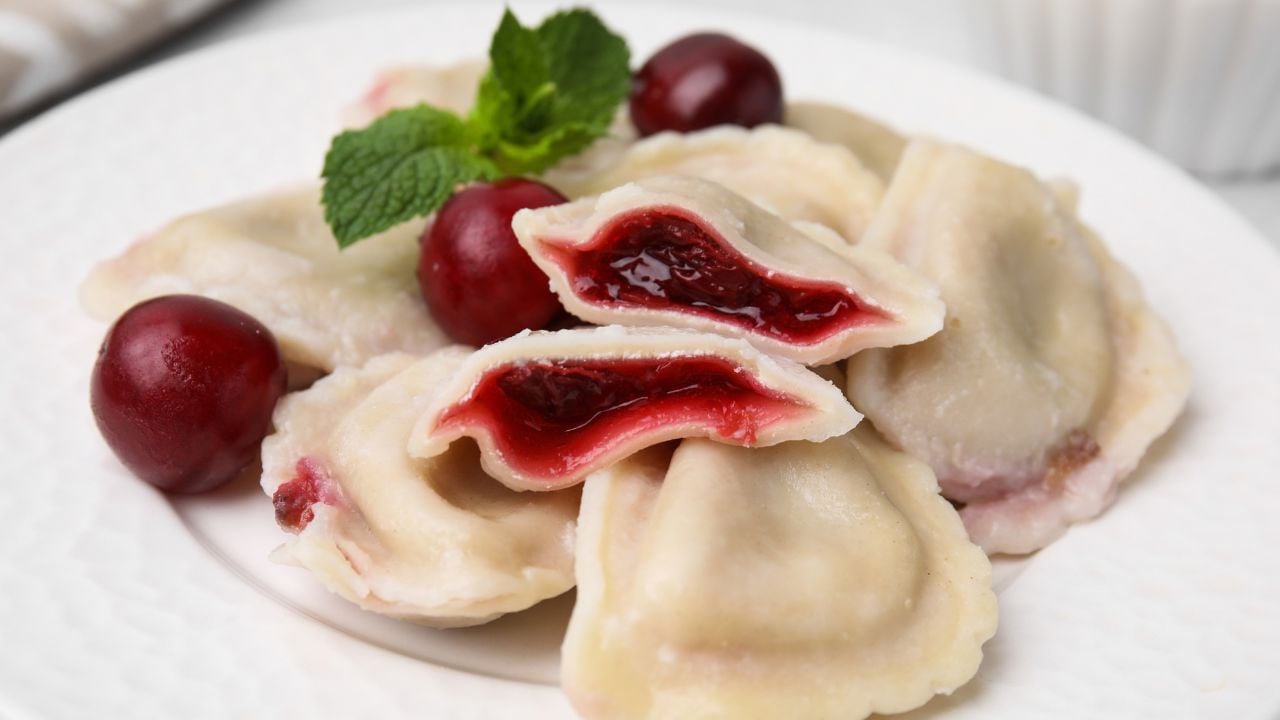
Pierogi, hand-folded dumplings stuffed sweet or savory, are the whole point of Holy Trinity Ukrainian Orthodox Church’s Pierogi Fest in North Royalton.
The festival folds them in five varieties, potato, sauerkraut, sweet cheese, blueberry, and cherry.
You won’t find the blueberry or cherry versions at a grocery store deli counter.
Grocery shelves stop at potato.
Borscht, cabbage rolls, and belyash, a fried meat pie, round out the table, all folded and cooked by church volunteers for the one weekend the festival runs.
Psst! How much do you know about the immigrant communities that shaped Ohio’s cities? Take our quiz and see how many you can get right.
8. St. Ambrose’s Chicken Dinner
St. Ambrose Church in Garrettsville has served the same meal since 1959, a home-cooked chicken dinner plated by parish volunteers on the last Saturday and Sunday of June.
No caterer runs the kitchen.
Parishioners also bake roughly 600 pies for dessert, some from scratch and some doctored up from a store-bought crust.
The weekend stands as the parish’s biggest fundraiser of the year.
Skip that weekend in June, and the dinner is gone until next year, since no restaurant in Garrettsville lists a home-cooked chicken dinner like it the other 363 days.
Volunteers fold up the tables, scrub the roasters, and scatter back to regular life until next year’s calendar comes back around to the same weekend.
Sunday service runs until 6 p.m., and that’s it until the last weekend of June comes around again.
7 Ohio Traditions That Have All but Disappeared in the Last 20 Years

Parish festivals are only part of the story. Ohio’s Catholic parishes have also been closing and merging for years, and the count of Sunday regulars has fallen right along with them.
Several other everyday Ohio habits faded out the same gradual way, long before anyone printed a farewell notice.
7 Ohio Traditions That Have All but Disappeared in the Last 20 Years
5 Ohio Gas Station Foods Tourists Refuse to Believe People Actually Buy
Not every Ohio food tradition needs a parish hall or a folding table. Some of the state’s most talked-about eating happens under gas station lights instead.
Out-of-staters pull off the highway expecting a candy bar and leave with something they didn’t know a gas station could sell.
5 Ohio Gas Station Foods Tourists Refuse to Believe People Actually Buy
