
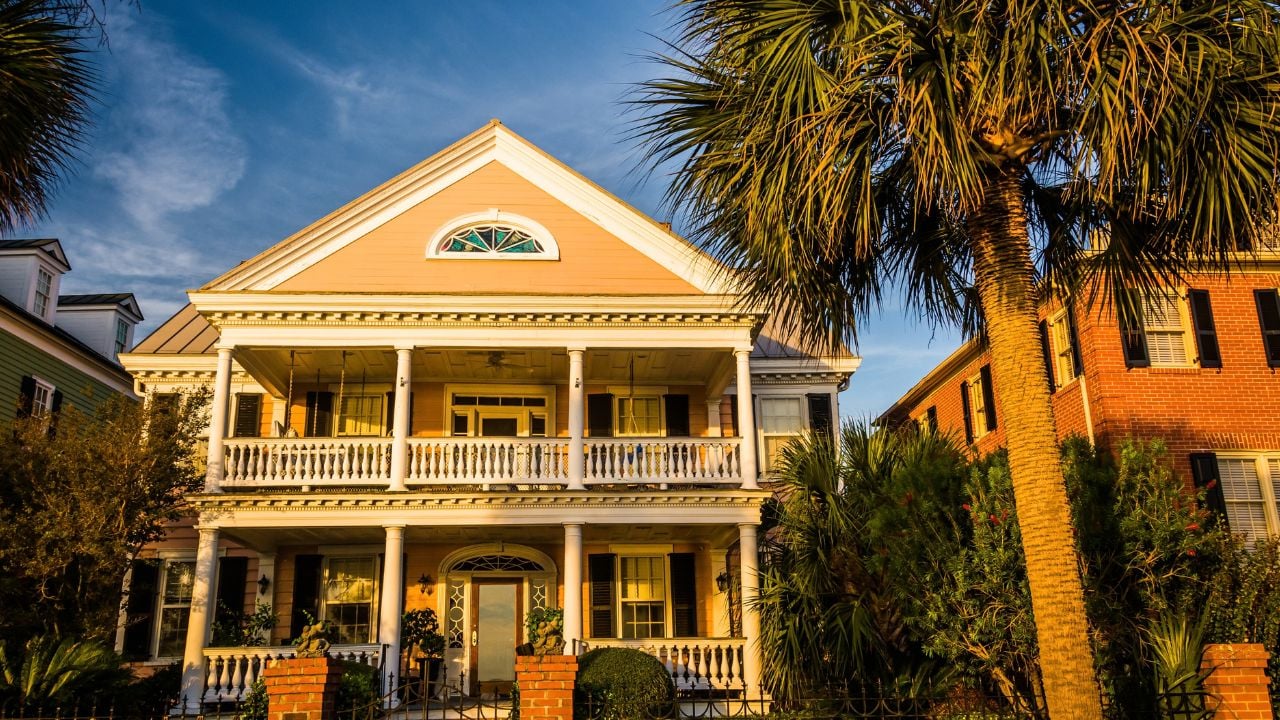
5 South Carolina Porch Traditions Rooted in Charleston and Gullah Geechee History

The Preservation Society of Charleston is walking visitors past dozens of historic homes this month, during its annual Fall Tours.
Many of those visitors don’t know why the porches they’re touring look the way they do.
Every detail has a reason.
These are South Carolina porch traditions rooted in Charleston and Gullah Geechee history.
1. Charleston Green Porch Ceilings
Charleston’s grandest porches carry a paint color found almost nowhere else in the country.
It’s a near-black green called Charleston Green.
Historic Charleston Foundation’s director of museums traces the color to the years right after the Civil War, when the federal government supplied residents with black paint under Reconstruction.
Charlestonians mixed in a little yellow and green pigment to brighten the flat black.
The shade stuck long after the paint shortage ended.
Charleston Green still covers porch ceilings across the city’s historic homes today, distinct from any other shade the state’s porches are known for.
A whole different story.
2. Haint-Blue Porch Ceilings
Charleston’s porches carry a second protective paint color alongside Charleston Green, a pale blue shade known as haint blue.
The color grew out of Gullah culture, the community that formed on South Carolina’s Sea Islands as enslaved West Africans blended African traditions with English influence.
Charleston tour guide Alphonso Brown says some families paint a porch ceiling blue simply because they like the color.
Other families paint it blue to keep evil spirits away, Brown says.
Some also believe the color keeps wasps and other bugs from nesting under the roof.
Citadel history professor Damon Fordham traced the belief back through oral histories with Gullah families from the 1930s and 1940s.
Architectural historian Christina Butler found the earliest newspaper use of the term only in 1985, showing how much of this history survived only in spoken memory.
Historic Charleston Foundation’s Lauren Northrup says the popular idea that the color came straight from indigo dye probably isn’t true.
Indigo doesn’t hold color well in exterior paint.
The dye would have faded even faster under Charleston’s old lime-based whitewashes.
Two colors, two different reasons.
3. Charleston’s Stacked Piazzas
Charleston’s single houses, the narrow homes with a side porch called a piazza, became common across the Charleston peninsula by the mid-1700s.
A defensive wall enclosed just 62 acres of colonial Charleston.
Narrow single houses with stacked piazzas fit neatly onto those cramped lots.
Enslaved builders did the physical work of putting up nearly all of that early architecture, piazzas included.
A single house’s piazza could run a single story or stack two or three stories high, depending on how much its owner could afford to build.
The grandest versions climbed through the classical column orders, plain Doric on the ground floor and fancier columns above it.
Humbler single houses made do with a single-story piazza and no columns at all.
Wealth built the columns.
The Preservation Society of Charleston still walks visitors past these piazzas every fall, during its Fall Tours, which run each October through downtown’s historic neighborhoods.
Charleston’s Piazza Word
Charlestonians started calling their porches piazzas around 1730, according to architectural historian Carl Lounsbury, likely borrowed from visitors or settlers arriving by way of the Caribbean.
The word traces back further, to the Latin and Italian piazza, meaning an open square.
London architect Inigo Jones bent that meaning when he designed the arcaded square at Covent Garden.
People started applying piazza to a sheltered space after that, instead of an open square.
Charleston’s neighbors up the coast in Virginia and New England used the same word for a while, then dropped it for porch.
Jonathan Poston, author of The Buildings of Charleston, says Charlestonians simply tend to hold onto old traditions longer than many places do.
Charleston’s preservation rules still use the word today, treating a piazza as a protected architectural feature separate from an ordinary porch.
4. Freedman’s Cottage Porches
Charleston’s grandest single houses weren’t the only homes built with a piazza.
After the Civil War, builders put up small one-story homes called Freedman’s Cottages across the city, built for freed Black Charlestonians along with immigrants and working-class white residents.
Every one of them carried the same narrow piazza running along one side, just like the grand single houses across town.
The design crossed from mansion to modest cottage without changing shape.
A survey more than two decades ago found 106 Freedman’s Cottages still standing on Charleston’s Upper Peninsula.
Many have sat empty for decades since, including a cottage on Line Street that collapsed after 60 years without a resident.
Tourists photographing Charleston’s grand single houses downtown rarely notice a Freedman’s Cottage a few blocks over, even though its porch shares the same design story.
The piazza outlasted the house.
Psst! How much do you know about Charleston and Lowcountry home history? Take our quiz and see how many you can get right.
Quiz
Lowcountry Porch Pop Quiz
Answer these questions on Charleston and Lowcountry home history. We bet you can’t get them all right. Prove us wrong?
A 1931 preservation project by decorator Dorothy Haskell Porcher Legge gave Charleston’s East Bay Street the pastel colors behind which famous stretch of homes?
5. Blue Bottle Trees
Gullah Geechee families along the coast still hang bottle trees in their yards, often within view of the porch.
The custom traces to West Central Africa, carried over by enslaved ancestors, according to College of Charleston professor Dr. Kameelah Martin.
The belief holds that glass bottles trap harmful spirits overnight.
The spirits fade away with the morning dew.
No spirits, no trouble.
Blue glass is the color of choice, tied to indigo, once one of the Lowcountry's biggest cash crops, and to spiritual meanings carried over from West Africa.
Sixth-generation sweetgrass weaver Corren Alston keeps the custom going as a way of holding onto her family's traditions.
Bottle trees still dot yards up and down the coast today, from Beaufort to the Charleston peninsula.
Corren Alston learned to build a bottle tree at six years old, taught by her mother, father, and grandmother.
The National Park Service protects that heritage through its Gullah Geechee Corridor, which stretches across four states, from Wilmington, North Carolina, to Jacksonville, Florida.
7 Humble South Carolina Ingredients That Somehow Became Gourmet
High Wire Distilling put 570 bottles of Jimmy Red bourbon corn whiskey on sale in Charleston in December 2016, and buyers cleared the shelf within an hour.
That corn had nearly disappeared along with the last bootlegger still growing it, and it's far from the only South Carolina ingredient that almost didn't survive.
7 Humble South Carolina Ingredients That Somehow Became Gourmet
7 South Carolina Town Names Even Longtime Residents Say Wrong

South Carolina residents will confidently correct a tourist's pronunciation of a hometown road, then turn around and butcher the name of a town two counties over.
The state is full of names that look like one thing on a road sign and sound like something else once a local says them out loud.
7 South Carolina Town Names Even Longtime Residents Say Wrong
