

10 Things Florida Neighbors Can Report You For That Are Perfectly Legal

A neighbor spots your clothesline and reaches for their phone.
But in Florida, state law protects it, so their complaint may go nowhere.
These are the things Florida neighbors can report you for even though they’re perfectly legal.
Note: This is general information, not legal advice. Local ordinances, homeowners association (HOA) rules, and state statutes vary by community and are subject to change.
1. Solar Panels on the Roof
Solar panels draw a neighbor’s complaint to the HOA almost as often as they go up, and many boards still try to make them disappear.
The panels win.
Florida Statute 163.04 blocks a deed restriction, covenant, or association rule from banning a solar collector on a home outright.
A board can ask that the array face south, or within 45 degrees of it, but that’s the extent of its say once the panels work.
Nothing else survives a challenge.
2. Clotheslines in the Yard
A clothesline strung across a backyard draws almost the same neighbor complaint as a solar panel, and the law treats the two exactly alike.
The same law that protects solar collectors names clotheslines directly and blocks a board from outlawing them too.
Drying racks count too.
A community can require the line be tucked out of street view, but it can’t forbid the practice altogether just because it dislikes the look of laundry outside.
3. Running a Business From Home
A home business that never sends a stream of customers to the curb is harder to shut down than many Florida neighbors assume.
Florida Statute 559.955 stops a city or county from licensing, restricting, or banning one, as long as it stays secondary to the home’s residential use.
Two outside workers, max.
The business can bring on up to two employees or contractors who live elsewhere.
The house still has to look ordinary from the street, with no sign or equipment noise that gives it away.
4. Registered Cars in the Driveway
An old, faded car sitting in a driveway pulls in complaints from neighbors who assume looks alone make it a violation.
Looks aren’t the test.
Pasco County’s ordinance, like many Florida county codes, defines a violation by whether a vehicle is inoperative or unregistered, not by rust or a dented fender.
A car that still runs and carries a current tag can sit in that driveway indefinitely, no matter how it looks parked next to a neighbor’s newer model.
5. Grass on the Long Side
Grass that’s crept past a normal mow still isn’t automatically a code violation, even when a neighbor thinks it should be.
Hernando County only cites a property once its grass or weeds top 18 inches within 100 feet of another home, a set line rather than a guess.
Under that, it’s fine.
Report the yard to code enforcement today, and the complaint doesn’t move without a name attached.
A 2021 law requires anyone who files a complaint to hand over their name and address first.
Psst! How many of these Florida neighbor complaints would hold up in front of a code officer? See if you can call it before you tap.
6. Boats and RVs Out Back
A boat or recreational vehicle (RV) parked at a house draws a neighbor’s report to code enforcement almost the moment it shows up, especially in a tighter subdivision.
Miami-Dade County, like many Florida counties, allows one RV or boat per property once it sits behind the front building line, carries current registration, and looks presentable.
One rig, one spot.
It can’t double as a guest house, either. Using it for sleeping, storage, or full-time living voids the exemption fast.
7. Fences Built to Code
A privacy fence going up next door tends to draw a neighbor’s call to code enforcement before the last post even sets.
Many Florida cities cap a backyard or side fence at 6 feet and a front-yard fence at 4 feet.
Palm Bay and Hollywood both use those exact numbers.
Height alone isn’t a violation.
8. Second Yard Sales
A yard sale sign at the end of the driveway draws more reports than many Florida homeowners realize, usually from someone convinced there’s a limit already broken.
Miami-Dade County allows two garage sales a year per address, and a second one within that stretch is well inside the rule.
The cap resets every year.
Go past the limit, or skip the rule against posting signs on the public right-of-way, and that’s the version that draws a citation.
9. Mowing Inside Legal Hours
A mower running at 7 in the morning gets many Florida neighbors dialing code enforcement before their coffee’s even ready.
West Palm Beach’s noise ordinance exempts lawn equipment between 7 a.m. and 8 p.m., so a mower running inside that window isn’t breaking anything.
Timing is what counts.
Run it at 6 a.m. or well after dark instead, and the same ordinance stops covering the noise.
Noise Hours Change by County
Florida sets no single statewide start time for noisy yard work, so West Palm Beach’s window isn’t the window everywhere.
Collier County exempts lawn care from 7 a.m. to 10 p.m., two hours later than West Palm Beach’s 8 p.m. cutoff.
Check the ordinance where the mower runs before assuming either window applies.
10. Backyard Hens
A few hens scratching around a backyard still draw a report to Florida code enforcement from neighbors convinced no residential lot allows it.
Hillsborough County has allowed up to five hens on a residential property since 2020, with no rooster in the mix.
No rooster, no problem.
St. Petersburg allows chickens under its code too, as long as the coop sits at least 100 feet from a neighboring house without that neighbor’s written sign-off.
Move the coop closer than that without asking, and the flock crosses into the one setup code enforcement can cite.
8 Documents You Need to Sell a House in Florida Without a Realtor
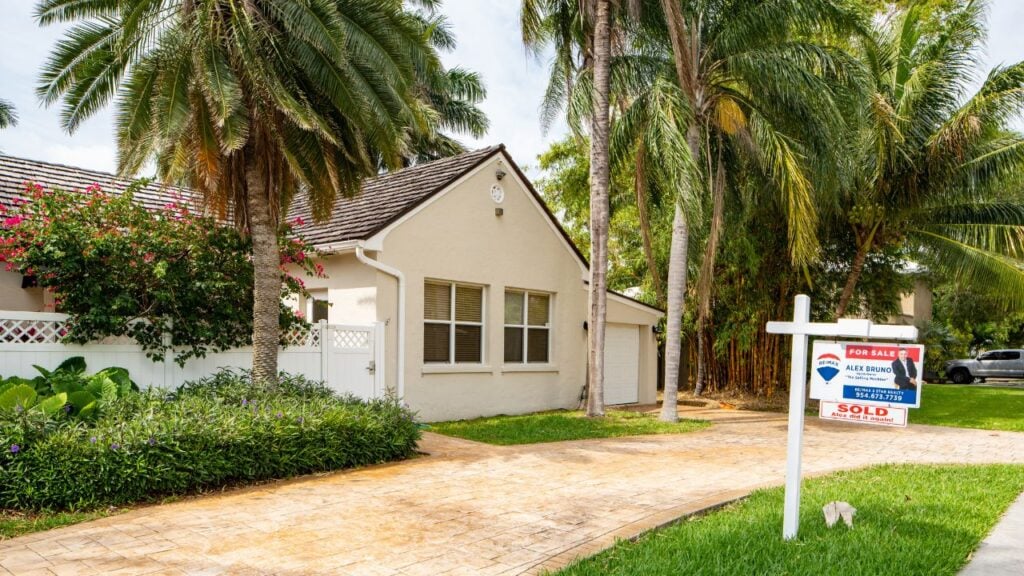
Florida charges a documentary stamp tax of 70 cents per $100 of a home’s sale price, a fee that lands the moment the county records the deed.
Selling a house without a realtor doesn’t cut a single document from that stack. It just means nobody’s left to chase them down.
8 Documents You Need to Sell a House in Florida Without a Realtor
10 Hotel Features Florida Travelers Over 50 Care About More Than a Trendy Lobby

Hotel beds now typically sit 30 to 32 inches off the floor, tall enough to photograph well for a booking website.
A bed closer to 23 inches is easier to climb out of.
10 Hotel Features Florida Travelers Over 50 Care About More Than a Trendy Lobby
